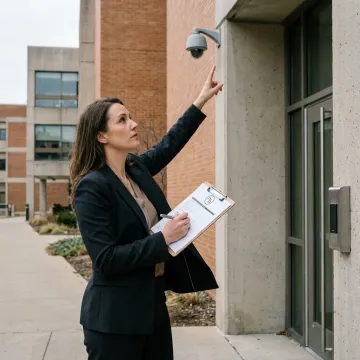
What is included in a university security risk assessment?
A university security risk assessment reviews physical infrastructure, operational procedures, and human-factor risks. EMD evaluates access control, doors, locks, CCTV coverage, lighting, signage, visitor management, residence hall security, emergency notification, lockdown capability, training, and response protocols. The final findings prioritize vulnerabilities and recommend practical improvements for campus safety and resilience.
How is a university risk assessment different from a general security audit?
A general audit often checks whether security measures exist. EMD’s university risk assessment evaluates how those measures perform against realistic campus threats and daily operations. The review considers open campus access, student housing, laboratories, athletic events, after-hours activity, visitor flow, and emergency response procedures to produce more useful, institution-specific recommendations.
Does EMD assess cybersecurity or IT security risks?
No. EMD’s vulnerability and risk assessment scope is focused on physical and operational security, not cybersecurity or IT architecture. Assessments may review physical access to sensitive areas such as server rooms, laboratories, records areas, and control spaces, but network security, penetration testing, software systems, and data protection controls are outside the engagement scope.
Who should be involved in the campus assessment process?
Useful participants often include campus security leadership, university police, facilities, emergency management, residential life, student affairs, capital planning, athletics, risk management, and senior administration. Involving the right stakeholders helps EMD understand how spaces are used, where policies meet reality, and which recommendations are practical for implementation.
Can EMD assess residence halls and student housing?
Yes. Residence halls are a key component of higher education security assessments. EMD can review exterior access, lobby control, visitor procedures, camera coverage, stairwell and elevator access, after-hours entry, lighting, door hardware, emergency communication, and operational practices that affect student safety while preserving the residential nature of campus life.
What kinds of threats does EMD consider during the assessment?
EMD evaluates campus vulnerabilities against real-world scenarios such as active assailant events, organized targeting, opportunistic crime, unauthorized access, vehicle ramming, environmental hazards, after-hours intrusion, and crowd-related risks around events. The goal is to understand how threats could exploit gaps in design, procedures, staffing, technology, or training.
Will the assessment include recommendations for security technology?
Yes. Recommendations may address access control, CCTV placement, intrusion detection, emergency notification, visitor management, lighting, communications, and integration with lockdown or shelter-in-place procedures. EMD focuses on how technology supports the broader security program rather than recommending equipment in isolation from operations, staffing, and campus design.
How can assessment findings support future security improvements?
Assessment findings help leadership prioritize investments based on risk, urgency, and operational value. Recommendations can guide capital planning, security design, policy updates, training needs, vendor scopes, and future target-hardening projects. EMD’s structured approach gives universities a clearer roadmap for improving safety without losing sight of accessibility and campus culture.