The answer is more complicated than most school administrators expect. Safety is genuinely shared across a school community, but legal accountability concentrates in specific roles. Many principals and district leaders operate without a clear picture of where those lines fall — and that gap carries real consequences.
This article covers what a school risk assessment actually is, which federal and state legal obligations apply, who holds formal accountability, how a compliant assessment team should be structured, and what a complete assessment must include.
Key Takeaways
- Ultimate legal responsibility rests with the school district's governing board, with the superintendent and principal carrying operational accountability
- OSHA's General Duty Clause, ESSA, and Section 504/IDEA create overlapping federal duties with no single comprehensive mandate covering all school safety obligations
- Most states require documented, periodic risk assessments, but timelines, triggers, and scope vary widely by state law
- Risk assessments must be documented in writing; an undocumented assessment offers little legal protection
- A compliant assessment requires a multidisciplinary team; assigning responsibility to one person exposes the district to legal and operational risk
What Is a School Risk Assessment?
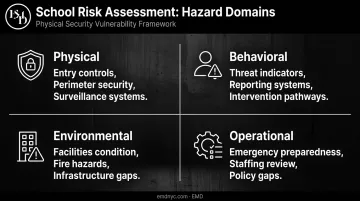
A school risk assessment is a systematic process for identifying, evaluating, and prioritizing hazards that could threaten the safety of students, staff, or visitors. Those hazards span four broad categories:
- Physical — entry controls, perimeter vulnerabilities, surveillance gaps
- Behavioral — threat indicators, student concerns, reporting system adequacy
- Environmental — facilities condition, fire hazards, infrastructure risks
- Operational — emergency preparedness, staffing, policy gaps
Threat Assessment vs. Risk Assessment
These terms are often used interchangeably, but they serve distinct purposes.
A threat assessment is individual-focused — it evaluates whether a specific person poses a risk of violence. A school risk assessment is institution-wide, covering the full spectrum of physical, operational, and systemic hazards across an entire campus.
Both are required in most jurisdictions and serve complementary functions — neither replaces the other.
Why Risk Assessments Matter Beyond Compliance
Understanding what a risk assessment is — and what it isn't — makes clear why doing it well matters. Compliance is the floor, not the ceiling. A well-executed risk assessment does several things that a checkbox exercise cannot:
- Builds the evidence base for emergency response protocols and safety planning
- Drives resource allocation toward actual, documented vulnerabilities
- Supports accreditation requirements at many institutions
- Creates the prerequisite foundation for identifying and protecting students at risk
- Produces the documentation that demonstrates due diligence if an incident occurs and litigation follows
The Legal Framework Governing School Risk Assessments
There is no single federal statute requiring a specific risk assessment format for all K-12 schools. What exists instead is a web of overlapping legal obligations.
Federal Obligations
OSHA's General Duty Clause requires employers — including school districts — to provide a workplace free from recognized hazards. In states where OSHA has jurisdiction over public employers, this applies directly to schools. OSHA's workplace violence enforcement guidance confirms that failure to address foreseeable workplace violence risks can constitute a violation.
The Every Student Succeeds Act (ESSA), through Title IV, Part A, requires districts receiving funding to address school safety and support safe, healthy learning environments — including assessments of need that inform how funds are used.
The Gun-Free Schools Act creates additional compliance obligations tied to federal funding, requiring districts to maintain policies and reporting mechanisms around weapons on school grounds.
Section 504 and IDEA: A Frequently Overlooked Requirement
The July 2022 joint guidance from OCR and OSERS makes clear that schools must avoid disability discrimination in any threat or risk assessment process. Specifically:
- Threat assessment teams must coordinate with a student's Section 504 or IEP team when that student is being assessed
- Failure to do so can constitute a violation of the student's right to a Free Appropriate Public Education (FAPE)
- Disciplinary responses that disproportionately impact students with disabilities — even when framed as safety responses — can trigger OCR scrutiny
This is a compliance gap in many districts. Assessment teams that operate without awareness of disability-related obligations create legal exposure beyond the incident itself.
Federal requirements set the floor — state law often raises it considerably.
State-Level Mandates
Most U.S. states have enacted their own school safety statutes that go further than federal minimums. Requirements vary significantly, but several examples illustrate the range:
- Virginia mandates annual school safety audits under Va. Code § 22.1-279.8, with findings submitted to the Virginia Center for School and Campus Safety
- Texas requires campus behavior coordinators and documented threat assessment processes under Education Code § 37.108, with periodic audits filed with the Texas Education Agency
- Florida requires each school district to implement the Florida Safe Schools Assessment Tool (FSSAT) and maintain documented safety plans under Florida Statute § 1001.212
Every state has different triggers, timelines, and filing requirements. Administrators must verify their state's specific obligations and document compliance accordingly.
Legal Liability When Assessments Are Skipped
When a school fails to conduct or document a risk assessment and an incident occurs, the consequences are not abstract. In Florida, litigation following the Parkland shooting established that school personnel — including a security officer — could face negligence claims for failure to act on foreseeable risks. Courts examine what the school knew, when they knew it, and what they did in response — and individual administrators can face personal accountability depending on state law and the nature of the failure.
The Documentation Requirement
A risk assessment that isn't documented is nearly worthless from a legal standpoint. Schools must maintain written records of:
- Assessment dates and scope
- Findings and identified vulnerabilities
- Corrective actions taken and timelines
- Responsible parties for each action item
- Review dates and follow-up
That paper trail is the legal and operational record of the school's due diligence.
Who Is Responsible for School Risk Assessments?
The Governing Board
Ultimate legal responsibility rests with the school district's governing board. The board holds a duty of care to the entire school community and is accountable for ensuring that compliant safety policies and risk assessment processes exist across every school in the district.
This responsibility cannot be delegated away. It flows directly from the board's fundamental governance role.
The Superintendent
The superintendent is responsible for implementing the board's safety policies, allocating resources for assessment activities, and ensuring consistent standards across buildings. Operational accountability flows downward from this level. When a district has inconsistent practices across campuses, that gap points back to district-level implementation failures.
The School Principal
The principal is the on-site responsible party. They are accountable for:
- Ensuring the risk assessment is conducted at their building
- Acting on assessment findings — not just filing them
- Ensuring appropriate staff receive required training
- Leading the threat assessment team
On that last point: the American School Counselor Association (ASCA) has surveyed school counselors on this directly. According to ASCA, 100% of surveyed counselors agreed the principal should lead the threat assessment team, not the counselor. The principal carries the authority, accountability, and positional responsibility that the role demands.
The Multidisciplinary Team
Risk assessment is not a solo function. Federal guidance and best practice require a team that distributes responsibility across roles:
| Role | Primary Contribution |
|---|---|
| Principal or designee | Team lead, final accountability |
| Mental health professional | Clinical assessment, intervention planning |
| School resource officer or law enforcement liaison | Threat evaluation, law enforcement coordination |
| Teacher representative | Early warning observation, student context |
| Facilities/operations staff | Physical environment assessment |
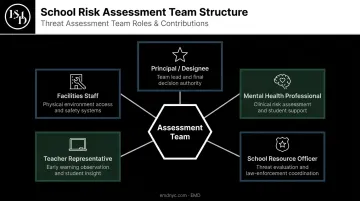
No single person should carry the full burden of assessment. The ASCA survey found that 91.4% of school counselors indicated risk assessment should involve collaboration with other trained professionals.
What Counselors Should and Should Not Do
Counselors play a vital preventive and support role. They identify students of concern, build protective factors, and contribute to intervention planning. They should not serve as the primary assessor or team lead. That distinction matters for both legal accountability and appropriate role boundaries.
The Broader Safety Network
Counselors aren't the only ones whose boundaries matter here. Students, parents, and law enforcement don't carry legal responsibility for conducting assessments, but they are essential to the information ecosystem that makes assessments effective. The U.S. Secret Service's analysis of targeted school violence found that in many averted school attacks, peers were the first to observe warning signs — often before any adult in the building. A school's reporting culture is part of its safety infrastructure.
How a School Risk Assessment Team Should Be Structured
Recommended Team Composition
- Principal or designee — team lead and decision authority
- At least one mental health professional — counselor, psychologist, or social worker
- Security or law enforcement representative — SRO or local law enforcement liaison
- Teacher representative — front-line observer and student context provider
- Facilities/operations staff — physical environment and infrastructure perspective
- Legal counsel (larger districts) — especially where threat assessment decisions carry potential litigation risk
Core Team Responsibilities
The team's ongoing work covers more than conducting periodic assessments. Specifically:
- Conduct and document formal risk assessments on the required schedule
- Define behavioral thresholds that trigger formal review
- Maintain a central reporting system for concerns from staff, students, and community
- Develop individualized management plans for identified risks
- Coordinate with law enforcement when imminent threats are identified
Training Requirements
All team members must be trained in threat recognition, assessment protocols, legal obligations (including disability-related requirements), and documentation standards. Training is not a one-time event — requirements shift as laws change and new threat patterns emerge. Virginia's Department of Criminal Justice Services, for example, provides updated behavioral threat assessment training materials annually for K-12 teams.
When Outside Expertise Strengthens the Process
Most schools lack dedicated in-house security expertise — which is exactly where a qualified security consultancy can close the gap. An outside expert brings structured methodology, independence from internal politics, and documented findings that hold up under legal scrutiny.
EMD provides school-specific physical security vulnerability assessments and supports schools in accessing federal funding — including the COPS School Violence Prevention Program (SVPP), which offers up to $500,000 for qualifying security enhancements.
What a Comprehensive School Risk Assessment Should Include
Core Assessment Domains
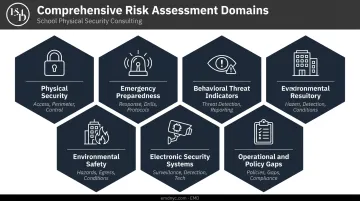
A complete school risk assessment must evaluate all of the following:
- Physical security — entry controls, perimeter integrity, surveillance coverage, access control
- Emergency preparedness — response plans, drills, communication systems, coordination with local emergency services
- Behavioral threat indicators — reporting mechanisms, case management protocols, intervention tracking
- Environmental safety — facilities condition, fire hazards, structural infrastructure
- Electronic security systems — integration of access control, surveillance, and intrusion detection with operational protocols
- Operational and policy gaps — staffing adequacy, visitor management, supervision protocols
The Assessment Cycle
A risk assessment is not a one-time exercise. Schools should:
- Conduct a formal comprehensive assessment at least annually (or per state requirement)
- Conduct interim reviews following any significant incident, major policy change, or facility modification
- Document each cycle independently — prior assessments don't carry forward
What the Output Must Look Like
The assessment must produce a written report that includes:
- Prioritized findings by severity and likelihood
- Corrective action assignments with named responsible parties
- Implementation timelines
- A review date for each open item
This written record serves two concrete functions: it drives updates to the school's emergency operations plan and, when scrutinized in a legal proceeding, it documents the institution's due diligence. Treat it accordingly.
Frequently Asked Questions
Who is responsible for risk assessments in schools?
Ultimate legal responsibility rests with the school district's governing board. The superintendent is accountable for implementation across the district, and the building principal is accountable at the campus level — supported by a multidisciplinary team that includes mental health professionals, security personnel, and teacher representatives.
What is a risk assessment for schools?
A school risk assessment is a structured evaluation of physical, behavioral, environmental, and operational hazards across a school campus. It identifies vulnerabilities and informs safety planning, emergency preparedness protocols, and resource allocation decisions.
Who is responsible for ensuring students at risk are identified?
This is a shared responsibility. The threat assessment team, led by school administration, holds formal accountability — but teachers, counselors, school resource officers, and peers all play a role in surfacing early warning signs. A strong reporting culture is what makes the formal process work.
What is the difference between a threat assessment and a risk assessment in schools?
A threat assessment is individual-focused: it evaluates whether a specific student poses a risk of violence. A school risk assessment is institution-wide, covering physical, operational, and systemic hazards across the entire school environment. Both are typically required and serve different functions.
How often should schools conduct risk assessments?
Most state laws require at least annual formal assessments, with interim reviews following incidents or significant changes to the facility or student population. Documentation of each cycle demonstrates legal compliance.
What are the legal consequences for schools that fail to conduct risk assessments?
Districts can face civil liability, federal compliance violations under Section 504 and ESSA, and loss of accreditation standing. Under some state laws, individual administrators may also face personal accountability for documented failures to act on known risks.