
Introduction
New York City doesn't just have more security challenges than other cities — it has a fundamentally different kind. With over 38,000 landmark properties, 472 subway stations, and 1.195 billion subway rides logged in 2024, the city's physical environment creates threat exposure that most security frameworks aren't designed for.
That complexity makes the cost of getting security wrong unusually high — and the value of getting it right unusually concrete. Most organizations know security matters; fewer recognize how much a dedicated consulting firm changes the equation beyond basic safety measures.
What follows covers the operational benefits of working with a security consulting firm in NYC: what changes for schools, transit authorities, museums, and houses of worship, and how federal and state grant programs like NSGP and SVPP can fund the very infrastructure a firm recommends.
Key Takeaways
- NYC's threat landscape requires localized expertise that in-house staff rarely have
- Structured risk assessments target the right vulnerabilities — not just the most visible ones
- FEMA's NSGP distributes hundreds of millions in annual funding — most eligible organizations never successfully claim it
- Proactive consulting prevents incidents; waiting until after a breach costs significantly more to fix
- The right consulting partnership compounds over time — producing safer facilities, secured funding, and a security posture built to keep pace with evolving threats
What Is a Security Consulting Firm?
A security consulting firm is an external team of specialists hired to assess, design, and guide the implementation of security programs. Unlike guard companies or equipment installers, consultants focus on strategy, risk, and planning — determining what's actually needed before anyone buys a camera or hires an officer.
That scope spans both physical and operational domains:
- Threat and vulnerability assessments
- Access control design and surveillance planning
- Emergency response protocols
- Crowd management and public event coordination
- Compliance with grant program requirements
The engagement is built around outcomes: reducing risk, supporting compliance, and positioning the organization to secure funding. EMD pairs AI-driven analysis with hands-on human expertise to deliver assessments that remain actionable well beyond the initial engagement.
Key Benefits of Hiring a Security Consulting Firm in NYC
The benefits below focus on measurable, operational impact for the types of organizations that define NYC's security landscape: schools, cultural institutions, transit systems, corporate campuses, and houses of worship.
Benefit 1: NYC-Specific Expertise In-House Teams Can't Easily Replicate
NYC's threat environment is genuinely different. The density of symbolic targets, the complexity of transit infrastructure, the volume of major public events, and the city's permitting system — gatherings of 75 or more indoors can trigger Department of Buildings review — create threat vectors that require localized knowledge to navigate.
A consulting firm with NYC-focused experience brings direct familiarity with NYPD coordination, sector-specific threat histories, and how local regulatory requirements interact with security design. A generalist hire rarely delivers that depth.
According to SHRM, the average cost per hire runs nearly $4,700 — and many employers estimate total hiring cost at three to four times the role's salary. In the New York metro area, BLS data shows security guard wages averaging $45,760 annually, with first-line supervisors at $74,880.
Building a team with that depth of NYC-contextual knowledge costs more than a consulting engagement — and still doesn't guarantee equivalent expertise.
This benefit matters most for:
- Organizations that have recently experienced a security incident
- Institutions expanding across multiple NYC locations
- Sectors with elevated threat exposure: K-12 schools, transit stations, houses of worship
NYC's 2024 hate crime data makes the sector-specific point precisely: the city recorded 648 hate crime complaints, with 344 anti-Jewish and 44 anti-Muslim complaints. Organizations in these communities need threat assessments that reflect those patterns — not generic security frameworks that ignore them.
Benefit 2: Structured Risk Assessments and Tailored Security Design
A formal vulnerability assessment evaluates physical entry points, surveillance coverage, access control weaknesses, crowd management protocols, and emergency response procedures — then translates findings into a security design specific to that organization's layout and risk profile.
A checklist doesn't do that.
EMD's approach combines AI-driven analysis with direct security expertise to model real-world threat scenarios — including active assailant incidents, organized activity, and environmental risks — before vulnerabilities are exploited. The result is a design that closes the right gaps, not just the visible ones.
Why the structured approach matters operationally:
Two documented cases show what happens when this step is skipped:
- MTA (April 2022): Despite more than 10,000 subway cameras system-wide, streaming video from the 36th Street Station was unavailable to NYPD during the shooting — an MTA OIG finding that exposed a critical gap between hardware deployment and operational readiness.
- Uvalde: Investigators found written policies requiring locked doors, but a culture of noncompliance made those policies irrelevant when it mattered most.
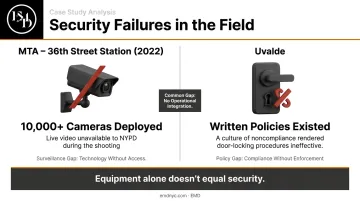
Neither organization lacked equipment. Both lacked the operational integration a structured consulting process produces: tested systems, trained staff, and documented accountability.
This benefit matters most when:
- Organizations are undergoing renovation or expanding to new sites
- A near-miss incident has exposed gaps in existing protocols
- A major recurring event — graduations, public exhibitions, religious gatherings — demands fresh assessment
NY DHSES makes the grant connection explicit: every project in an NSGP Investment Justification must link to a vulnerability identified in a current site-specific assessment. An assessment that isn't grant-ready isn't just a planning document — it's a missed funding opportunity.
Benefit 3: Access to Federal and State Security Funding Most Organizations Miss
This is where security consulting shifts from an expense to a funding mechanism.
Several federal and state programs are specifically designed to help eligible organizations pay for physical security upgrades:
| Program | FY2025 Funding | Key Beneficiaries |
|---|---|---|
| FEMA NSGP (Urban Area) | $137.25M | Nonprofits at high risk of terrorist/extremist attack |
| FEMA NSGP (State) | $137.25M | Same, through State Administrative Agencies |
| NY DHSES NSGP | Up to $200K/site, $600K/org | New York 501(c)(3) nonprofits |
| NY SCAHC | $25M (FY 2023-24) | Nonprofits at risk of hate crimes |
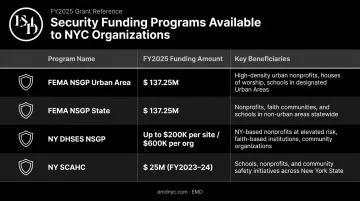
Qualifying for these programs requires more than eligibility — it requires documentation. NY DHSES mandates a site-specific vulnerability assessment, and every requested project must tie back to a vulnerability identified in that assessment. Most organizations aren't equipped to produce that documentation at the quality level grant reviewers expect.
EMD's grant management process covers the full cycle: eligibility assessment, vulnerability assessment, Investment Justification preparation, narrative development, state worksheet completion, submission support, and post-award administration — including EHP submission, procurement coordination, and reimbursement management.
EMD clients have secured consecutive NSGP awards, with funded upgrades including video surveillance systems, access control software, panic buttons, intercom systems, reinforced doors, and active shooter training.
For many eligible organizations, the grant fully offsets — or comes close to covering — the cost of the improvements a consulting firm recommends. The engagement pays for itself.
Most likely to benefit:
- K-12 schools, higher education institutions, houses of worship, museums, and transit authorities in NYC
- Organizations that have never applied, or that applied and didn't succeed
- Nonprofits operating in communities with documented hate crime exposure
What Happens When Security Consulting Is Skipped
Organizations that manage security internally — or defer professional assessment indefinitely — tend to operate reactively. Cameras get added after a trespassing incident. Access protocols get updated after a breach. Compliance gaps get patched ahead of audits.
Each reactive fix addresses a symptom, not a system. Without a formal security design, resources concentrate on visible but low-impact measures. Structural vulnerabilities — gaps in access control, surveillance coverage, or emergency coordination — go unaddressed in the meantime.
The Uvalde and 36th Street examples above are predictable outcomes of this pattern: equipment deployed without governance, policies that exist without accountability structures to enforce them.
Skipping assessments also closes off federal funding. Organizations without current, documented security assessments are typically ineligible for NSGP and similar programs. They not only pay more for security out of pocket — they forfeit access to the funding streams specifically designed to offset those costs.
How to Get the Most Value from a Security Consulting Partnership
The value of consulting compounds when the relationship is treated as ongoing rather than one-time.
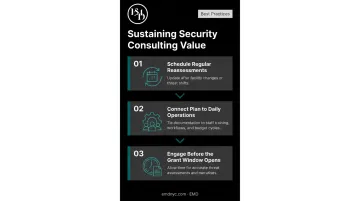
Three practices consistently separate organizations that extract sustained value from those that don't:
Schedule formal reassessments at regular intervals and after any significant change to the facility, personnel, or threat environment. Treating the initial assessment as a permanent document is how security postures fall behind.
Connect the plan to daily operations — documented security plans provide minimal protection if they aren't tied to staff training, facility workflows, and budget cycles. Leadership involvement converts a plan into a functioning program.
Engage your consulting firm before the grant window opens, not after. Organizations pursuing NSGP or NY SCAHC funding need time to develop accurate threat assessments, security narratives, and implementation plans. Rushed documentation is a common reason otherwise eligible applications fall short.
Conclusion
For organizations operating in NYC — whether managing a transit hub, a school, a museum, or a house of worship — security consulting delivers value across three connected dimensions: specialized risk intelligence that prevents incidents, tailored security designs that direct resources where they matter, and structured access to federal and state funding that can finance the upgrades themselves.
None of those benefits are one-time. Threats evolve, buildings change, populations shift, and grant programs open annually. Organizations that review their security posture regularly, pursue funding strategically, and build staff-level awareness into daily operations are consistently better positioned than those that treat security as a fixed installation.
For most eligible NYC organizations, the cost of deferring professional security consulting — in unaddressed vulnerabilities, missed grant cycles, and reactive spending after an incident — consistently exceeds the cost of the engagement itself. Working with a qualified security consultant now means fewer gaps, more funding, and a program built to hold up as conditions change.
Frequently Asked Questions
What makes a good security consultant?
A good security consultant combines deep domain expertise with local operating knowledge — in NYC, that means familiarity with threat patterns, NYPD coordination protocols, and sector-specific risk histories. Recommendations should tie to measurable outcomes, not just compliance checklists.
How much does a security consulting firm cost in NYC?
Fees vary based on scope — a single-site assessment differs significantly from a multi-location program design. For many eligible organizations, federal and state grants can offset or fully cover the cost of security improvements the consulting firm recommends, making the net investment substantially lower than the upfront fee suggests.
What types of organizations need a security consulting firm in NYC?
Any organization managing a publicly accessible space or a high-visibility target benefits from professional guidance. K-12 schools, higher education campuses, museums, houses of worship, and landmark buildings are common examples — each carries specific grant eligibility and elevated threat exposure.
How is a security consulting firm different from a security guard service?
A guard service provides personnel for day-to-day safety coverage. A consulting firm assesses the entire security architecture, identifies structural gaps, designs corrective strategies, and often helps secure funding to implement them. The two are complementary: consulting defines what's needed, and guard services help carry it out.
Can a security consulting firm help organizations qualify for federal security grants?
Yes. Firms with grant management expertise help organizations prepare the threat assessments, security plans, and application documentation required for programs like FEMA's NSGP. Without that support, many eligible organizations miss documentation requirements or submission deadlines.
How often should an organization update its security assessment?
At minimum, annually — and after any significant change to the facility, key personnel, or threat environment. Organizations in grant programs typically need current assessments on file for renewal eligibility, making regular review both a safety and a financial priority.