Introduction
Campus security has shifted from a background function to a frontline operational priority. Today's institutions manage unauthorized access, behavioral escalations, civil unrest, and emergency scenarios simultaneously, across sprawling and open environments.
Yet most campuses still respond to incidents after they happen. A formal threat assessment changes that equation. It bridges the gap between reactive incident management and systematic prevention, with direct consequences for student safety, Clery Act compliance, institutional liability, and access to federal funding.
The scale of the problem is concrete: NCES data shows 23,400 on-campus criminal incidents at U.S. degree-granting institutions in 2021, rising 12% from the prior year. Residential campuses reported a crime rate of 21.0 per 10,000 FTE students — nearly four times the rate of non-residential institutions.
This guide breaks down what a structured campus threat assessment involves, which vulnerabilities it uncovers, and how institutions can move from identifying gaps to closing them.
Key Takeaways
- A campus security threat assessment is a structured review of physical, behavioral, and operational risks that produces a prioritized action plan — not just a findings report.
- Assessments surface vulnerabilities that internal teams miss because familiarity with the environment creates blind spots.
- Clery Act civil penalties reach $71,545 per violation; undocumented security practices are a major liability exposure.
- Federal and state grant programs (NSGP, COPS SVPP) require a documented assessment to qualify for funding.
- A completed assessment turns security spending from instinct-driven decisions into a documented, defensible strategy.
What Is a Campus Security Threat Assessment?
A campus security threat assessment evaluates an institution's security measures, threat environment, and operational vulnerabilities — then delivers a prioritized risk profile with actionable recommendations.
These assessments apply across K-12 schools, higher education campuses, corporate campuses, and other open-access environments where the population is large, the perimeter is complex, and the threat landscape is diverse. The scope and methodology shift depending on the setting — a public school district faces different operational realities than a transit authority or university.
The Three Core Dimensions
Every complete campus assessment evaluates three interconnected areas:
- Physical security — access control coverage, perimeter integrity, lighting, surveillance gaps, door and window hardening, ballistic protection, and intrusion detection
- Behavioral threat indicators — early warning signals, mental health concerns, targeted violence risk, and the functionality of existing behavioral reporting systems
- Operational readiness — emergency response plans, communication systems, staff training, drill frequency, and visitor management protocols
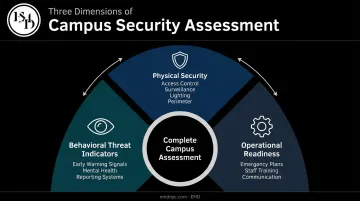
These dimensions don't hold up independently. A door with a functioning lock is a physical asset, but if staff aren't trained to enforce access protocols, that measure fails in practice. The most useful assessments trace how a gap in one layer weakens the others.
Why Campus Security Assessments Are Non-Negotiable
The Familiarity Problem
Campuses with long-tenured security staff often become habituated to chronic risks. When the same unmapped service entrance has been used informally for years without incident, it stops registering as a gap. An external assessment catches what familiarity misses — and AI-augmented methodology identifies behavioral and structural patterns that internal teams have stopped questioning.
RAND research on higher education safety identifies this directly: historical campus safety approaches have been affected by siloing and weak coordination between university units. An external, structured assessment cuts across those silos by design.
The Compliance Stakes
Campuses receiving federal funding must meet Clery Act obligations — and the financial exposure for non-compliance is significant:
| Clery Act Liability Factor | Detail |
|---|---|
| Civil penalty cap (2025) | $71,545 per violation (Federal Register, effective Jan. 21, 2025) |
| Liberty University settlement (2024) | $14M fine for serious, persistent Clery violations |
| FY2022 total fines | $2.56M across 18 institutions |
Undocumented or unreviewed security practices don't just create operational risk — they create audit exposure. Assessment documentation is the institutional record that demonstrates a security posture was actively evaluated and maintained.
The Funding Catalyst
That same documentation serves a second purpose: it's the eligibility prerequisite for major federal and state security grants. Several programs require a completed assessment before an institution can even apply:
- FEMA Nonprofit Security Grant Program (NSGP) — requires a site-specific vulnerability assessment for each applying facility; up to $200,000 per site
- COPS School Violence Prevention Program (SVPP) — K-12 focused; up to $500,000 per award; assessment requirement may be waived if one was completed within the prior three years
- Ohio Campus Safety Grants — $7.5M awarded to 28 colleges in FY2025–26; eligibility requires a documented security and vulnerability assessment
- Maryland Higher Education Safety Grants — $18.75M in awards to higher education institutions
Institutions that complete a documented assessment before grant cycles open are positioned to apply immediately — those that haven't are disqualified before the process starts.
How a Campus Security Threat Assessment Works — Step by Step
The six stages below represent the full assessment lifecycle — from scoping to action plan activation. The most common failure points are noted at each stage.
Step 1 — Define Scope and Objectives
Establish what the assessment covers: which campus zones, which threat types, which population groups, and which regulatory or institutional mandates apply.
Common mistake: Scoping too narrowly. Focusing only on buildings while ignoring parking lots, open plazas, service corridors, and adjacent public areas produces an incomplete risk picture — and leaves some of the highest-probability access points unexamined.
Step 2 — Gather Campus Intelligence and Data
Collect inputs across four channels:
- Incident history — formal crime reports, security logs, prior findings
- Physical site inspection — on-site walkthrough of infrastructure, access points, lighting, surveillance coverage
- Stakeholder interviews — students, faculty, staff, security personnel, emergency coordinators
- External intelligence — local crime trends, comparable institution incidents
Common mistake: Relying exclusively on formal incident reports. Near-misses, informal faculty concerns, and behavioral observations that were never logged contain some of the most actionable intelligence in the entire assessment.
Step 3 — Map and Organize Vulnerabilities
Categorize findings across physical security, behavioral indicators, and operational gaps. Each vulnerability should be documented with its location, affected population, frequency of exposure, and potential consequence severity.
Common mistake: Listing vulnerabilities without context. A finding that reads "surveillance gap near east entrance" is far less useful than one that specifies the entrance handles 400 students daily, has no coverage during early morning hours, and sits adjacent to an unsecured parking structure.
Step 4 — Conduct the Threat Analysis
Apply a threat-vulnerability matrix to assess each identified risk by probability of occurrence and potential impact. This produces a prioritized risk register that guides resource allocation decisions.
AI-augmented analysis strengthens this stage considerably. EMD uses AI-driven scenario analysis to detect non-obvious risk clusters across access control logs, surveillance data, and incident frequency patterns — identifying structural vulnerabilities that manual review alone would not surface. The result is a risk register grounded in both quantitative pattern detection and experienced human judgment.
Step 5 — Interpret and Prioritize Findings
Translate the risk register into a clear threat profile with three tiers:
- Immediate intervention — high-probability, high-impact risks requiring urgent action
- Policy and procedural changes — mid-tier risks addressable through process updates or moderate investment
- Monitoring — lower-tier risks tracked over time, reassessed at defined intervals
Common mistake: Treating all findings as equally urgent. This creates paralysis and prevents institutions from addressing the vulnerabilities that carry the greatest consequence.
Step 6 — Build and Activate the Response Plan
Convert prioritized findings into a documented, time-bound action plan with:
- Assigned ownership for each remediation item
- Resource requirements and procurement guidance
- Review milestones and reassessment triggers
- Communication protocol updates
- Staff training schedules and drill cadences
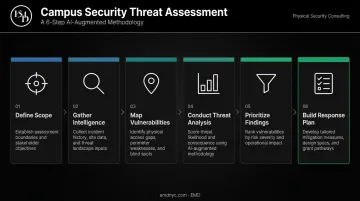
Without a living response plan, findings lose their owners — and accountability disappears with them. The action plan is what keeps remediation on track between assessment cycles.
Campus Security Assessment in Practice: A Scenario Walkthrough
Consider a mid-sized university with an open campus, multiple uncontrolled entry points, aging surveillance infrastructure, and a recent uptick in unauthorized access incidents. The assessment is triggered by an upcoming Clery Act review and a pending NSGP grant application.
The intelligence-gathering phase surfaces two critical gaps before a single recommendation is written:
- An unmapped service entrance regularly used by contractors — with no ID verification process and no access control coverage
- A behavioral threat reporting system that faculty acknowledge exists but rarely use, because the submission process is unclear and feedback is non-existent
Both gaps move directly into threat analysis. The data tells a sharper story than anyone expected.
The contractor entrance appears repeatedly in after-hours access log anomalies — a pattern no manual review had ever caught as systemic. And across three prior behavioral incidents, warning signs were observed but never formally escalated, because the reporting pathway wasn't clear to the people who noticed them. Both are confirmed high-priority risks.
Findings convert into specific, documented actions:
- Access control hardware is installed on the service entrance with a contractor credentialing protocol
- Faculty receive targeted retraining on the behavioral reporting system, with a simplified process and a defined escalation pathway
- Both items are documented with before-and-after risk context and incorporated into the NSGP Investment Justification
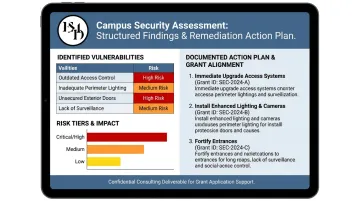
The result: measurable risk reduction and a stronger grant application — produced in a single assessment cycle. That's what a structured assessment process delivers when intelligence, analysis, and action are connected from the start.
How EMD Can Help
EMD is a physical security consulting firm that combines AI-driven threat analysis with 15+ years of institutional expertise to conduct campus assessments tailored to each environment's specific risk profile, culture, and compliance obligations.
Three things set EMD's methodology apart:
- AI-augmented assessment that surfaces hidden vulnerabilities across physical infrastructure, operational processes, and behavioral patterns — not just what's visible during a walkthrough
- Grant-ready documentation formatted to meet FEMA NSGP, COPS SVPP, and state school-safety program requirements, so assessment findings translate directly into fundable applications
- Integrated service delivery covering assessment, security design, grant application, post-award administration, and implementation advisory — the assessment is a starting point, not a deliverable
EMD serves K-12 schools, higher education campuses, corporate campuses, houses of worship, healthcare facilities, and other institutional environments across the United States.
To schedule an initial consultation, contact EMD at info@emdnyc.com or (833) 363-6921.
Frequently Asked Questions
What is the difference between a threat assessment and a vulnerability assessment?
A vulnerability assessment identifies physical and operational weaknesses in an environment. A threat assessment evaluates the likelihood and potential impact of specific threats exploiting those weaknesses. A complete campus security review incorporates both as interconnected dimensions, not separate workstreams.
How often should a campus security assessment be conducted?
Best practice is an annual comprehensive assessment. Conduct triggered reviews after significant incidents, major facility changes, enrollment surges, or ahead of large-scale events. COPS SVPP grant rules allow assessment requirements to be waived if a comprehensive assessment was completed within the prior three years.
What are the most common security threats identified during campus assessments?
The most frequently surfaced categories include unauthorized access, behavioral violence indicators, inadequate emergency communication, poor lighting and surveillance coverage, and gaps in visitor management — particularly around contractor and after-hours access.
Who should be involved in conducting a campus security assessment?
Effective assessments engage campus security leadership, facilities management, emergency management coordinators, HR, and legal. An outside consultant adds objectivity and cross-institutional perspective that internal teams alone cannot replicate.
Can a campus security assessment help secure federal or state funding?
Yes. Federal programs including FEMA's NSGP and the COPS SVPP require documented assessments as a condition of application eligibility. A rigorous, well-documented assessment is a prerequisite , not merely a supporting document, for many security grant programs.
What happens after a campus security assessment is completed?
The assessment should produce a prioritized action plan with assigned ownership and defined timelines. Immediate hardening measures come first, followed by training updates, drill scheduling, and a formal review cycle. Treat it as a living document that evolves with the threat environment — not filed and forgotten.