Introduction
Most organizations don't discover their security gaps through proactive review. They discover them after a door is propped open too long, a visitor slips past reception, or something far worse happens.
The numbers make this hard to ignore. The FBI recorded 48 active shooter incidents across 26 states in 2023 — a figure that's up 60% since 2019. Meanwhile, 77% of public schools reported at least one crime incident in 2019–20, totaling 1.4 million incidents nationally.
Those incidents didn't happen to organizations that skipped security entirely — they happened to institutions that assumed existing measures were sufficient. Unauthorized access, theft, workplace violence, and infrastructure vulnerabilities accumulate quietly, and without a structured audit, the gaps stay invisible until they're exploited.
This guide walks through what a physical security audit is, how to conduct one, and what to do with the findings.
Key Takeaways
- A physical security audit systematically evaluates your facility's defenses against real-world threats — unauthorized access, theft, violence, and emergencies
- Audits expose hidden vulnerabilities in perimeter security, access control, surveillance, and emergency preparedness before an incident occurs
- Most facilities should audit at least annually, with additional reviews after renovations, incidents, or regulatory changes
- The process moves from scoping and site survey through physical inspection, system testing, and policy review — delivering a prioritized, actionable remediation plan
- Partnering with a specialized consultancy connects audit findings to design solutions, grant funding pathways, and implementable security upgrades
What Is a Physical Security Audit and Why Does It Matter?
A physical security audit is a structured, in-depth evaluation of a facility's physical safeguards. It covers perimeter defenses, access controls, surveillance systems, lighting, and emergency protocols — with the goal of confirming that protections work as intended across all credible threat scenarios, not just the ones you've planned for. The DHS defines physical security as protecting organizational assets from threats that could cause losses or damage — and states explicitly that maintaining security posture requires continual assessment, not a one-time review.
Why Audits Can't Be Skipped
Security systems degrade quietly. Camera lenses fog, access control databases accumulate outdated credentials, emergency signage gets obscured by new furniture. None of these failures trigger an alarm. They just sit there until someone exploits them.
The access control data tells a clear story: according to ASIS International, 61% of security professionals experienced tailgating or piggybacking in the prior six months, 50% dealt with propped-door issues, and only 8% reported zero access control failures. These aren't edge cases — they're the norm.
Who Needs Physical Security Audits
The need spans every sector and facility type:
- K-12 schools and university campuses: high foot traffic, open-access culture, and vulnerable populations
- Houses of worship face heightened soft-target risk, often with limited security investment
- Museums and cultural institutions balance public access against valuable and irreplaceable assets
- Healthcare facilities contend with complex visitor flows, behavioral health risks, and infant security
- Transit authorities managing multi-node environments with persistent assault and fare-evasion patterns
- Corporate campuses with multi-tenant access, contractor management, and executive protection considerations
Each faces a distinct threat profile. A generic security plan doesn't account for those differences — which is exactly why tailored audits matter.
How to Conduct a Physical Security Audit: Step by Step
A physical security audit is not a single walk-through. It's a structured process with distinct phases, and the most common failure is rushing the scoping phase — which produces incomplete findings that miss entire threat categories.
Step 1 – Assemble the Audit Team and Define Scope
An effective audit requires involvement across departments: facility managers, security personnel, and HR at minimum. An independent external consultant should also be included — internal teams know the facility well, but that familiarity can cause real gaps to go unnoticed.
Scope definition should answer:
- Which locations and buildings are included?
- Which assets, systems, and threat categories are in scope?
- What regulatory frameworks apply (OSHA, HIPAA, FERPA, NFPA)?
- Are satellite locations or remote assets included?
External consultants with credentials like the ASIS Physical Security Professional (PSP) certification bring structured methodology and unbiased perspective that internal reviews often can't replicate.
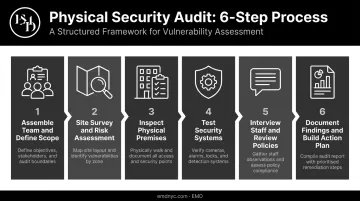
Step 2 – Conduct a Site Survey and Risk Assessment
The site survey maps the physical environment: entry and exit points, high-value asset locations, traffic flow patterns, and low-visibility zones. It's the foundation everything else builds on.
The risk assessment layer then answers: which threats are most probable and most damaging in this specific facility? An elementary school and a transit hub share some risks but diverge sharply on others.
EMD applies AI-augmented analysis at this stage, combining historical incident data with facility-specific observations to rank threats by probability and potential impact. The goal is to model how specific weaknesses could be exploited before any recommendations are made — so priorities reflect actual risk, not assumptions.
Step 3 – Inspect the Physical Premises
This step moves from mapping to evaluating. Auditors inspect:
- Structural integrity of fencing, walls, and gates
- Exterior and interior lighting at entry points and along the perimeter
- Lock hardware, door and window security, and hinge exposure
- Physical condition of barriers, bollards, and vehicle access points
- Egress paths for obstructions or maintenance neglect
Maintenance issues are consistently underestimated. Cluttered corridors don't just look bad — they slow emergency response and obscure camera sightlines. Deteriorated perimeter fencing signals low deterrence to anyone surveilling the site.
Step 4 – Test Security Systems
Installed systems need to be verified, not assumed operational. Testing covers:
- Access control readers — Are they logging correctly? Are revoked credentials truly deactivated?
- Surveillance cameras — Do they cover all high-risk zones without blind spots, including parking areas and stairwells?
- Alarm and intrusion sensors — Do they respond correctly and trigger the right notifications?
- Emergency communication systems — Do they activate as designed under realistic conditions?
Systems installed five or more years ago may be technically "on" while failing to meet current performance benchmarks. Age alone is a risk factor worth documenting.
Step 5 – Interview Employees and Review Policies
Technology checks reveal what's broken. Employee interviews reveal what's being ignored. Some of the most significant findings come from conversations, not inspections:
- Do staff actually know the visitor escort policy — or just the written version?
- Is tailgating tolerated because "everyone knows everyone"?
- Are credentials shared between shifts to avoid badge hassles?
Policy review confirms whether written procedures are current, enforceable, and aligned with actual threat conditions. Outdated policies that reference systems no longer in use — or don't account for recent regulatory changes — are common findings.
Step 6 – Document Findings and Build a Prioritized Action Plan
The final deliverable should do more than list problems. A strong audit report:
- Categorizes findings by severity (critical, high, medium, low)
- Maps each vulnerability to specific threat scenarios
- Provides actionable recommendations with implementation timelines
- Connects findings to funding opportunities where applicable
Security leaders use this document to brief executives, allocate budgets, and schedule follow-up reviews. When findings are clearly prioritized and tied to real consequences, that report becomes the foundation for meaningful security improvement — not a document that gets filed and forgotten.
Physical Security Audit Checklist: Key Areas to Assess
A thorough physical security audit spans five core domains. Whether you're assessing a K-12 school, a house of worship, or a corporate campus, these are the areas that consistently reveal gaps — and the ones regulators, insurers, and courts will scrutinize first.
Perimeter and Exterior Security
The perimeter is your first line of defense. Weaknesses here undermine every layer behind it.
- Are fences, walls, and gates structurally sound and free of gaps or damage?
- Is exterior lighting adequate at all entry points and along the full building perimeter?
- Are security signage and visual deterrents visible and current?
- Are vehicle access points controlled with appropriate barriers?
Access Control
Access control failures are among the most common findings in physical security assessments — and among the most preventable.
- Are all entry points secured with appropriate credentials for the risk level?
- Are permissions regularly audited and revoked for former employees, contractors, and vendors?
- Are visitor management procedures consistently enforced — including sign-in logs and escort policies?
- Are temporary credentials tracked digitally, not on paper? According to ASIS, 39% of organizations still rely on manual systems — a gap that creates accountability blind spots.
Surveillance and Monitoring
Camera coverage means little if footage is low-quality, unmonitored, or siloed from your access control data.
- Are cameras positioned to cover all high-risk zones with no blind spots?
- Do cameras provide clear imagery across varying lighting conditions, including low light?
- Is footage monitored in real time or via alert-based notifications?
- Are video and access control systems integrated? Integration remains a critical gap — only 54% of organizations have achieved it, leaving the majority without correlated incident data.
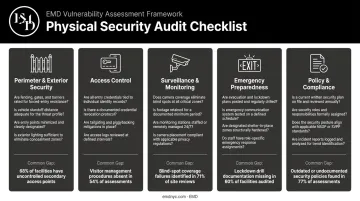
Emergency Preparedness
Preparedness gaps aren't always visible during normal operations — they surface when it's already too late to fix them.
- Are emergency exits clearly marked, unobstructed, and operational?
- Are evacuation plans current and posted in visible locations throughout the facility?
- Have emergency drills been conducted within the past 12 months — and were outcomes formally reviewed?
- Does the Emergency Action Plan meet OSHA requirements for the facility's employee count?
Policy and Compliance
Documentation and policy alignment determine whether your security program holds up under regulatory scrutiny or litigation.
- Are security policies consistent with current regulatory requirements (OSHA, HIPAA, FERPA, NFPA 101)?
- Are there documented incident response procedures with assigned roles?
- Is there a formal schedule for policy reviews tied to audit cycles?
Common Vulnerabilities Found During Physical Security Audits
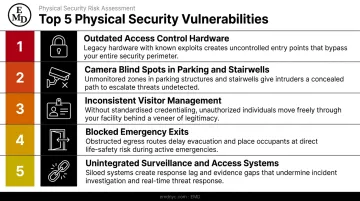
Certain weaknesses appear consistently across facility types — from a 50-person nonprofit to a multi-building university campus.
The most frequently identified issues:
- Outdated access control hardware — older systems that can't enforce modern credentialing policies or log access events reliably
- Camera blind spots — particularly in parking structures, stairwells, loading docks, and secondary entrances
- Inconsistent visitor management — sign-in procedures that exist on paper but aren't enforced at busy entry points
- Blocked or improperly maintained emergency exits — storage, furniture, and general clutter are the usual culprits
- Unintegrated systems — surveillance and access control operating in silos, preventing coordinated response
Operational gaps are harder to catch through system checks alone. Doors propped open for convenience, credentials shared between staff to save time, visitors left unescorted in restricted areas — these behaviors don't show up in equipment logs. They surface through employee interviews.
ASIS International survey data underscores the scale of this gap: 61% of security professionals reported tailgating incidents, while only 8% reported no access control failures at all. Those numbers reflect organizations with written policies — the failures happen in the space between policy and daily practice. An audit's value lies in closing that space, not just documenting it.
How EMD Can Help
EMD is a national physical security consulting firm that pairs AI-powered threat modeling with the judgment of Elisa Mula — a practitioner with 15+ years of physical security experience and SEAK Expert Witness training. Every assessment integrates technology-driven analysis with on-the-ground expertise to produce findings that hold up under real scrutiny.
Tailored Assessments for Complex Environments
EMD's AI-augmented vulnerability assessments are built for facilities where generic approaches fall short: K-12 schools, university campuses, houses of worship, museums, healthcare facilities, transit authorities, and corporate campuses. Each assessment evaluates physical infrastructure, operational workflows, and human-factor risks against realistic threat scenarios: active assailant events, organized targeting, vehicle ramming, opportunistic crime, and environmental hazards.
The output is a prioritized security roadmap with specific, implementable recommendations — not a generic compliance report.
From Audit Findings to Funded Improvements
Most organizations identify security gaps and then stall. Budget pressure and grant complexity are the two most common reasons audit findings sit on a shelf. EMD's grant services move those findings into funded action.
EMD has a proven track record of securing federal and state grant funding to move audit recommendations into funded reality:
- FEMA's Nonprofit Security Grant Program (NSGP) — FY2025 totals $274.5M, with awards up to $200,000 per site for eligible 501(c)(3) nonprofits, with no cost-share requirement
- COPS School Violence Prevention Program (SVPP) — up to $500,000 per K-12 applicant for school safety measures including locks, lighting, access control, and emergency notification
- State-level school safety grants across NY, NJ, CA, OH, FL, TX, and additional states
One charter school in Hawaii secured two consecutive NSGP awards through EMD's guidance, implementing comprehensive security upgrades across their campus. Another organization used consecutive grants to fund a full video surveillance overhaul, upgraded access control software, panic buttons, intercom systems, reinforced locks and doors, and active shooter training.

Audit findings directly feed the grant application — documenting threat exposure, identifying eligible improvements, and building the investment justification that grant programs require.
Ready to get started? Contact EMD at info@emdnyc.com or (833) 363.6921 to schedule a security consultation.
Frequently Asked Questions
What is a physical security audit?
A physical security audit is a structured evaluation of a facility's physical defenses — including access controls, surveillance, perimeter security, and emergency protocols. It identifies vulnerabilities and verifies that existing safeguards hold up against real threat scenarios.
How often should a physical security audit be conducted?
Most organizations should conduct a full audit at least annually. Additional reviews are warranted after major renovations, security incidents, significant staffing changes, or updated regulatory requirements. Higher-risk facilities — schools, healthcare, transit — may benefit from biannual assessments.
Should a physical security audit be conducted by internal staff or an outside consultant?
Internal teams bring facility familiarity; external consultants provide an unbiased perspective and specialized expertise. A combined approach typically produces the strongest findings — especially in high-stakes environments where internal blind spots are hardest to catch.
What are the most common vulnerabilities found during a physical security audit?
The most frequently identified issues include:
- Outdated or malfunctioning access control systems
- Surveillance camera blind spots, particularly in parking areas and stairwells
- Inconsistent visitor management practices
- Emergency preparedness gaps such as blocked exits and outdated drill records
How long does a physical security audit take?
Duration depends on facility size and complexity. A single-location assessment typically takes one to two days. Multi-site or complex campuses — universities, transit systems, hospital networks — can require a week or more, including documentation and reporting.
What should an organization do after a physical security audit is completed?
Findings should be reviewed with leadership and risks prioritized by severity. From there, develop an action plan with assigned responsibilities, deadlines, and a follow-up schedule to track implementation. Before budgeting improvements independently, evaluate findings for grant funding eligibility — federal and state programs may cover a significant portion of costs.