According to NCES data, about 85% of public schools recorded at least one crime incident in 2021–22, up from 71% in 2019–20. That statistic isn't just about schools — it's a signal that reactive, piecemeal security approaches are falling short across institutional settings.
This guide covers what facility security design actually means, the frameworks that inform it, how to conduct a proper risk assessment, what a complete system looks like, how design priorities shift by facility type, and how to fund the work.
Key Takeaways
- Facility security design is strategic planning — not a product purchasing exercise
- Start every design with a risk assessment — the product catalog comes later
- Defense in Depth and CPTED are the two most practical frameworks for institutional facilities
- Design priorities shift significantly by facility type: schools, transit hubs, museums, and houses of worship each have distinct requirements
- Federal grants (FEMA NSGP, DOJ SVPP) can fund eligible security projects; documented vulnerability assessments are required to apply
What Is Facility Security Design and Why It Matters
Facility security design is the process of planning how physical, technological, and operational security measures integrate into a building or campus to deter, detect, delay, and respond to threats. It's distinct from procurement. Buying cameras is procurement. Determining where they go, what they cover, how they connect to access control, and who receives alerts when they trigger — that's design thinking applied to security.
The difference matters because poorly designed systems fail in specific, predictable ways:
- Security blind spots — cameras positioned for convenience rather than coverage
- Integration failures — alarm systems that don't communicate with surveillance platforms
- Compliance gaps — designs that miss ADA requirements or state-mandated safety standards
- Poor visitor experience — security that creates friction for legitimate users while stopping nobody
- Staff overload — too many manual monitoring tasks because automation wasn't designed in
Avoiding these failures requires looking at all four dimensions at once: physical infrastructure, technology platforms, operational processes, and human behavior. EMD's assessments work across all four simultaneously — producing designs that are compliant today and scalable as threat environments change.
Key Principles and Frameworks Behind Effective Facility Security Design
No single framework covers everything. Effective designs draw on several, applied to the specific facility's threat profile.
Defense in Depth
This principle structures security in concentric layers — perimeter, exterior, interior, and asset-level — so that a breach of one layer doesn't expose everything behind it. Each layer is designed to complement the others, eliminating single points of failure.
A transit station, for example, might have perimeter fencing as Layer 1, surveillance and lighting at entry zones as Layer 2, access-controlled staff areas as Layer 3, and secured control rooms as Layer 4. If someone bypasses the perimeter, they still face subsequent barriers before reaching critical infrastructure.
CPTED (Crime Prevention Through Environmental Design)
The DOJ COPS framework describes CPTED as using environmental conditions to reduce crime opportunity. Its four principles:
- Natural surveillance — design spaces so legitimate users can observe activity (open sightlines, adequate lighting)
- Natural access control — physical layout that guides people toward monitored entry points
- Territorial reinforcement — clear signals about public vs. private space (signage, landscaping, fencing)
- Maintenance — a well-maintained environment signals active ownership and deters opportunistic behavior
CPTED doesn't replace technology or guards — it works alongside them, reducing the conditions in which threats develop.
The ISC Risk Management Process
The Interagency Security Committee's Risk Management Process provides a structured framework for threat, vulnerability, and consequence assessment. Originally developed for nonmilitary federal facilities, schools, nonprofits, and other institutional settings have since adopted it as a practical model. It guides organizations through determining a facility's security level and selecting appropriate countermeasures — a structured starting point for any formal security planning effort.
Integration and Interoperability
The frameworks above inform what to build — but how those systems communicate determines whether the design holds under pressure. Access control, video surveillance, sensors, and communications must operate as a single, coordinated system rather than isolated tools. A perimeter breach, for instance, should simultaneously activate camera recording and push an alert to response staff. When systems can't share data in real time, response windows shrink and incidents escalate faster than protocols can keep up.
How to Conduct a Facility Security Risk Assessment
No design decisions should happen before the risk assessment. Not component selection, not layout planning, not budget allocation. The assessment defines what you're designing against.
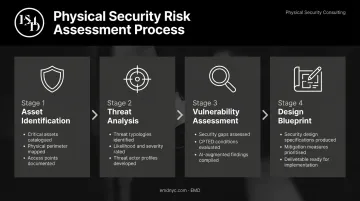
Step 1: Asset Identification
Catalog everything that requires protection:
- People — staff, students, visitors, congregation members
- Physical property — buildings, collections, equipment, vehicles
- Sensitive data — records, financial information, operational systems
- Operational continuity — the ability to keep functioning during and after an incident
Assign each asset a criticality rating. High-criticality assets warrant advanced protections; lower-criticality assets may need only baseline measures. This prioritization determines where security investment is concentrated.
Step 2: Threat Analysis
Threat analysis draws on multiple sources:
- Historic incident logs for the facility and similar facilities
- Local and regional crime data
- Industry-specific threat intelligence (active shooter patterns in schools, vandalism at transit hubs)
- FBI hate crime statistics — 2,699 religion-based hate crime incidents were reported in 2023 alone
- Consultation with law enforcement or security professionals
Threat analysis must account for both external and insider threats. CISA notes that proactively managing insider threats can stop or alter a trajectory toward harmful outcomes — a consideration that's easy to overlook when organizations focus exclusively on perimeter security.
Step 3: Vulnerability Assessment
This is where existing controls get tested. Walk the site physically. Review camera coverage maps for gaps. Test access control points. Identify blind spots and unmonitored zones.
EMD layers AI-driven analysis over on-site human expertise during this phase. The AI component detects hidden gaps between systems and networks — intersecting weaknesses that standard walkthroughs typically miss — while human intelligence interprets context and evaluates operational factors that algorithms can't assess alone. The result is a more complete vulnerability picture.
Step 4: From Assessment to Design Blueprint
The assessment output — a ranked list of threats, vulnerable points, and critical assets — becomes the direct input for design decisions. It determines:
- Where to invest in perimeter hardening
- Which access control points need upgrades
- Where surveillance coverage needs to expand
- Which components to prioritize in the first implementation phase
The Core Components of a Comprehensive Facility Security Design
Perimeter Security
The outermost defense layer establishes the boundary between public and controlled space. Components include:
- Physical barriers: fencing, bollards, vehicle barriers (tested against ASTM F2656/F2656M crash standards for vehicle threat environments), planters
- Security lighting per IES G-1-22 standards — horizontal and vertical illuminance, uniformity
- Perimeter-mounted cameras and IoT motion/sound sensors that trigger alerts and automate recording
- Clear signage establishing territorial boundaries
For museums, landmarks, and houses of worship, perimeter design must balance hardening with accessibility and aesthetics. Bollards can be architectural. Planters can be functional barriers. Security design at these facilities should never compromise the organization's mission to remain open and welcoming.
Access Control Strategy
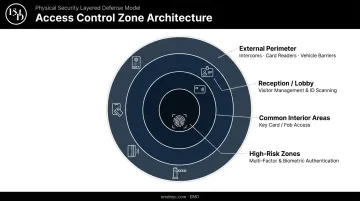
Layered access control guides people naturally through observed spaces toward authorized entry points. Each layer adds friction proportional to risk:
- External perimeter — intercoms, card readers, manned gates, or vehicle barriers
- Reception/lobby — visitor management, ID scanning (PASS guidelines recommend ID scanning completing in under 30 seconds for K-12 schools), credential verification
- Common interior areas — key card or fob access
- High-risk zones — multi-factor or biometric authentication per NIST SP 800-63B standards
Higher-risk zones demand stronger credentials — a server room and a public lobby don't carry the same threat profile, and access control should reflect that.
Video Surveillance Coverage
Not every camera fits every environment. Matching camera type to location improves coverage without over-engineering the system:
| Camera Type | Best Use |
|---|---|
| Bullet cameras | Perimeter, long-range outdoor coverage |
| Dome cameras | Indoor spaces, lobbies, corridors |
| PTZ cameras | Open areas requiring active tracking |
All critical points need coverage: entry/exit, reception, high-value asset locations, parking areas. AI-powered video analytics — flagging loitering, unauthorized access, crowd behavior changes — reduce the burden on human monitoring staff by surfacing anomalies rather than requiring constant observation.
Intrusion Detection, Alarms, and Communications
Smart sensors — motion detectors, glass-break detectors, door/window sensors, environmental monitors — function as both deterrents and real-time detection tools. Their value multiplies when integrated with cameras and communications platforms.
A triggered door sensor that simultaneously activates a nearby camera, logs the event, and sends an alert to security staff is far more effective than one that only sounds a local alarm.
Communications infrastructure should cover all failure scenarios. Core elements include:
- On-site intercoms for immediate staff coordination
- Encrypted radios for security personnel in the field
- Automated SMS/email alerts for triggered sensor events
- A centralized management platform for real-time monitoring and incident logging
If one channel fails during an incident, another must be ready. Redundancy isn't optional — it's the difference between a contained event and a cascading one.
How Facility Type Shapes Your Security Design Approach
The same core principles — layered defense, visibility, access control — run through every facility. But what those principles look like in practice depends entirely on who uses the space and how.
K-12 Schools
97% of public schools already control building access during school hours — controlled entry is a baseline expectation, not a differentiator. Design work at K-12 facilities focuses on what comes next:
- Strengthening visitor screening and management processes
- Eliminating interior blind spots through camera placement and sight-line design
- Ensuring lockdown systems can be activated quickly from multiple points
Age-appropriate design matters throughout. Security measures should reinforce safety without creating an environment that undermines the educational mission.
Transit Authorities
Transit environments are high-traffic, multi-node, and continuous — which means a single design gap can propagate across an entire system. Security design here follows APTA's interconnected model, with planning, operations, physical security, and technology coordinated across zones.
The core challenge: a breach at one station needs to be detected, communicated, and responded to without disrupting service across the broader network. Crowd management, wide-area perimeter coverage, and law enforcement coordination are the primary design drivers.
Museums and Historical Landmarks
Museums face a specific design tension: the more secure the facility feels, the less it functions as a cultural institution. Barriers, checkpoints, and visible cameras must be integrated without undermining the visitor experience.
AAM's standards address this directly — collection security requires both procedural and physical controls, and neither should compromise public access. The goal is protection that's present but unobtrusive.
Houses of Worship
CISA's analysis of targeted attacks on houses of worship found that 67% were motivated by hatred of a racial or religious identity associated with the target. These facilities face a design challenge that is both practical and philosophical: their identity is defined by openness, yet that openness creates vulnerability.
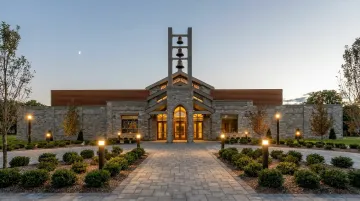
The solution is layered — outer, middle, and inner perimeter measures that allow the space to function as intended while adding detection and response capability at each level. Security that's visible to a potential threat but unobtrusive to a congregant.
Long-Term Considerations: Scalability, Compliance, and Funding
Scalability and Maintenance
A well-designed system accounts for what the facility will need in three to five years, not just today. Hardware standards, network infrastructure, and software platforms should be selected with future expansion in mind — new buildings, increased occupancy, technology upgrades.
Building these considerations in from the start is far less costly than retrofitting them later. Plan for:
- Regular maintenance cycles and inspection schedules
- Periodic system audits to identify gaps and aging components
- Technology refresh timelines aligned with vendor support windows
Compliance Requirements
Security designs must align with applicable standards:
- OSHA — workplace violence prevention guidelines
- ADA — accessible routes around security barriers, gates, and controlled entries must meet 2010 ADA Standards
- State school safety mandates — requirements vary significantly by state; Texas, California, and others have specific statutory obligations
- ISC Risk Management Process — the applicable standard for federal facilities, and a useful model for others
Non-compliance creates both security gaps and liability exposure. The good news: several federal grant programs help organizations meet these standards without bearing the full cost alone.
Funding Security Projects
Many organizations don't realize they can fund security design and implementation through federal grant programs:
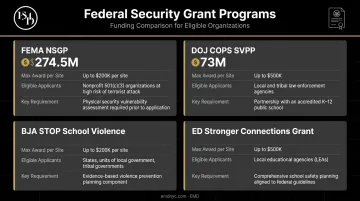
- FEMA Nonprofit Security Grant Program (FY 2025): $274.5M available; eligible nonprofits can request up to $200,000 per site, up to 3 sites. Requires documented vulnerability assessment.
- DOJ COPS School Violence Prevention Program (FY 2025): Up to $73M available; awards up to $500,000 federal share over 36 months; covers up to 75% of allowable costs for K-12 applicants.
- BJA STOP School Violence: Supports prevention programs including threat assessment and school safety planning.
- U.S. Department of Education Stronger Connections Grant: Formula grant supporting safe and supportive school environments.
EMD has helped clients across 14 states navigate these programs — including a Hawaii charter school that secured two consecutive NSGP awards and a religious institution that used consecutive NSGP funding to implement video surveillance, access control upgrades, panic buttons, intercom systems, and active shooter training.
Grant applications require vulnerability documentation and security design plans. That means the design process and the funding process directly reinforce each other — starting one effectively advances both.
Frequently Asked Questions
What are the common security principles and frameworks used in facility security design?
The most widely applied frameworks are Defense in Depth (concentric layers of protection), CPTED (Crime Prevention Through Environmental Design), and the ISC Risk Management Process. Most effective designs draw on multiple frameworks, selected and calibrated to the specific facility's threat profile rather than applied wholesale.
What is the difference between a facility security plan and a security system design?
A Facility Security Plan is the broader strategic document covering policies, procedures, roles, and response protocols. Security system design is the technical and spatial planning of how physical and electronic components are configured, placed, and integrated within the facility — one component of the larger plan.
Who is typically responsible for facility security design?
Security consultants, integrators, and in-house security directors typically lead the process, with input from facility managers, architects, IT teams, and sometimes law enforcement. For complex or high-risk facilities, engage an external security consultancy with sector-specific experience.
How often should a facility security design be reviewed or updated?
At minimum annually, and after any significant change — a facility renovation, major incident, shift in occupancy or use, or emergence of a new threat type. Security designs that aren't reviewed fall out of alignment with the current risk environment fast.
What role does CPTED play in facility security design?
CPTED shapes how physical spaces are arranged to deter criminal behavior, using lighting, landscaping, sightlines, and spatial layout to reduce opportunity. It complements technological and procedural measures rather than replacing them — most useful for public-facing facilities where heavy visible security would be counterproductive.
How can organizations fund a facility security design project?
Several federal programs fund eligible organizations, including FEMA's Nonprofit Security Grant Program, the DOJ COPS School Violence Prevention Program, and Department of Education formula grants. Applications require documented vulnerability assessments and defined project scopes. Working with a consultancy experienced in grant management improves both application quality and award likelihood.