Introduction
Faith communities across the United States face a real and documented threat. According to DOJ hate crime statistics, there were 11,679 hate crime incidents in 2024 — with religious bias accounting for nearly a quarter of all single-bias victims. In 2022, 3.6% of all hate crime incidents occurred specifically at churches, synagogues, temples, or mosques.
For congregations weighing security upgrades against tight budgets, federal funding exists, though it's rarely straightforward to find or navigate.
This guide covers both FEMA grant programs available to houses of worship — the Nonprofit Security Grant Program (NSGP) for proactive security hardening, and Public Assistance (PA) for disaster recovery. Here's what you'll find inside:
- Who qualifies for each program
- What expenses are covered
- How to apply step by step
- How to build a competitive application
Key Takeaways
- Two FEMA programs apply to houses of worship: NSGP for security hardening and Public Assistance for disaster recovery
- NSGP offers up to $200,000 per site, with a maximum of $600,000 across three sites
- FY2025 NSGP total funding pool: $274.5 million
- Applications go through your state's SAA, not directly to FEMA
- A completed vulnerability assessment is required and must justify every budget line item
The Two Main FEMA Grant Programs Houses of Worship Should Know About
"FEMA grants for houses of worship" covers two completely separate programs. They serve different needs, activate under different conditions, and follow entirely different application processes. Knowing which one applies to your situation is the first step.
Nonprofit Security Grant Program (NSGP)
The NSGP is the primary security-focused grant. Administered by FEMA and funded through DHS, it provides money to 501(c)(3) nonprofits — churches, synagogues, mosques, temples, and other faith-based organizations — specifically to harden their physical security against terrorist and extremist threats.
Key program facts:
- FY2025 total funding: $274.5 million (split equally between NSGP-UA and NSGP-S)
- Application pathway: Houses of worship apply as subapplicants through their state's State Administrative Agency (SAA) — not directly to FEMA
- State deadlines vary and are separate from federal deadlines listed on FEMA's website
- Reimbursement model: Organizations spend funds first, then submit invoices for reimbursement
- Performance period: 36 months — relevant for financial planning and phasing larger projects
Public Assistance (PA) for Disaster-Impacted Nonprofits
FEMA's Public Assistance program is reactive, not proactive. It's triggered by a presidential disaster declaration — you can't apply in advance. When a declaration is issued, private nonprofits providing certain essential services may qualify for reimbursement to repair or replace disaster-damaged facilities.
After the LA wildfires in early 2025, for example, FEMA announced that houses of worship and other nonprofits could apply for PA. Eligibility under PA isn't uniform, though — FEMA separates qualifying organizations into two tiers:
- Critical service providers — eligible for PA directly
- Essential non-critical social service providers — must first apply for an SBA disaster loan before PA permanent-work eligibility is determined
Who Qualifies for FEMA Grants? Eligibility Requirements
Core NSGP Requirements
To qualify for the NSGP, an organization must meet two fundamental criteria:
- 501(c)(3) nonprofit status (or tax-exempt under IRC 501(a))
- "At-risk" designation — the organization must demonstrate a plausible threat from terrorism or extremism based on its ideology, beliefs, or mission
The "at-risk" requirement isn't a checkbox. It's a substantive part of the application that requires documented evidence — prior incidents, credible threats, or demonstrated targeting of similar communities.
Site-Based Funding Structure
The NSGP uses a site-based award model:
| Parameter | Limit |
|---|---|
| Maximum per site | $200,000 |
| Maximum sites per state | 3 |
| Maximum total per organization | $600,000 |
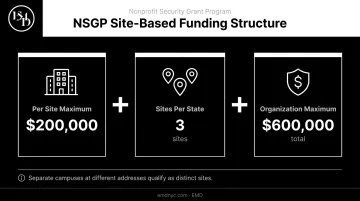
A "site" is defined as a singular address or physical building. Separate campuses at different addresses qualify as distinct sites. Multiple buildings at the same address may be identified by name and treated as one site.
You don't need to own the building. Leaseholders are eligible as long as the organization occupies the space, is fully operational there, and the property owner permits the funded work. Each site requires a separate application.
The Vulnerability Assessment Requirement
Every NSGP applicant must conduct a security vulnerability risk assessment before submitting. This assessment:
- Identifies specific physical security gaps
- Validates the at-risk determination
- Directly drives every budget item requested
CISA's Houses of Worship Security Self-Assessment is an official tool designed for this purpose. Local law enforcement can also conduct assessments.
A strong application ties every budget line directly to documented vulnerabilities. Security consultants who specialize in NSGP applications — like EMD, which uses AI-augmented assessments built around FEMA's documentation standards — can ensure the assessment output holds up under reviewer scrutiny.
What FEMA Grant Money Can (and Cannot) Be Used For
Eligible Expenses
The NSGP covers a broad range of physical and operational security enhancements:
Physical security upgrades:
- Fencing, gates, and barriers
- Reinforced access control hardware (card readers, door hardening)
- Fixed area lighting
- Screening equipment
Electronic security systems:
- CCTV surveillance cameras
- Access control systems
- Alarm and intrusion detection systems
- Intercoms and public address/notification systems
Emergency communications:
- Portable radios
- Public warning systems
- Generators — but only when used to support security infrastructure, not general facility operations
Training and personnel:
- Active shooter response training
- Evacuation drills and exercises
- Behavior threat detection training
- Temporary contracted security personnel (equipment for contract guards is not covered)
Cybersecurity (physical access layer):
- Risk-based security planning
- Physical access control cybersecurity measures
- Cybersecurity performance goal improvements tied to physical security
Management and administration: Up to 5% of the award can reimburse staff time spent on grant management, reporting, and compliance — worth building into your budget from the start.
What NSGP Does Not Cover
- Permanent staff salaries
- Routine facility maintenance
- Religious programming or activities
- General operating expenses
- Costs incurred to develop the vulnerability assessment or Investment Justification itself
New construction is not a standard eligible expense. Renovation and construction work may be allowable with prior written approval, subject to program limits.
Every expense must trace directly back to a documented vulnerability. Reviewers will reject line items that don't connect clearly to assessment findings — and a weak cost justification can bring down an otherwise strong application.
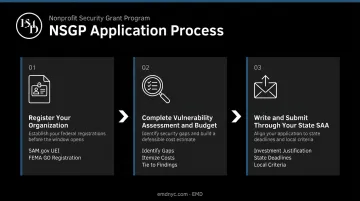
How to Apply: Step-by-Step Process
Step 1: Register and Prepare Your Organization
Before anything else, complete two federal registrations:
- Obtain a Unique Entity Identifier (UEI) through SAM.gov. Registration can take up to 10 business days to become active — start early.
- Register in FEMA Grants Outcomes (FEMA GO) — the system through which SAAs submit applications.
Allow several weeks for this step, especially if your organization has never applied for federal funding before.
Step 2: Complete Your Vulnerability Assessment and Build Your Budget
This is the analytical core of the application. The assessment identifies security gaps; the budget translates those gaps into specific, itemized projects.
When building the budget:
- Tie every line item directly to an assessment finding
- Get realistic cost estimates for each project or phase
- Consider phasing larger projects across the 36-month performance period to reduce upfront out-of-pocket exposure
Working with a grant consultant at this stage ensures the assessment findings map directly to your narrative and budget — eliminating the gaps that most commonly weaken applications. EMD's services cover both the vulnerability assessment and application documents together, so nothing falls through the cracks.
Step 3: Write and Submit Through Your State's SAA
The Investment Justification (IJ) is the written narrative that connects threat evidence, vulnerability findings, and proposed solutions into a cohesive case for funding. A weak IJ is the most common reason otherwise fundable applications are scored down.
Houses of worship do not submit to FEMA directly. Find your SAA contact through FEMA's SAA directory and confirm:
- State-specific deadlines (often earlier than FEMA's federal deadline)
- Required materials and worksheets
- Local scoring criteria
How to Build a Competitive NSGP Application
Nail the At-Risk Narrative
The at-risk narrative is where many applications fall short. Reviewers need to understand why your specific congregation faces an elevated threat — not just that religious organizations generally face threats.
Strong at-risk documentation includes:
- Prior incidents or threats directed at your organization
- Hate crime trend data affecting similar faith communities in your region
- Current events that place your denomination or faith tradition at heightened risk
- Any contact with law enforcement regarding threats
Understand the Competition
NSGP funding has grown significantly — from $25 million in FY2005 to approximately $275 million in FY2025, according to the Congressional Research Service. Despite that growth, demand still exceeds available funding and many applicants do not receive awards.
Given the competitive landscape:
- Read the current year's Notice of Funding Opportunity (NOFO) carefully — scoring criteria can change annually
- Attend FEMA or SAA informational webinars to get direct access to scoring guidance
- Treat the Investment Justification as a persuasive document, not just a form to complete
Consider Professional Support
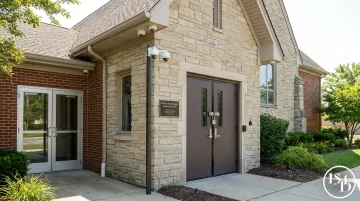
The Investment Justification, procurement documentation, state worksheets, and multi-role compliance requirements are genuinely time-intensive. EMD has helped houses of worship secure NSGP funding — including one client that received two consecutive NSGP awards to implement:
- Video surveillance and upgraded access control software
- Panic buttons and intercom systems
- Reinforced locks and doors
- Active shooter training
EMD engages early in the process, typically starting with a complimentary 30-minute onboarding call and a detailed intake session. From there, EMD leads the preparation of grant documents while the client's primary role is providing follow-up information.
Grant Compliance: What to Expect After Winning
Winning an NSGP award comes with binding administrative obligations that run for the full performance period.
Ongoing obligations include:
- Following federal procurement standards under 2 CFR 200.317–200.327 when selecting and contracting vendors
- Maintaining internal controls and conflict-of-interest standards per 2 CFR 200.303 and 200.318
- Completing regular program and fiscal reporting to your SAA
- Retaining all federal award records for three years from the date of submission of the final financial report (per 2 CFR 200.334)
FEMA may conduct audits within that window. Noncompliance can result in required repayment of funds.
Managing an NSGP award spans procurement coordination, EHP submissions, reimbursement requests, and reporting — across multiple distinct roles. The 5% management and administration allowance can offset some staff costs, but assess your capacity honestly before applying. Organizations running lean on administrative staff should build this workload into their planning.
EMD's post-award grant management services cover vendor identification, EHP submissions, procurement coordination, reimbursement processing, and ongoing reporting support — typically targeting full project completion within 12–18 months of award, well within the 36-month performance period.
Frequently Asked Questions
Does FEMA give money to churches?
Yes. FEMA provides funding to churches through two programs: the Nonprofit Security Grant Program (for security enhancements) and Public Assistance (for disaster-damaged facilities). Both are available to 501(c)(3) faith-based organizations.
Who is eligible for FEMA grants?
NSGP eligibility requires 501(c)(3) nonprofit status and a demonstrated risk from terrorist or extremist threats. Public Assistance eligibility is triggered by a presidential disaster declaration and depends on the type of services the nonprofit provides.
What is the FEMA security grant for churches?
The FEMA security grant for churches is the Nonprofit Security Grant Program (NSGP), administered through DHS. It provides up to $200,000 per site and up to $600,000 total across three sites, specifically for physical security hardening measures.
How much money can a house of worship receive from the NSGP?
Up to $200,000 per site, with a maximum of three sites per state — for a potential total of $600,000. Awards are competitive; amounts vary by state and applicant pool.
What expenses are not covered by the FEMA NSGP?
NSGP funds cannot be used for permanent staff salaries, routine maintenance, general operating expenses, or religious programming. All spending must directly address security vulnerabilities identified through a formal assessment.
How do houses of worship apply for the FEMA NSGP?
Applications are submitted through each state's State Administrative Agency (SAA), not directly to FEMA. Before applying, organizations must:
- Register in SAM.gov and FEMA GO
- Complete a formal vulnerability assessment
- Submit an Investment Justification document by the state's deadline