Introduction
The U.S. physical security market reached $40.8 billion in 2024 and is projected to grow to $56.8 billion by 2030. For institutions — from K-12 schools and transit systems to museums and houses of worship — that growth reflects a hard reality: security threats are too persistent and too layered for one-off consulting engagements to address.
Most organizations still approach retainer pricing without a clear framework. They compare monthly fees without understanding what drives those fees, what's included versus excluded, or whether the engagement model fits their actual risk environment.
This guide breaks down realistic retainer price ranges, the factors that push costs up or down, what a well-structured retainer should include, and how to evaluate the right arrangement for your organization — from single-site nonprofits to multi-campus transit authorities.
Key Takeaways
- Monthly retainer costs vary widely — no single market rate applies across institution types or engagement scopes
- Key cost drivers are scope, specialization, site complexity, number of locations, and the engagement model chosen
- Expect higher retainer fees if your environment involves high occupancy, federal compliance obligations, multiple sites, or specialized threat profiles (schools, transit, houses of worship)
- Retainers outperform hourly engagements when your organization needs continuous risk oversight and long-term strategic accountability
How Much Does a Security Consulting Retainer Cost?
Security consulting retainers don't have a fixed price. Costs shift based on the type of services, the consultant's specialization, and the risk profile of the environment being protected.
Organizations that misjudge their budget run into two common problems: they underbudget and receive incomplete coverage, or they overpay for generalist services that don't match their actual risk environment.
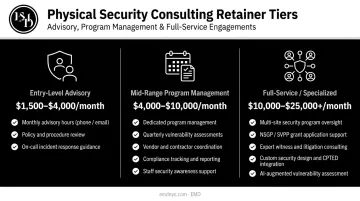
Entry-Level / Advisory Retainer
Typical range: $1,500–$4,000/month
This tier covers limited monthly hours — usually 4 to 10 hours — with access to a consultant for questions, periodic guidance, and light documentation review. It suits single-site facilities with straightforward security needs: small nonprofit offices or single-building community centers that are just beginning to formalize their programs.
What this tier typically doesn't include:
- Structured site assessments or formal written reports
- Proactive risk monitoring
- Policy development support
Mid-Range / Ongoing Program Management Retainer
Typical range: $4,000–$10,000/month
This is the most common structure for K-12 districts, mid-size corporate campuses, and community-based nonprofits with active programming. It generally covers:
- Dedicated consultant access (15–30 hours/month)
- Periodic site assessments or walkthroughs
- Written risk reports and recommendations
- Coordination with internal security staff or administration
- Support for policy development and planning
High-End / Full-Service or Specialized Retainer
Typical range: $10,000–$25,000+/month
Full-service retainers fit organizations with multi-site oversight needs, compliance obligations, or specialized threat profiles — transit authorities, major historical landmarks, large higher education campuses, and institutions managing active federal grant requirements.
This level typically covers:
- Multi-site program management and coordination
- Regulatory compliance support (such as FTA PTASP requirements for transit)
- Grant coordination and post-award administration
- Advanced threat analysis
- Access to specialists across multiple security disciplines
Note: These ranges reflect U.S.-based engagements and represent market observations rather than published rate schedules. Actual retainer costs depend on the specific scope negotiated with the consulting firm.
Key Factors That Affect Security Consulting Retainer Pricing
Pricing is shaped by a combination of technical, environmental, and business considerations that interact differently for every client.
Type and Specialization of Security Consulting
The type of consulting required is one of the strongest cost drivers. A generalist security consultant working from standard industry frameworks charges less than a specialist with deep, sector-specific credentials and methodology.
Consider what your environment actually demands:
- Physical security design — perimeter hardening, access control, CCTV, CPTED
- Regulatory compliance consulting — transit agencies under FTA's PTASP regulation (49 CFR Part 673), for example, need consultants who understand Agency Safety Plan requirements
- Grant consulting — NSGP and SVPP applications require knowledge of federal funding rules, vulnerability assessment documentation, and Investment Justification writing
- Hybrid physical-cyber — environments where physical and digital systems intersect require broader expertise and charge higher rates
When a single firm covers multiple specializations — physical design, compliance, and grant consulting — retainer scope and pricing are structured differently than single-service engagements.
Scope and Scale of the Engagement
More sites, more stakeholders, and more deliverables mean higher monthly costs.
- A single-site school district costs less to service than a 12-campus district
- A museum with one building requires less recurring oversight than a historical landmark with multiple structures and public access points
- Multi-jurisdiction transit authorities involve coordination across more stakeholders and compliance layers
Scope also includes the expected monthly output: how many reports, how many site visits, what turnaround times, and which stakeholders the consultant is expected to engage.
Risk Profile and Site Complexity
According to the FBI's 2024 active shooter report, 24 active shooter incidents occurred across 19 states in 2024, spanning schools, houses of worship, government facilities, and public spaces. The DOJ reported 11,679 hate crime incidents in the same year, with nearly a quarter motivated by religious bias.
High-risk environments — schools, transit systems, houses of worship — require more intensive ongoing analysis than lower-risk commercial settings. Sites with federal compliance obligations, prior incidents, or high daily occupancy typically require more consultant hours per month and more frequent site visits, which is why these engagements consistently land at the higher end of monthly fee ranges.
Engagement Model: Advisory vs. Embedded vs. Outcome-Based
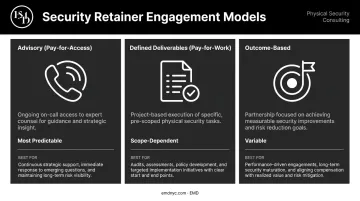
Three primary retainer structures exist, each with different cost and flexibility profiles:
| Model | Structure | Cost Profile | Best For |
|---|---|---|---|
| Advisory (pay-for-access) | Monthly fee for consultant availability and guidance | Most predictable | Organizations needing responsive expertise without heavy deliverables |
| Defined deliverables (pay-for-work) | Set fee for specific monthly outputs | Predictable, scope-dependent | Organizations with clear reporting and assessment cadence |
| Outcome-based | Fees tied to measurable results (e.g., grant awards, compliance milestones) | Variable | Grant-focused or compliance-driven engagements |
Experience, Credentials, and Firm Depth
Credential depth matters. Consultants holding recognized ASIS certifications — particularly combined with sector-specific experience — charge higher retainer fees:
- CPP (Certified Protection Professional) — requires 5–7 years of security experience, including at least 3 years in responsible charge of a security function
- PSP (Physical Security Professional) — requires 3–5 years of relevant physical security experience
Firms using advanced analytical tools, such as AI-assisted threat modeling and vulnerability mapping, increase analytical depth across assessments. This affects both the quality of outputs and what consultants can reasonably charge for complex environments.
Security Consulting Retainer Cost Breakdown
The monthly retainer figure isn't the whole picture. Understanding how costs break down helps organizations budget accurately and avoid scope disputes.
Core Retainer Fee
Covers agreed hours, defined deliverables, or advisory access. Clarify upfront whether unused capacity carries over or expires monthly — this single detail affects how much value you extract from the engagement.
Site Assessments and Formal Reporting
Structured risk assessments, security audits, and written reports may be included in the retainer or billed as separate project fees. This distinction is one of the most common sources of budget surprises — confirm the billing treatment in writing before signing.
Incident Response and Emergency Access
Most physical security consulting retainers do not automatically include emergency response or crisis consulting. For high-risk environments — schools, transit authorities, houses of worship — confirm whether incident response is included or requires a separate arrangement with a defined response timeline.
Out-of-Scope and Project-Based Work
Work falling outside the retainer scope is typically billed separately. Common examples include:
- Grant applications (NSGP, SVPP, state school-safety programs)
- Capital project consulting and technology procurement support
- Regulatory submissions and agency coordination
EMD's NSGP and SVPP grant services, for example, run as standalone engagements with their own scope and process — separate from any ongoing security design retainer. A written out-of-scope policy in the agreement protects both parties and prevents the disputes that derail most retainer relationships.
Low-Cost vs. High-Cost Security Consulting Retainers — What's the Difference?
A lower monthly retainer doesn't always mean poorer value — but it does mean different capabilities, access, and depth of service.
Performance and Deliverables
The gap shows up quickly in day-to-day service:
- Lower-cost retainers provide fewer monthly touchpoints, lighter reporting, and reactive guidance when issues arise
- Premium retainers include proactive risk monitoring, structured site evaluations on a defined schedule, and strategic planning that ties security investments to organizational goals
Expertise Depth and Analytical Tooling
Generalist consultants using standard frameworks cost less. Specialists with sector-specific credentials and AI-assisted vulnerability mapping cost more. For environments like transit authorities or historical landmarks with preservation constraints, that analytical depth produces materially different recommendations.
Long-Term Value and Grant Access
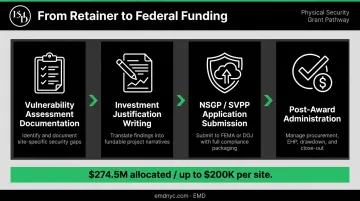
For institutional clients, this is where a higher retainer frequently pays for itself. FEMA's FY2025 Nonprofit Security Grant Program allocated $274.5 million — split evenly between Urban Area and State grants — for target hardening at nonprofits facing elevated risk. Subapplicants can request up to $200,000 per site and $600,000 per organization.
A well-scoped retainer that includes grant coordination can turn the consulting cost into a net positive for capital planning.
The vulnerability assessment documentation required for NSGP eligibility, the Investment Justification narrative, and post-award administration are all services a retainer-engaged consultant can carry — potentially unlocking six figures in federal funding that would otherwise go unclaimed.
How to Estimate the Right Retainer Budget for Your Organization
Matching the retainer structure to your organization's actual risk exposure — not hunting for the lowest price — is what produces lasting value. Start by answering a few foundational questions before any number gets attached to scope.
Key Questions to Answer Before Budgeting
- What is the nature and frequency of security threats relevant to your environment?
- How many sites or access points require ongoing oversight?
- Do you have existing security infrastructure, staff, or plans that a consultant will work alongside?
- Are there regulatory, compliance, or grant funding obligations requiring documented security planning?
Matching Scope to Budget
Organizations with complex, high-occupancy, or multi-site environments (K-12 districts, transit authorities, higher education campuses) should budget for mid-to-upper retainer tiers and prioritize firms with demonstrated expertise in their specific sector.
For organizations newer to structured security consulting, a scoped vulnerability assessment is often the right starting point before committing to a monthly retainer. EMD offers an onboarding call to assess needs before formalizing engagement, which helps set realistic scope and fee expectations upfront.
Total Cost of Engagement
Monthly retainer fees are only one line item. Account for:
- Project-based work billed outside the retainer
- Travel and on-site visit requirements
- Internal administrative time required to manage the engagement
- Costs associated with grant applications or compliance submissions, if not covered by the retainer
Building a complete annual budget, not just a monthly fee comparison, gives decision-makers an accurate picture of total cost — and makes it far easier to justify the expenditure internally.
What Most Organizations Get Wrong About Security Consulting Retainer Costs
Focusing Only on the Monthly Fee
Organizations that evaluate retainers by monthly cost alone often miss the cost of out-of-scope work, the absence of emergency access provisions, and the opportunity cost of working with a consultant who lacks sector-specific depth. A lower monthly fee from a generalist firm can easily be erased by project fees for work that a more specialized retainer would have covered.
Not Defining Scope Clearly Enough Before Signing
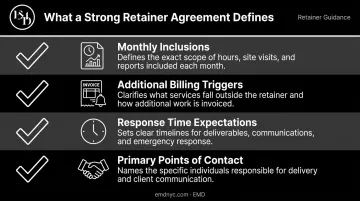
Vague retainer agreements — those promising "ongoing security support" without specifying deliverables, response times, meeting cadence, or escalation procedures — are among the most common causes of retainer disputes. A strong retainer agreement defines:
- What is included each month (hours, visits, reports)
- What triggers additional billing
- Response time expectations for urgent matters
- Who the primary point of contact is on both sides
Underestimating the Value of Continuity
Security consulting retainers derive much of their value from the long-term relationship. A consultant who understands your site history, your risk profile, and your stakeholder landscape provides meaningfully better guidance than a series of disconnected engagements.
Organizations that cycle through consultants to cut costs often spend more in the end. Repeated onboarding resets institutional knowledge each time. Inconsistent recommendations create gaps in your security posture. And those gaps tend to surface at the worst possible moment — during an incident, an audit, or a grant review where a long-term advisor would have seen it coming.
Conclusion
Security consulting retainer costs vary widely based on scope, specialization, site complexity, and the engagement model chosen. The right retainer reflects your organization's actual risk environment, not just a price point you can defend in a budget meeting.
Before engaging a firm, invest time in defining scope. Clarify what's included, what isn't, and what triggers additional billing. Evaluate consultants on sector expertise, analytical capability, and a track record of supporting long-term security outcomes. The proposal's price matters far less than whether the firm can actually close the gaps that leave your organization exposed.
Frequently Asked Questions
What is a retainer fee for consulting services?
A retainer fee is a recurring payment (typically monthly) that secures ongoing access to a consultant's expertise and defined deliverables, unlike per-project or hourly billing where each engagement is scoped and closed separately.
How much does a security consulting retainer cost per month?
Monthly costs vary widely: entry-level advisory retainers typically run $1,500–$4,000/month, mid-range program management retainers $4,000–$10,000/month, and full-service or specialized retainers $10,000–$25,000+/month. Actual costs depend on scope, site complexity, and the engagement model negotiated.
What is typically included in a security consulting retainer?
Most retainers cover scheduled advisory calls or site visits, risk assessments or written reports, strategic planning support, and defined communication access. Incident response and discrete capital projects are typically billed separately.
How long should a security consulting retainer contract be?
Most retainers begin with a three- to twelve-month minimum term. Shorter terms are possible but typically come at higher monthly rates to offset the reduced commitment.
When does a retainer make more sense than hourly security consulting?
Retainers suit organizations with ongoing, complex security needs (schools, transit authorities, healthcare systems) where continuity and long-term strategic input matter more than one-off project support.
What's the difference between a security consulting retainer and an incident response retainer?
A standard security consulting retainer covers ongoing advisory and planning services. An incident response retainer is a separate standing fee that guarantees priority access and a defined response SLA when a security incident or crisis occurs. Both may be active at the same time, but they are scoped and priced independently.