Introduction
Violence targeting houses of worship is not rare. According to The Violence Project database, there have been 399 homicide incidents at U.S. houses of worship between 2000 and 2025, resulting in 512 deaths and 213 injuries — including 19 incidents in 2025 alone. Meanwhile, DOJ and FBI data shows religion-based bias accounted for 23.5% of all single-bias hate crimes in 2024.
Houses of worship face a challenge that schools and corporate campuses don't: their mission requires openness, and that openness creates real vulnerabilities.
Unlocked doors, predictable service schedules, untrained volunteers, and limited security budgets combine to create conditions that both opportunistic and targeted attackers can exploit.
The goal is layered security planning that protects congregants while preserving the welcoming environment these communities are built on. That means ongoing attention — not a one-time camera installation or a single policy review.
This guide covers each component of that plan: risk assessment, emergency response, access control, team training, physical security, and the funding resources available to support it all.
Key Takeaways
- Open access policies, predictable schedules, and lean security resources make houses of worship high-value targets
- Effective security requires four integrated pillars: risk assessment, emergency response procedures, access control, and trained personnel
- Camera systems, mass notification tools, and physical hardening measures help small or volunteer-based teams cover more ground
- FEMA's Nonprofit Security Grant Program (NSGP) provided $274.5 million in FY2025 funding; houses of worship qualify for this grant
- Treat security planning as a continuous process, not a one-time setup
Why Houses of Worship Face Unique Security Risks
Most security frameworks assume a controlled environment: a school with defined entry points, a corporate campus with badge access. Houses of worship are built around the opposite premise. Open doors, public schedules, and a presumption of welcome toward every visitor are central to the mission — not oversights. Those same characteristics, however, create vulnerabilities that require deliberate management.
The Threat Landscape Is Broader Than Most Congregations Assume
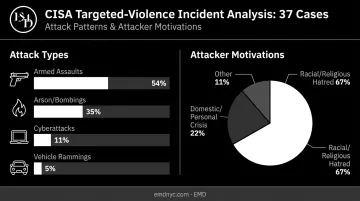
CISA's analysis of 37 targeted-violence incidents at houses of worship from 2009–2019 found the following breakdown:
- 54% of incidents involved armed assaults
- 35% involved arson or bombings
- 11% involved cyberattacks
- 5% involved vehicle rammings
Motivation data from the same study showed that 67% of attacks were driven by hatred of a specific racial or religious identity, while 22% were linked to domestic disputes or personal crises. Theft, vandalism, and insider threats round out the risk picture, though institution-specific data on those categories is limited.
Large Gatherings Concentrate Risk
Weekly services, holiday events, and community programs create conditions where hundreds of people — some unfamiliar to the congregation — share a space with multiple entry points, limited sight lines, and active children's programs running simultaneously. Every large gathering is, in security terms, a soft-target event.
The Absence of a Plan Is Its Own Risk Factor
CISA's analysis also found that 58% of known perpetrators in those 37 incidents showed observable pre-attack planning behavior before they acted. When no written security plan exists, those warning signs often go unrecognized. Volunteers improvise, roles go undefined, and early intervention never happens. A written security plan is designed to interrupt that sequence before an incident develops.
Core Components of a House of Worship Security Plan
A security plan isn't a single document filed away after a staff meeting. It's an integrated system of physical measures, documented procedures, and trained people — and each layer depends on the others. No single measure (a camera, a lock upgrade, a well-meaning greeter) is sufficient on its own.
Conducting a Thorough Risk Assessment
A risk assessment for a house of worship should cover:
- Physical layout, blind spots, and sight line limitations
- Entry and exit points, including secondary and emergency exits
- Peak attendance times and seasonal variation
- Existing security measures and their specific gaps
- Nearby community threat data and historical incident patterns
CISA's free Houses of Worship Security Self-Assessment is a practical starting point for any congregation beginning this process.
A checklist, however, only shows what's present. It doesn't reveal how those elements perform under pressure. A professional assessment models real threat scenarios, including active assailant incidents, organized activity, and environmental risks, to surface vulnerabilities before they're exploited.
EMD's AI-augmented methodology analyzes how vulnerabilities intersect across physical infrastructure, operational processes, and human behavior, catching the gaps between systems that internal reviews routinely miss. For houses of worship specifically, that process is designed to be respectful and discreet, preserving community trust while delivering a clear, prioritized security roadmap.
Developing Emergency Response Procedures
Generic emergency guidance isn't useful when something is actually happening. Response plans must be scenario-specific, covering at minimum:
- Active shooter/assailant — Run, Hide, Fight framework (CISA's Active Shooter Preparedness Action Guide, updated 2025, provides civilian-focused protocols)
- Fire — evacuation routes, assembly points, head counts
- Medical emergency — first responder roles, AED location, 911 coordination
- Natural disaster — shelter-in-place procedures, communication protocols
Every plan should assign named roles: who calls 911, who guides the congregation to exits, who manages the children's area, who accounts for mobility-limited members. Plans without named roles produce confusion at exactly the wrong moment. Revisit and update procedures every time leadership changes, the facility expands, or attendance patterns shift significantly.
Implementing Access Control Strategies
Emergency procedures address what happens when a threat materializes. Access control reduces the likelihood it reaches that point at all. Most congregations don't need a security checkpoint at the front door — practical, low-friction measures are usually enough:
- Monitored entry points during services with designated greeters
- Visitor check-in protocols for children's programs
- Restricted access to administrative, financial, and server areas
- Perimeter lighting at parking lots and secondary entrances
- Cameras at key entry and exit points
The goal is to create friction for threats without creating friction for members. Clear entry lanes during peak hours and basic ID procedures for sensitive areas reduce risk significantly while preserving the welcoming environment congregations depend on.
Building and Training a House of Worship Security Team
Volunteers showing up with good intentions aren't a security team. A functional team needs defined roles, a clear selection process, and structured training — built around competence, not just commitment.
Core Team Roles
| Role | Primary Responsibility |
|---|---|
| Security Coordinator | Oversees planning, training, and ongoing review |
| Safety Volunteers | Positioned and active during each service or event |
| Communications Lead | Manages contact with 911 and internal announcements |
| Medical Response Member | First aid/CPR certified; manages medical emergencies |
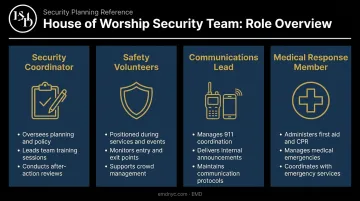
CISA recommends appointing a Security Coordinator and forming a Security Planning Team as foundational steps in any house of worship security program.
Selecting the Right Volunteers
Prior law enforcement experience is useful but not required. More important criteria:
- Reliability and composure under pressure
- Strong situational awareness
- Discretion — security presence should be calm, not conspicuous
- Genuine de-escalation ability
What Training Should Cover
Every team member should complete training in:
- Run, Hide, Fight response framework (civilian active shooter response)
- De-escalation techniques — most security interactions aren't emergencies
- First aid and CPR — medical emergencies are the most common security-adjacent incident
- Suspicious activity recognition and reporting procedures
- Evacuation and lockdown drill participation — at least annually
Once the internal team is trained, the next step is building the external relationships that support them.
The Law Enforcement Partnership
Invite local officers to tour the facility before an incident ever occurs.
Share building schematics and photos — the DHS/FBI Emergency Operations Planning Guide recommends this step to accelerate first-responder orientation during an actual event. When officers already know your layout and have a direct contact on-site, they can act decisively from the moment they arrive — not spend the first minutes orienting themselves.
Physical Security and Technology Measures
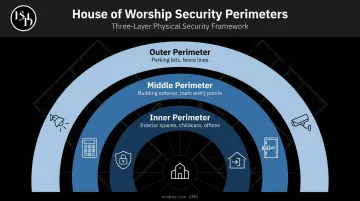
Physical security measures work at three levels: the outer perimeter (parking lot, fence lines), the middle perimeter (building exterior, main entry points), and the inner perimeter (interior spaces, childcare areas, administrative offices). CISA recommends evaluating all three while respecting each area's purpose.
Foundational Physical Measures to Evaluate
- Lighting across parking lots, secondary entrances, and blind spots deters approach and improves camera effectiveness
- Reinforced doors and upgraded hardware close off vulnerable entry points before a threat reaches the interior
- Lockable safe rooms with internal communication give occupants a shelter-in-place option when evacuation isn't possible
- Emergency exits that are visible, unobstructed, and familiar to regular attendees reduce panic during evacuation
- Camera coverage paired with adequate parking lot lighting creates a documented deterrent at the outer perimeter
The Violence Project database found security measures were present in only 13% of house-of-worship homicide incidents, and 88% of facilities were publicly accessible at the time of attacks. These numbers show how much ground most congregations still need to cover — and where technology can extend what a small team manages on its own.
Technology That Extends a Small Team's Reach
- Surveillance systems cover blind spots and provide documentation; EMD assists houses of worship in evaluating and selecting appropriate surveillance platforms as part of security design consulting
- Mass notification platforms deliver instructions instantly across multiple buildings or to remote participants during an incident
- Alarm integration can trigger lockdown protocols automatically, reducing response lag
Many modern platforms integrate with existing camera infrastructure, so full replacement isn't always necessary. Grant funding (see FAQ below) can offset upgrade costs — one EMD client secured two consecutive NSGP awards covering video surveillance, access control software, panic buttons, intercom systems, and reinforced doors across their entire campus.
Common House of Worship Security Mistakes to Avoid
Security doesn't end at installation. Many congregations install cameras or draft an emergency plan and consider the work finished. Facilities change, leadership turns over, and threats evolve. Security requires scheduled reviews — at minimum annually, and whenever significant changes occur.
Volunteer goodwill isn't a substitute for training. When roles are undefined and procedures are unwritten, volunteers may inadvertently escalate a situation or freeze at a critical moment. This is a preparation gap — one that structured training directly addresses.
Pre-attack behaviors go unreported. CISA's analysis found that 58% of known perpetrators in targeted-violence incidents at houses of worship showed observable pre-attack behaviors before acting. Behavioral indicators include:
- Written or verbal threats directed at the congregation or staff
- Unusual or repeated surveillance of the building or parking areas
- Escalating personal conflicts involving members, staff, or regular visitors
Staff and volunteers need to know what to look for and how to report it. Without a reporting mechanism and basic training on warning sign recognition, those signals never reach the people who can act on them.
Frequently Asked Questions
What are the most common security threats houses of worship face?
Physical threats include targeted violence, hate crimes, arson, vandalism, and theft — with CISA's research showing armed assaults and arson/bombings together accounting for nearly 90% of studied targeted-violence incidents. Insider threats from staff or volunteers and cyber risks affecting member databases and financial records are growing concerns as well.
How do we start a security risk assessment for our house of worship?
Start with CISA's free Houses of Worship Security Self-Assessment tool, then walk your facility with a security-minded team member or a local law enforcement contact to identify blind spots, unmonitored entries, and emergency procedure gaps. A professional assessment builds on that foundation with scenario modeling and cross-system analysis.
What should a house of worship emergency response plan include?
At minimum, it should cover scenario-specific protocols (active shooter, fire, medical emergency, natural disaster), named roles for each scenario, communication procedures for reaching 911 and notifying the congregation, and evacuation or lockdown instructions. Drills should be conducted at least once per year.
How can houses of worship fund security improvements?
FEMA's Nonprofit Security Grant Program (NSGP) provided $274.5 million in FY2025 funding with awards up to $200,000 per site; DHS's TVTP Grant Program covers prevention capabilities. Many states offer supplemental funding — California announced $80 million for faith-based organizations in 2026. A consultant experienced in grant management, like EMD, can meaningfully improve application outcomes.
Do small congregations need a formal security plan?
Yes. The absence of a written plan is what turns a manageable situation into a crisis, regardless of congregation size. Even a small congregation benefits from documented emergency procedures, two or three designated safety roles, and a basic protocol for contacting emergency services — none of which require significant staff or budget to put in place.
When should a house of worship work with a professional security consultant?
Consider professional consultation when a congregation operates multiple buildings, runs childcare or school programs, hosts large public events, has received threats, or has never had an independent review. Internal reviews tend to confirm what's already in place; a professional assessment finds what's missing — including cross-system gaps that only surface under scenario-based analysis.