Federal and state grant programs exist specifically to close that gap. Programs like COPS SVPP, FEMA NSGP, ESSA Title IV-A, HSGP, and the BSCA Stronger Connections Grant collectively make hundreds of millions of dollars available annually for school security upgrades — yet many eligible institutions never apply.
This guide covers the five most impactful school safety grant programs available for the 2026 funding cycle: what they fund, who qualifies, how much is available, and what separates winning applications from rejected ones.
Key Takeaways
- School safety grants are non-repayable funds from federal agencies, state governments, and private organizations for physical security upgrades, technology, and training
- Top 2026 programs include COPS SVPP (up to $500,000/award), FEMA NSGP (up to $200,000/site), ESSA Title IV-A, HSGP, and the BSCA Stronger Connections Grant
- Eligible expenses include surveillance cameras, access control, panic alarms, metal detectors, visitor management software, emergency notification systems, and staff training
- A formal threat and vulnerability assessment is required for every competitive federal grant application — and it must be completed before you apply
- Stacking multiple complementary grant programs is permitted and encouraged — just ensure no costs are duplicated across awards
Overview of School Safety Grants in the US
School safety grants are monetary awards from government entities or qualified charitable organizations that do not require repayment — provided recipients maintain compliance throughout the grant period. Funds may need to be returned if a school:
- Withdraws early from the program
- Loses eligibility after award
- Receives duplicate funding for the same cost
- Fails to meet requirements under 2 CFR Part 200
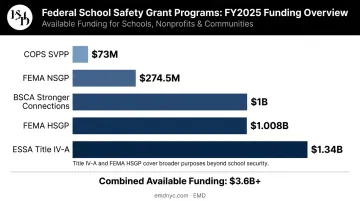
The federal funding landscape is substantial. Across five major programs, FY2025 allocations totaled over $3.6 billion — though Title IV-A and HSGP cover broader purposes beyond school security alone:
| Program | FY2025 Verified Funding |
|---|---|
| COPS SVPP | $73 million |
| FEMA NSGP | $274.5 million |
| ESSA Title IV-A | $1.34 billion (total; safety is one of three use areas) |
| FEMA HSGP | $1.008 billion |
| BSCA Stronger Connections | $1 billion (one-time; available for obligation through September 30, 2026) |
The Bipartisan Safer Communities Act of 2022 expanded the landscape — adding $20 million annually through FY2026 to the SVPP's base funding and creating the Stronger Connections Grant as a separate $1 billion allocation to states for safer learning environments.
Each program below was selected for its funding magnitude and national reach. All five cover K-12 and higher education institutions, with allowable expenses spanning both security technology and staff training.
Top School Safety Grant Programs for 2026
COPS School Violence Prevention Program (SVPP)
Administered by the U.S. Department of Justice's COPS Office under the STOP School Violence Act, the SVPP is one of the largest competitive federal grants specifically targeting school security infrastructure.
What it funds:
- Camera systems, metal detectors, locks, lighting, window film, and panic alarms
- Radios and technology for expedited law enforcement notification
- Training for SROs and local law enforcement
Not funded: Hiring of SROs or security officers; anonymous threat-reporting systems.
| Detail | Information |
|---|---|
| Funding Amount | Up to $500,000 per award; $73 million allocated for FY2025 |
| Award Period | 36 months; up to 75% federal cost share |
| Eligibility | K-12 public school districts, state/local governments, tribal entities — private schools are not eligible as primary applicants |
| Application Portal | SF-424 via Grants.gov + full application in DOJ JustGrants |
| FY2025 Deadline | Full application due June 26, 2025; awards anticipated September 1, 2025 onward |
| FY2026 Status | Confirm current NOFO at cops.usdoj.gov |
FEMA Nonprofit Security Grant Program (NSGP)
Funded by the Department of Homeland Security and administered through FEMA, the NSGP supports target-hardening and preparedness for 501(c)(3) nonprofits at elevated risk of terrorist or extremist attack.
What it funds:
- Physical access control, CCTV and security cameras, and impact-resistant doors and gates
- Fencing, bollards, and contract security
- Planning, training, and exercises (per FEMA's Authorized Equipment List)
Nonprofits do not apply to FEMA directly — they apply through their State Administrative Agency (SAA). SAA deadlines typically precede the federal deadline, so watch your state's timeline carefully.
| Detail | Information |
|---|---|
| Funding Amount | $274.5 million total (FY2025); up to $200,000 per site, up to $600,000 per nonprofit per state |
| Eligibility | 501(c)(3) nonprofits, including private K-12 schools, houses of worship, community centers |
| Application Portal | Through SAA (subapplicants) → FEMA GO |
| FY2025 NOFO Released | July 28, 2025; SAA deadline August 11, 2025 |
| Assessment Requirement | Facility-specific vulnerability assessment required; CISA self-assessment, law enforcement assessment, or contractor assessment all accepted |
EMD has secured consecutive NSGP awards for both faith-based institutions and a private charter school in Hawaii, funding surveillance systems, access control, panic buttons, reinforced doors, and active shooter training.
ESSA Title IV-A Student Support and Academic Enrichment (SSAE)
Title IV-A is a formula grant — not competitive — distributed annually to all Local Education Agencies (LEAs) receiving ESSA funds. One of its three allowable use areas is "safe and healthy students," making it a reliable annual funding stream for security technology and training.
What it funds: Safety-related training, emergency preparedness, and technology infrastructure (up to 15% of funds used for technology can go toward infrastructure). Specific eligibility for physical security hardware depends on state and SEA guidance — confirm with your State Education Agency before budgeting.
| Detail | Information |
|---|---|
| Funding Amount | Formula-based; $1.34 billion distributed to states in FY2025 — verify your district's allocation at ed.gov |
| Eligibility | All LEAs receiving ESSA funds |
| Application | No national competitive process; annual cycle varies by state |
| Key Requirement | Local needs assessment; spending must align with one of three SSAE areas |
Homeland Security Grant Program (HSGP)
FEMA's HSGP provides annual funding to state, local, tribal, and territorial governments to prevent, protect against, and respond to terrorist attacks. Schools access HSGP funds through local government partnerships and sub-award mechanisms — not direct applications to FEMA.
FY2025 HSGP totaled $1.008 billion, split across three components: SHSP ($373.5M), UASI ($553.5M), and OPSG ($81M). SAAs must pass through at least 80% of SHSP and UASI funding to local or tribal governments.
| Detail | Information |
|---|---|
| Funding Amount | $1.008 billion total (FY2025); no per-award maximum |
| Eligibility | State, local, tribal, territorial governments; nonprofits as subrecipients via SAAs |
| School Access | Via SAA sub-award process — contact your state's SAA for current timelines |
| Eligible Uses | Planning, equipment, training, exercises; FEMA explicitly lists school hardening including bullet-resistant doors/glass and 911 notification systems |
BSCA Stronger Connections Grant (SCG)
Created through the Bipartisan Safer Communities Act of 2022 and administered under Title IV-A, the SCG provided $1 billion nationally to states to fund safer and healthier learning environments through competitive subgrants to high-need LEAs.
Key timing note: SCG funds are available for obligation by SEAs and LEAs through September 30, 2026. If your state has unobligated SCG funds, windows may be closing soon — contact your State Education Agency immediately.
California's CDE confirms SCG funds may be used for surveillance cameras, two-way communications systems, and metal detectors. Other states have directed funds toward emergency planning, behavioral threat assessment software, and perimeter hardening.
| Detail | Information |
|---|---|
| Funding Amount | Varies by state; verify your state's current SCG allocation through your SEA |
| Eligibility | Public school districts and LEAs; charter and nonpublic school eligibility varies by state |
| Obligation Deadline | September 30, 2026 — verify with your SEA immediately |
| Application | State-administered; contact your SEA for current sub-grant availability |
What School Safety Grants Fund: Eligible Equipment & Programs
Most school safety grant programs — SVPP, NSGP, HSGP, and state-level funds — cover a broader range of equipment and services than applicants expect. Here's what's documented as eligible across these programs:
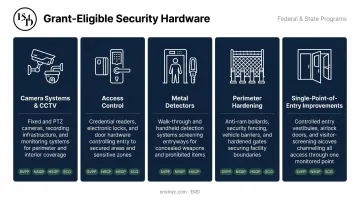
Physical Security Hardware
- Camera systems and CCTV — verified under SVPP, NSGP, and California's SCG program
- Access control — smart locks, intercoms, credential systems; covered under NSGP's AEL and SVPP
- Metal detectors — explicitly listed under SVPP and California SCG
- Perimeter hardening — fencing, bollards, impact-resistant doors/gates, window film under NSGP and HSGP
- Single-point-of-entry improvements — vestibule hardening is a documented SVPP use case
Detection and Alert Technology
- Panic alarms and emergency notification — verified under SVPP as "expedited law enforcement notification technology"; HSGP references immediate 911 notification
- Two-way communications — radios, intercoms, PA system upgrades covered under SVPP and California SCG
- Environmental sensors — vape, smoke, and IoT sensors are not explicitly verified in official federal NOFOs; check state-specific guidance before budgeting these
Visitor and Campus Management Systems
Visitor management systems are a documented eligible expense — not just hardware. State-level programs in particular have confirmed this category:
- Arkansas DESE (2025) — approved expenditures list explicitly includes visitor management systems
- Maryland Nonpublic School Health and Security Program — covers surveillance systems, alarm systems, and trained security personnel for private schools
Training, Planning, and Personnel
Most programs fund more than hardware:
- Staff training on violence prevention and emergency response
- Threat assessment team implementation
- Emergency operations plan development
- Active shooter drills
- Mental health intervention programs
- SRO employment (varies by program — SVPP excludes it; Indiana's state program includes it)
How to Apply for School Safety Grants in 2026
Assembling Your Grant Team
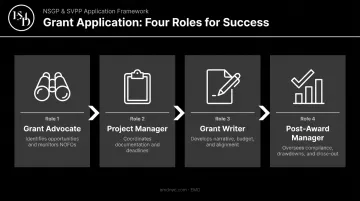
Successful applications require coordinated effort across four functional roles:
- Grant Advocate: identifies funding opportunities and monitors NOFO releases
- Project Manager: coordinates documentation and manages internal deadlines
- Grant Writer: develops the narrative, budget justification, and program alignment
- Post-Award Manager: oversees compliance reporting, drawdown requests, and close-out
Most rejections stem from incomplete documentation or missed deadlines — not unqualified schools. External consultants like EMD handle the majority of this workload: vulnerability assessment, narrative development, budget construction, and post-award administration. The school side needs one responsive primary contact to keep the process moving.
Conducting a Professional Needs Assessment
Nearly every federal and competitive state grant requires a formal threat and vulnerability assessment as the foundation of the application. This document establishes current security gaps, justifies the funding request, and maps directly to each program's selection criteria.
Program requirements differ. For NSGP, FEMA accepts a CISA self-assessment, a law enforcement assessment, or an outside contractor assessment — and the Investment Justification must match identified vulnerabilities. For SVPP, the threat and school-climate narrative must demonstrate evidence-based need.
EMD's AI-augmented assessment methodology evaluates three dimensions:
- Physical infrastructure: perimeter security, access control, surveillance coverage, locks, ballistic protection, and lighting
- Operational processes: visitor management, lockdown procedures, emergency notification, and drill effectiveness
- Human-factor risks: active assailant scenarios, organized targeting, opportunistic crime, and vehicle threats
- Climate and behavioral indicators: threat reporting culture, staff training gaps, and prior incident history
The output maps directly to NSGP and SVPP application requirements, producing a threat narrative, investment justification, and prioritized recommendations tied to specific grant funding pathways.
Developing Budget Justifications and Timelines
Funders evaluate both financial credibility and operational feasibility:
- Include market-rate cost research and vendor quotes where possible
- Account for indirect costs and state-specific matching requirements
- Break large projects into phases — competitive reviewers favor phased rollouts that pilot technology in priority areas first
- Timelines should reflect realistic milestones, not aspirational estimates
Submitting Through the Right Channels
SAM.gov registration is mandatory before any federal application. Start this process at least 30 days before your target deadline, since Grants.gov and JustGrants each require separate steps.
| Program | Submission Portal |
|---|---|
| COPS SVPP | SF-424 via Grants.gov + full application in DOJ JustGrants |
| FEMA NSGP | Through SAA → FEMA GO |
| ESSA Title IV-A / SCG | State SEA portal — varies by state |
| HSGP | Through SAA sub-award process |
Review the full NOFO or RFP before submitting. Formatting requirements, evidence standards, and required attachments vary significantly between programs.
How We Chose These Grant Programs
These five programs were selected based on:
- National or multi-state reach — all are accessible to schools across the US
- Award sizes meaningful relative to typical school security project costs
- Clear eligibility for K-12 and/or higher education institutions
- Broad allowable expense categories covering both technology and training
- Active or imminent funding cycles for 2026
One common mistake: schools chase the largest grants without checking eligibility or application capacity. SVPP, for example, does not accept private schools as primary applicants. NSGP requires 501(c)(3) status. HSGP requires working through a government intermediary.
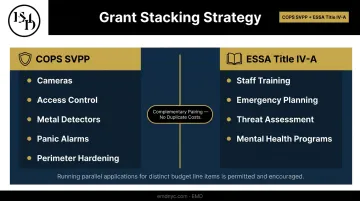
Map your security priorities across multiple compatible programs — for example, pairing SVPP for physical hardware with Title IV-A for training and staff development. Applications must designate costs clearly to avoid duplicate funding, but running parallel applications for complementary purposes is both permitted and encouraged. Schools that align grant pairings to distinct budget line items tend to move through review faster and with fewer compliance issues post-award.
Conclusion
School safety grants are real, accessible, and substantially underpursued by eligible institutions. The funding exists. The gap is consistently in preparation: a missing threat assessment, an incomplete budget narrative, or an application submitted without understanding what a specific program actually prioritizes.
Start here:
- Conduct a professional threat and vulnerability assessment
- Register in SAM.gov — allow 30 days
- Identify your state's SAA for NSGP and HSGP sub-award access
- Contact your SEA about remaining SCG obligation windows (closing September 2026)
- Build a grant calendar that maps upcoming deadlines to your district's security roadmap
EMD covers the full cycle — from vulnerability assessment and application development through post-award administration and close-out — for K-12 schools, higher education campuses, houses of worship, and nonprofit institutions. To get your security upgrades funded, contact EMD at info@emdnyc.com or (833) 363-6921.
Frequently Asked Questions
What types of security equipment do school safety grants typically fund in 2026?
Common eligible categories include camera systems, access control, metal detectors, panic alarms, emergency notification systems, two-way communications, visitor management software, perimeter fencing, and door hardening. Eligible categories vary by program, so always verify against the specific NOFO or state program guidelines before budgeting.
Can K-12 schools apply for multiple school safety grants at the same time?
Yes, and they should. Schools can apply to multiple programs simultaneously, provided each application clearly designates which grant funds which cost. Duplicate funding for identical expenses is prohibited, but funding different components of a security plan through separate programs is entirely appropriate.
How long does the school safety grant application process typically take?
For COPS SVPP, FY2025 applications were due in late June with awards anticipated from September — roughly 2-3 months to award decision. State programs vary. Formula-based programs like Title IV-A flow through annual cycles without a competitive review period.
What documentation is required for a school safety grant application?
Core requirements include:
- Professional threat and vulnerability assessment
- Detailed budget with cost justification
- Implementation timeline
- Community or government partnership letters of support
- Active SAM.gov registration (required for all federal programs)
Are private schools eligible for federal school safety grants?
Private schools may qualify for FEMA NSGP if they hold 501(c)(3) status and meet the program's risk requirements. They are not eligible as primary SVPP applicants. Some state SCG sub-grants and state-specific programs extend eligibility to nonpublic schools — verify with your SAA or SEA.
What are the most common reasons school safety grant applications get denied?
The top reasons are failure to meet eligibility requirements, weak or absent needs assessments, budget narratives that lack cost justification, late submission, and proposals that don't clearly align with the funder's stated selection criteria. A professionally conducted threat assessment tied directly to the investment justification addresses several of these at once.