This is the pattern. Not ignorance of threats, but the absence of a formal process for finding the gaps between what organizations think their security covers and what it actually covers.
In 2023, DOJ reported 2,699 religion-based hate crime incidents in the U.S. alone. U.S. transit systems recorded 2,200 major assault injuries that same year — the highest annual total in federal data collection history. Schools, museums, houses of worship, and transit hubs face real, documented threats. A security vulnerability assessment is the structured process that turns that threat awareness into actionable defense.
Key Takeaways
- A security vulnerability assessment systematically identifies, analyzes, and prioritizes weaknesses in an organization's physical security environment
- It covers access points, surveillance coverage, emergency protocols, staffing gaps, and environmental factors
- Four stages guide the process: asset and threat identification, security evaluation, vulnerability scoring, and mitigation planning
- FEMA's NSGP and the COPS SVPP both require a documented vulnerability assessment before any grant application can proceed
- Without one, security gaps go undetected until an incident forces the issue
What Is a Security Vulnerability Assessment?
A security vulnerability assessment is a structured, systematic evaluation of an organization's physical security environment. Its purpose is to identify gaps, weaknesses, and threat exposures before they can be exploited — not after.
This is distinct from a cybersecurity vulnerability assessment, which focuses on software, networks, and IT infrastructure. A physical security vulnerability assessment examines tangible elements:
- Entry points and perimeter defenses
- Surveillance camera placement and coverage
- Lighting levels and alarm systems
- Visitor management protocols and emergency procedures
- Human factors such as staff behavior and training compliance
Assessment vs. Penetration Test
These two terms are often confused.
- Vulnerability assessment — broadly identifies and catalogs weaknesses across the security environment
- Penetration test (red team exercise) — actively attempts to exploit those weaknesses to test whether defenses hold
Organizations typically conduct assessments on an ongoing or annual basis. Penetration tests are used at strategic intervals to confirm whether identified vulnerabilities have actually been resolved.
Three Assessment Scopes
Physical security assessments aren't one-size-fits-all. Scope is determined by organizational need:
- Internal assessment — evaluates controls, protocols, and vulnerabilities within the facility
- External assessment — evaluates perimeter defenses, approach routes, and access from outside
- Hybrid assessment — covers both internal and external exposure; recommended for most facilities where threats can originate from either direction — inside the building or beyond the perimeter
Why Security Vulnerability Assessments Are Critical
Soft targets — schools, transit hubs, houses of worship, museums, and campuses — face elevated risk precisely because they are designed to be open and accessible. That openness is a feature of their mission. It also creates structural security challenges that can't be addressed by instinct or informal observation.
The Texas House investigation into Robb Elementary found that none of the three exterior doors to the school's west building were locked during the attack, and a classroom door had a known faulty lock with no written work order filed for repair. The school already had a written active shooter plan adopted in 2020. The plan existed. The assessment to verify whether physical conditions actually supported that plan did not happen.
That gap — between documented policy and physical reality — is exactly what a vulnerability assessment is designed to close.
Operational Benefits
A completed assessment delivers measurable value across several dimensions:
- Proactive threat identification — vulnerabilities are found and addressed before a threat actor finds them first
- Budget prioritization — risk scoring directs limited dollars toward the highest-consequence weaknesses
- Compliance and insurer requirements — documented reviews satisfy regulatory mandates across multiple sectors
- Emergency preparedness validation — confirms existing protocols are functional and actually known to staff
- Stakeholder confidence — boards, funders, and the public can see that safety is a managed, documented priority
The Grant Funding Connection
A completed vulnerability assessment isn't just a safety tool — it's a prerequisite for federal and state security funding.
Three major programs illustrate how closely assessments and funding are tied:
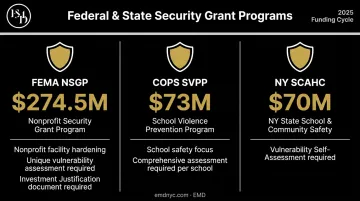
- FEMA NSGP (FY2025) — $274.5 million allocated for nonprofit facility hardening; each applying site must submit a unique vulnerability assessment and completed Investment Justification
- COPS SVPP (FY2025) — up to $73 million available; requires comprehensive school safety assessments for every school in the funded project
- New York SCAHC (2026) — up to $70 million available; requires a facility-specific Vulnerability Self-Assessment as part of any application
Organizations that haven't completed a formal assessment before applying are at a significant disadvantage. Those that have one are positioned to compete.
How to Conduct a Security Vulnerability Assessment: Step by Step
Every facility is different, but rigorous assessments follow a consistent four-stage framework. Each stage builds on the last to produce a prioritized, evidence-based picture of where risk lives and what to do about it.
Step 1: Identify Assets and Threats
Before evaluating any security measure, you need to know what you're protecting and from what.
Asset mapping covers:
- Personnel (staff, students, congregants, visitors, patients)
- Sensitive records and data storage locations
- High-value equipment and collections
- Physical spaces (primary gathering areas, perimeter, secondary access points)
Threat cataloging covers:
- Criminal activity (opportunistic crime, targeted attacks)
- Active assailant and active shooter scenarios
- Natural disasters and environmental hazards
- Insider threats and procedural noncompliance
- Threats specific to the facility type (for example, hate-motivated targeting at houses of worship, or fare-evasion-related violence at transit stations)
Stakeholder interviews with security staff, administrators, and first responders familiar with the facility are essential at this stage. Physical observation alone won't surface threats that locals know about or procedural vulnerabilities that only emerge in conversation.
Step 2: Evaluate Existing Security Measures
This is the physical and operational inventory: what's in place, and does it actually work?
Physical infrastructure:
- Access control systems (electronic access, mantraps, visitor management workflows)
- Surveillance camera placement, coverage angles, and blind spots
- Perimeter barriers, fencing, and vehicle access control
- Lighting levels across all exterior and interior zones
Operational and procedural systems:
- Intrusion detection and alarm systems
- Emergency notification systems
- Lockdown and shelter-in-place protocols
- Staff training records and drill frequency
Common oversights found at this stage:
- Cameras installed but covering the wrong angles
- Access doors that allow entry without passing through visitor check-in
- Alarm systems that haven't been tested or updated in years
- Emergency response plans that staff can't locate or haven't reviewed
Step 3: Classify and Score Vulnerabilities
Cross-referencing the asset and threat data against the security evaluation produces a list of specific vulnerabilities. You classify each by type — physical, procedural, or environmental — and assign a risk score based on two factors:
- Likelihood of exploitation — how probable is it that a threat actor encounters and uses this weakness?
- Potential impact — what are the consequences if this vulnerability is exploited?
Risk scoring matters because not every gap carries equal weight. A propped-open side entrance at a school presents a fundamentally different risk than a slightly under-lit parking lot. Scoring ensures that remediation is ordered by consequence, not by what's easiest to fix.
Step 4: Develop and Implement a Mitigation Plan
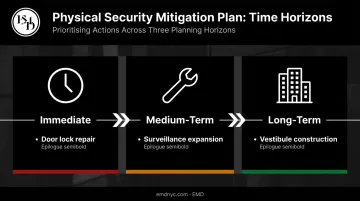
The scored vulnerability list becomes the foundation for a prioritized action plan with three time horizons:
- Immediate: Low-cost fixes that close high-risk gaps now — repairing a faulty door lock, updating a visitor sign-in protocol
- Medium-term: System upgrades requiring procurement and installation — surveillance expansion, access control replacement
- Long-term: Strategic changes requiring redesign or capital investment — vestibule construction, perimeter hardening
Each item in the plan needs an assigned owner, a timeline, and a measurable success criterion. And once remediation is complete, a follow-up assessment should verify that the fix worked and didn't introduce new vulnerabilities in the process.
Security Vulnerability Assessment in Action
Consider a mid-sized K-12 school conducting its first formal assessment.
Findings by stage:
- Asset & threat identification: Staff interviews surfaced two threats invisible from a walkthrough — a history of unauthorized entry attempts at the rear gymnasium exit, and a recurring staff habit of propping that same door during afternoon shift changes.
- Security evaluation: Two entrance cameras had drifted and were pointing at sections of ceiling. The visitor management system required sign-in but couldn't prevent tailgating through the main vestibule.
- Vulnerability scoring: The propped gymnasium door ranked highest — high exploitation likelihood (already occurring regularly) combined with high potential impact (direct unsupervised access to occupied corridors).
The outcome:
The assessment produced a prioritized action list with 14 items across three time horizons. The immediate fixes — a door alarm on the gymnasium exit and a staff protocol update — cost less than $500. The medium-term upgrade plan, including vestibule hardening and surveillance reconfiguration, mapped directly to COPS SVPP eligibility criteria. The documented assessment also satisfied the district's insurance carrier's annual security review requirement.
The school applied for SVPP funding the following cycle, using the completed vulnerability assessment as the foundational document in the application.
How EMD Can Help
EMD is a physical security consulting firm that combines AI-augmented assessment methodology with over 15 years of hands-on expertise across every major soft-target environment: K-12 schools, houses of worship, transit authorities, museums, nonprofits, healthcare facilities, and corporate campuses.
What separates EMD from a standard checklist review is an AI-driven layer that detects gaps between systems — the places where access control and surveillance coverage don't overlap, where procedural protocols and physical infrastructure contradict each other, where a threat could move through a facility without triggering any single alert.
Traditional manual assessments examine systems one at a time. EMD's methodology models how vulnerabilities interact across the entire environment.
EMD applies sector-specific frameworks for each client type:
- K-12 schools: drop-off procedures, vestibule design, classroom door hardening, and lockdown capabilities
- Houses of worship: NSGP-aligned target hardening, sanctuary protection, and congregant flow management
- Transit authorities: station security, vehicle protection, and multi-node perimeter control

EMD connects assessment findings directly to funding. The firm's grant services for NSGP, SVPP, and state school-safety programs are built on the foundation of the vulnerability assessment — translating identified gaps into Investment Justifications, evidence-based program narratives, and compliant application packages.
That integrated process has delivered real results. A charter school in Hawaii secured two consecutive NSGP awards through EMD's process. A faith-based institution used EMD's assessment and grant support to fund a comprehensive upgrade covering video surveillance, access control, panic buttons, intercom systems, and active shooter training.
The assessment isn't just a report. It's the starting point for funded, implemented security improvements.
Contact EMD at info@emdnyc.com or (833) 363.6921 to schedule a consultation.
Frequently Asked Questions
Frequently Asked Questions
What is a security vulnerability assessment?
A security vulnerability assessment is a systematic process for identifying, analyzing, and prioritizing weaknesses in an organization's physical security environment. It surfaces exploitable gaps across infrastructure, operations, and human factors before an incident occurs — enabling proactive risk mitigation rather than reactive response.
What are the four steps in a vulnerability assessment?
The four stages are: (1) identify all assets requiring protection and catalog relevant threats; (2) evaluate existing physical and procedural security measures; (3) classify each vulnerability by type and assign a risk score based on likelihood and impact; and (4) develop a prioritized mitigation plan with assigned ownership and timelines.
What does a completed vulnerability assessment deliverable include?
A completed assessment typically includes a threat and asset inventory, an evaluation of existing countermeasures, a risk-scored vulnerability matrix, and a prioritized mitigation plan with recommended corrective actions. Many programs — including FEMA NSGP and COPS SVPP — accept this format as documentation of demonstrated security need.
How often should a security vulnerability assessment be conducted?
Frequency depends on sector requirements: Virginia mandates annual school safety audits, COPS SVPP accepts assessments within the prior three years, and FEMA NSGP requires one per application cycle. Outside of mandates, any significant facility change, occupancy shift, or security incident warrants an off-cycle reassessment.
What is the difference between a vulnerability assessment and a penetration test?
A vulnerability assessment broadly identifies and documents security weaknesses across an environment. A penetration test (or red team exercise) actively attempts to exploit those weaknesses to determine whether existing defenses hold under real-world attack conditions. Assessments drive planning; penetration tests validate whether that planning holds up.
Can a vulnerability assessment help an organization qualify for security grants?
Yes. Programs including FEMA's NSGP, the COPS SVPP, and New York's SCAHC program each require a documented vulnerability assessment as a condition of application. A completed assessment both demonstrates documented security need and provides the evidentiary foundation for a competitive grant narrative.