Introduction
A university redesigns its campus pathways and upgrades lighting along after-hours routes. No additional security staff. No surveillance overhaul. Just intentional environmental changes — incident rates drop measurably.
That outcome isn't luck. It's the practical result of Crime Prevention Through Environmental Design (CPTED), a discipline built on a straightforward premise: the physical environment either invites criminal activity or discourages it. Thoughtful design shifts that balance toward deterrence.
Research from the Colorado Division of Criminal Justice confirms that effective CPTED strategies have reduced crime and calls for service by more than 60% in documented cases. That scale of reduction comes from design choices, not added headcount.
This article covers the five foundational CPTED principles, how they play out across schools, campuses, transit facilities, and landmark sites, and what a professional assessment uncovers that no checklist can replicate.
Key Takeaways
- CPTED uses physical design — lighting, landscaping, access paths, signage — to reduce criminal opportunity
- Five core principles: natural surveillance, natural access control, territorial reinforcement, maintenance, and activity support
- Applies across K-12 schools, higher education campuses, transit networks, museums, and houses of worship
- Early integration at the 30% design stage avoids the high cost and disruption of security retrofits
- Professional assessments support NSGP and SVPP grant applications
What Is CPTED and Where Did It Come From?
Criminologist C. Ray Jeffery coined the term "Crime Prevention Through Environmental Design" in 1971. Oscar Newman's concurrent "defensible space" theory reinforced the same core idea: environments can be designed to signal ownership, visibility, and activity — signals that directly influence whether a location becomes a target.
The discipline has since evolved through three generations:
- First generation — physical design features: lighting, sightlines, access control, fencing
- Second generation — introduced in 1997 by Saville and Cleveland, expanding into social cohesion, community culture, and programming
- Third generation — incorporates public health, economic vitality, and human needs alongside physical design
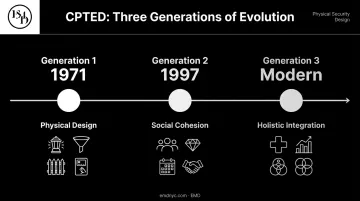
Modern security planning draws from all three generations, because no single layer works in isolation. A well-lit entrance matters less if the surrounding community has no investment in the space — physical measures and social conditions work together, not separately.
The evidence base is substantial. A peer-reviewed review published by Casteel and Peek-Asa in the American Journal of Preventive Medicine found multi-component CPTED programs reduced robbery rates by 30% to 84% across studied sites. Those are measured outcomes from implemented programs, not modeled estimates.
The 5 Core CPTED Principles
No single principle does the work alone. These five function as an interconnected system, and a gap in any one of them weakens the rest.
Natural Surveillance
The goal is simple: would-be offenders should perceive a high likelihood of being seen. Jane Jacobs called it "eyes on the street." CPTED formalizes it into design decisions:
- Unobstructed sightlines across entries, parking areas, and gathering spaces
- Lighting that illuminates faces at distance without creating glare-induced blind spots
- Window placement overlooking entryways and public zones
- Avoiding architectural recesses or pillars where someone can stand unseen
Natural Access Control
This principle uses physical cues to guide legitimate users clearly while signaling to potential offenders that unauthorized access is both visible and risky. Key elements include:
- Defined entrances that channel arrivals through observable paths
- Fencing, landscaping, and signage that distinguish public from restricted zones
- Limiting escape routes — not just limiting entry points
A site that makes unauthorized entry easy to detect but exit easy to execute has only solved half the problem. Access control must work in both directions.
Territorial Reinforcement
Well-defined spaces signal ownership. "Owned" spaces are perceived as watched and defended. Design elements that reinforce territory include:
- Low fencing or hedging that marks boundaries without obstructing visibility
- Distinctive paving or ground-cover transitions between zones
- Murals, signage, and bollards that communicate "this space belongs to someone"
- Lighting and landscaping maintained to a consistent standard
Research on mural placement confirms that colorful murals used as passive thematic prompts reduce graffiti attacks in previously vulnerable areas — a low-cost territorial signal with documented results.
Maintenance
The broken windows connection is direct: a deteriorating environment signals that no one is watching, which signals opportunity. A maintained environment signals the opposite.
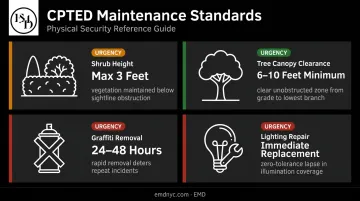
Practical standards are specific: bushes trimmed to no higher than 3 feet, tree canopies raised to at least 6 feet (some jurisdictions require 10 feet), graffiti removed within 24–48 hours, and failed lighting replaced immediately. Damaged fixtures, fencing, and signage should follow a defined repair schedule — not reactive patching.
Activity Support
Legitimate use crowds out criminal opportunity. When a space has regular foot traffic, events, and programming, the window for criminal activity narrows.
A national-scale study published in Science of the Total Environment found that each 1% increase in green space was associated with a 1.2% decrease in violent crime and a 1.3% decrease in property crime. Parks, plazas, and vendor areas that draw consistent foot traffic function as security infrastructure — the presence of legitimate users is itself a deterrent.
CPTED in the Real World: Examples by Environment
Schools and K-12 Campuses
K-12 environments are among the highest-stakes CPTED applications. The design challenges are specific:
- Single-point-of-entry with clear reception sightlines — visitors must pass through an observable vestibule before accessing the building interior
- Low vegetation near windows — dense shrubs under ground-floor windows create concealment for both intruders and unauthorized activity
- Perimeter fencing that defines the campus boundary without creating hiding spots along its length
- Motion-sensor lighting at after-hours access points — stairwells, service entries, and loading areas that are unmonitored overnight
These measures work in combination. A perimeter fence with concealing vegetation along its base undermines the access control it was meant to provide.
One critical timing point: embedding a CPTED review at 30% of project design allows safety features to be built in rather than bolted on. Retrofitting a single-entry configuration into a building designed with multiple access points is expensive and typically yields compromises. Early integration avoids both the cost and the workaround.
Corporate Campuses and Higher Education
Open, multi-building environments create distinct CPTED challenges. The boundary between public-access and restricted zones is often ambiguous — and that ambiguity is exploitable.
Effective design decisions for these environments:
- Wayfinding that channels foot traffic through well-lit, visible corridors — not the most direct route, but the most observable one
- Parking structures with light-colored paint on walls and ceilings (increases ambient illumination), open sightlines between levels, and eliminated stairwell recesses
- Paving transitions, signage, and planters that communicate zone changes without physical barriers
Second-generation CPTED also matters here. Programming public plazas with vendor presence, student events, and community activity creates the social surveillance that physical design alone can't replicate. A busy outdoor lunch area generates consistent foot traffic and informal observation — the same plaza sitting empty provides none of that deterrent value.
Transit Facilities and Public Spaces
Transit stations concentrate strangers in constrained spaces with limited exits and minimal dwell time for staff intervention. The American Public Transportation Association has published specific CPTED guidelines for these facilities, reflecting how deeply the industry has formalized these principles.
Key applications:
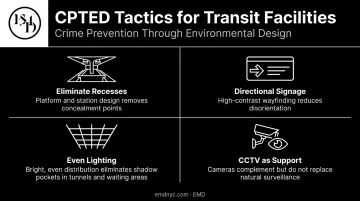
- Platform and station design that eliminates recesses and pillars where offenders can conceal themselves before or during an incident
- High-contrast directional signage that moves people efficiently and reduces the disorientation that makes individuals vulnerable
- Bright, evenly distributed lighting in tunnels and waiting areas — shadow pockets are more dangerous than low overall illumination
- CCTV placement that supports natural surveillance without substituting for it — cameras don't prevent incidents; they record them
Museums, Houses of Worship, and Landmark Sites
Openness is part of the institutional identity here. A museum that feels like a fortress has failed its mission. CPTED addresses this directly — through design that communicates safety without broadcasting defensiveness:
- Single identifiable entry points with clear queuing areas — visitors are guided, not filtered
- Bollards or reinforced planters that prevent vehicle-borne threats without appearing hostile (they read as landscaping, not barriers)
- Public art and landscaping that signal active stewardship — a well-maintained, artistically invested space communicates that it is watched and valued
Territorial reinforcement is especially critical for landmark sites. The symbolic value of the space can itself be a driver of threat. Design that signals active stewardship — maintained grounds, visible activity, clear boundaries — reduces that symbolic vulnerability without restricting public access.
Key Design Tactics That Deliver Results
The 3 L's — Locks, Lighting, and Landscaping — are a useful first diagnostic scanrather than a complete solution. A site with failed exterior lighting, overgrown entry vegetation, and propped-open side doors has already communicated opportunity to anyone observing it. The breakdowns below cover each of the latter two in practical terms.
Lighting Specifics
Effective security lighting means:
- Sufficient illumination to identify a face at 50 feet — a practical threshold for useful natural surveillance
- Even light distribution that eliminates shadow pockets between fixtures
- Motion-sensor and timer-based systems for after-hours zones — these signal activity even when no one is present, and remove the on/off pattern that static lighting makes easy to anticipate
Landscaping as Security Infrastructure
Landscaping choices either support or undermine every other CPTED measure:
- Prickly defensive vegetation (hawthorn, pyracantha) planted under ground-floor windows — an intruder deterrent that costs less than a camera and requires no maintenance beyond seasonal trimming
- Vines on graffiti-prone walls — climbing plants eliminate flat taggable surfaces and signal investment in the space
- Clear entry zones — no dense overgrowth within 10 feet of a building entrance
Each of these choices is low-cost at implementation and compounds in value over time — making landscaping one of the more underused tools in a CPTED assessment.
Common CPTED Mistakes to Avoid
Three patterns appear repeatedly in underperforming CPTED implementations:
Security theater: Visible cameras, imposing fencing, and branded security signage that don't address actual sightline gaps or access vulnerabilities. These installations create a false sense of protection for occupants while doing nothing to deter an observant offender.
Single-principle overreliance: Installing extensive lighting while leaving landscaping overgrowth untouched, or implementing access control that undermines the natural surveillance it depends on. CPTED principles form a system — optimizing one element while ignoring another tends to create new vulnerabilities at exactly that interface.
Late-stage implementation — attempting a CPTED retrofit after construction is complete. The City of Tacoma's permitting guidelines specifically recommend CPTED review at 30% of project planning, with follow-up reviews as design develops. Waiting until a building is occupied means working around decisions that should have been made in the design phase — at far greater cost.
How a Professional CPTED Assessment Makes the Difference
A self-administered checklist identifies obvious problems. A professional assessment identifies the interactions between problems — the way a landscaping gap compounds a lighting gap, or the way an access control configuration inadvertently reduces natural surveillance in a high-risk zone.
EMD's CPTED assessments apply all four core principles systematically across every relevant site zone:
- Site perimeter and boundary conditions
- Building entries and vestibules
- Parking and drop-off areas
- Landscape and lighting conditions
- Signage and wayfinding
- After-hours access points
The methodology pairs AI-driven environmental analysis with field-based security expertise — a combination that surfaces pattern-level vulnerabilities that visual walkthroughs miss in complex, multi-building environments.
For schools, transit authorities, and nonprofit institutions, there's a practical funding dimension as well. EMD's CPTED assessment findings map directly to the physical security enhancements eligible for funding under:
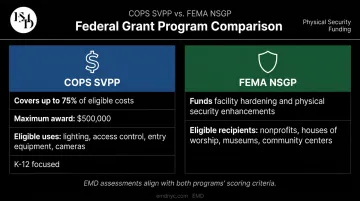
- COPS SVPP — covers up to 75% of eligible costs (max $500,000) for K-12 security improvements including lighting, access control, entry-control equipment, and security cameras
- FEMA NSGP — funds facility hardening and physical security enhancements for nonprofit organizations including houses of worship, museums, and community centers
EMD's assessments are structured to support grant applications — the vulnerability findings, threat narrative, and prioritized recommendations align directly with NSGP and SVPP scoring criteria. For institutions pursuing federal funding, that means one engagement covers both the security need and the application requirement, without hiring a separate grant consultant to reconstruct findings after the fact.
Frequently Asked Questions
What are the 5 principles of CPTED?
The five principles are natural surveillance, natural access control, territorial reinforcement, maintenance, and activity support. They work as an integrated system: each principle reinforces the others, and gaps in one tend to undermine the rest.
How effective is CPTED at reducing crime?
Research shows well-implemented CPTED programs can reduce crime and calls for service by more than 60%, with robbery reductions ranging from 30% to 84% in peer-reviewed studies. Effectiveness depends on applying all principles holistically and maintaining the environment consistently over time.
What is the difference between first-generation and second-generation CPTED?
First-generation CPTED focuses on physical design — lighting, sightlines, fencing, and access control. Second-generation, introduced in 1997, expands to social factors: community cohesion, programming, and neighborhood culture. Modern practice draws from both.
Can CPTED be applied to existing buildings, or only new construction?
CPTED principles can be retrofitted into existing environments. Early integration during the design phase is more cost-effective, but a professional assessment of an existing site will identify the highest-impact improvements available within current constraints.
What types of properties benefit most from a CPTED assessment?
Any property accessible to the public — schools, campuses, transit facilities, museums, houses of worship, corporate campuses, and landmark sites — benefits from CPTED assessment. The greatest gains come where open access and security must be balanced without one compromising the other.