Introduction
Schools, transit systems, museums, houses of worship, and nonprofits collectively depend on billions in federal awards each year — and the numbers reflect it. According to CRS and OMB budget data, federal grant outlays to state and local governments reached approximately $1.1 trillion in FY 2023, funding everything from school safety upgrades to transit infrastructure to community programming.
Receiving a grant, however, triggers far more than a funding deposit. It activates a full set of compliance obligations — reporting requirements, procurement rules, cost documentation standards, audit exposure — that organizations must manage throughout the entire award period and beyond.
The consequences of getting it wrong are serious. Under 2 CFR 200.339, noncompliance can trigger withheld payments, disallowed costs, award suspension or termination, and debarment proceedings — jeopardizing not just the current award, but future funding eligibility.
This guide covers the regulatory framework, core compliance areas, essential procedures, and how to build internal policies that protect your organization from application through closeout.
Key Takeaways
- Federal grants management spans five stages — pre-award, application, award, post-award, and closeout — each with its own compliance requirements
- 2 CFR Part 200 (Uniform Guidance) is the baseline compliance framework for all federal recipients, updated October 1, 2024
- The single audit threshold is now $1 million in annual federal expenditures (raised from $750,000 in 2024)
- Written internal controls aren't optional — they're required by 2 CFR 200.303 and evaluated during audits
- Clean audit records and consistent documentation directly strengthen your eligibility for future award cycles
What Is Federal Grants Management?
Federal grants management is the structured process of overseeing a federal award from pre-application planning through final closeout — ensuring funds are used for their intended purpose in compliance with all applicable requirements.
It's an ongoing operational discipline — not a one-time review — that runs across finance, procurement, program delivery, legal, and leadership at the same time.
The Federal Grant Lifecycle
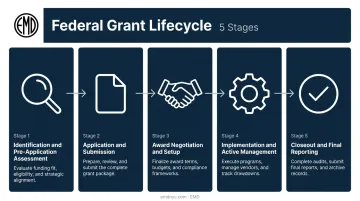
Grants.gov organizes the lifecycle into three broad phases — Pre-Award, Award, and Post-Award — but operationally, recipients work through five distinct stages:
- Identification and pre-application assessment — Evaluating fit, eligibility, and organizational capacity before committing resources
- Application and submission — Preparing competitive, compliant application packages
- Award negotiation and setup — Reviewing the Notice of Award, accepting terms, and establishing grant-specific systems
- Implementation and active management — Executing the funded project while meeting all financial and performance reporting requirements
- Closeout and final reporting — Submitting final reports, reconciling expenditures, and archiving required documentation
Understanding where your organization sits in that lifecycle starts with one foundational distinction.
Grantees vs. Subrecipients
Under 2 CFR 200.1, a recipient receives a federal award directly from a federal agency. A subrecipient receives funds passed through from a primary recipient to carry out part of the federal program.
Both carry compliance obligations — but the grantee remains responsible for monitoring subrecipient performance. That monitoring responsibility doesn't transfer just because funds flow downstream.
The Regulatory Framework: Policies and Guidelines That Govern Federal Grants
Federal grant policy operates on a three-tier hierarchy:
- Authorizing legislation passed by Congress — sets program priorities, eligible uses, and restrictions. Takes precedence over all other guidance
- OMB executive guidance — translates legislation into administrative rules applicable across agencies
- Agency-specific policies and award terms — apply additional requirements to individual recipients based on program rules or risk assessments
Every grant recipient operates within all three layers simultaneously.
Understanding 2 CFR Part 200
2 CFR Part 200, the Uniform Guidance, is the cornerstone compliance document for federal award recipients. Formally titled "Uniform Administrative Requirements, Cost Principles, and Audit Requirements for Federal Awards," it was revised and expanded by OMB's 2024 final rule, published April 22, 2024, with a government-wide effective date of October 1, 2024.
It applies regardless of which agency issued the award, unless program-specific legislation supersedes it. Anyone managing a federal award needs to know it.
Key Legislation Shaping Federal Grant Policy
Several landmark laws shaped today's policy landscape:
| Law | Year | Significance |
|---|---|---|
| Federal Grant and Cooperative Agreement Act (P.L. 95-224) | 1977 | Distinguished grants from contracts |
| Single Audit Act Amendments (P.L. 104-156) | 1996 | Standardized audit requirements for federal recipients |
| FFATA (P.L. 109-282) | 2006 | Required public transparency in federal funding data |
| OMB Uniform Guidance | 2014 (updated 2024) | Consolidated administrative and cost requirements |
OMB publishes regulatory updates in the Federal Register on a rolling basis. The most recent major revision took effect October 2024, and a proposed rule was published May 2026.
Reading Your Notice of Award
Beyond the CFR, each award comes with a Notice of Award (NOA) containing terms and conditions specific to your organization. These may include special conditions based on risk assessments, approved waivers, or program-specific rules.
Read the NOA before expending a single dollar. Common add-on requirements include:
- Approved budget restrictions or re-budgeting thresholds
- Prior-approval requirements for specific cost categories
- Domestic sourcing mandates (such as BABA, described below)
- Reporting timelines beyond standard federal requirements
Grants under the Infrastructure Investment and Jobs Act (IIJA), for example, trigger Build America, Buy America (BABA) requirements, codified at 2 CFR Part 184, mandating domestic sourcing preferences for infrastructure materials. Not every grant activates BABA, but when it applies, it adds procurement obligations on top of standard Uniform Guidance requirements.
Key Compliance Areas for Federal Grant Recipients
Federal agencies evaluate compliance continuously — throughout the award period, at reporting milestones, and during audits. Understanding these areas before a problem surfaces is what separates recipients who close out cleanly from those who face findings.
Internal Controls
Internal controls are the foundation. Under 2 CFR 200.303, recipients must establish, document, and maintain effective controls over federal awards. Controls should align with the GAO Green Book (GAO-14-704G, updated 2025 as GAO-25-107721) or COSO's Internal Control–Integrated Framework.
Written controls are a regulatory requirement. Missing or undocumented controls are among the most common audit findings for first-time recipients.
Strong internal controls include:
- Written policies and procedures with clear approval authorities
- Defined oversight channels and segregation of duties
- Documented processes for detecting and responding to fraud risk
- Regular staff training on compliance responsibilities
Procurement Standards
Federal procurement rules require documented policies organized by dollar threshold, open competition, and conflict-of-interest protections. Evaluating contractor performance history and compliance track record is expected — and all applicable grant terms must flow down into resulting contracts.
Key procurement requirements include:
- Written procurement policies organized by dollar threshold
- Open and free competition for all applicable purchases
- Documented conflict-of-interest disclosures for staff involved in vendor selection
- Evaluation of contractor performance history and compliance track record
- Flow-down of all applicable grant terms into resulting contracts
Cost Allowability
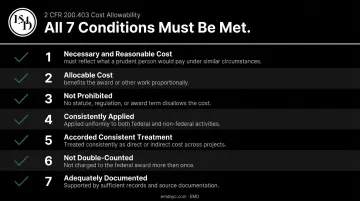
Under 2 CFR 200.403, a cost must meet all seven conditions to be allowable:
- Necessary and reasonable for performance of the federal award
- Allocable under the applicable cost principles
- Not prohibited by law or the award terms
- Consistent with policies applied uniformly to all activities
- Accorded consistent treatment
- Not double-counted with another federal award
- Adequately documented
Stay within your approved budget. Seek prior written approval from the program office before any deviations — retroactive approval is rarely granted.
Financial Accounting and Reporting
Recipients must maintain an accounting system that:
- Tracks federal expenditures separately by grant and by budget category
- Prevents cost overlap between awards
- Aligns time-and-effort records with salary charges
- Produces compliant financial reports on schedule
Build monthly reconciliations into your process — discrepancies caught internally are far easier to resolve than those surfaced during an audit.
Performance Reporting and Record Retention
Beyond financial reports, recipients must collect and submit performance data tied to program objectives on schedule.
Record retention: Under 2 CFR 200.334, records must be retained for three years from the date of the final financial report submission — longer if audits, litigation, or unresolved findings are ongoing.
Key categories to retain:
- Award documents and NOA
- Procurement files and contractor evaluations
- Expenditure records and invoices
- Time and attendance documentation
- Subaward documents
- Audit findings and corrective action plans
Single Audit Threshold
As of October 1, 2024, non-federal entities that expend $1,000,000 or more in federal awards during a fiscal year must undergo a single audit or program-specific audit. The 2024 Uniform Guidance revision raised this from the previous $750,000 threshold. If your organization is approaching that threshold, begin preparing your audit-ready documentation before year-end — not after.
Core Procedures for Managing Federal Grants Effectively
Sound grant policies only hold up when the operational procedures behind them are consistent and well-defined. Below are the core procedural steps organizations need to embed at every stage of the grant lifecycle.
Pre-Award Procedures
Before submitting an application, three actions are non-negotiable:
- Strategic alignment review — Confirm the grant supports organizational mission and core priorities, not just available funding
- Multi-year cost/benefit analysis — Account for matching fund requirements, overhead, audit costs, and post-grant commitments before committing
- Cross-departmental coordination — Loop in finance, operations, and legal early to surface cash flow, procurement, and compliance implications
Organizations that skip pre-award due diligence often discover mid-implementation that the award costs more to manage than it delivers.
Post-Award Setup
The first 60–90 days after award are critical. Use them to lay the administrative groundwork that prevents problems downstream:
- Review all award documents and flag any special conditions requiring immediate action
- Establish grant-specific accounts in the financial system
- Build a reporting calendar with every deadline marked
- Assign clear roles — financial management vs. program implementation are separate responsibilities
- Create a data collection plan for required performance metrics
Active Monitoring and Progress Reviews
With the foundation in place, regular internal check-ins are what keep compliance intact through implementation:
- Reconcile expenditures against approved budget categories every month
- Review progress against the approved work plan and performance targets on a scheduled basis
- Apply risk-based subrecipient monitoring, including progress reports and site visits where warranted
- Establish a clear internal escalation path so compliance risks get flagged before they reach a federal reviewer
A 2024 GAO analysis of 3,680 single audit findings from 2022–2024 found that subaward oversight weaknesses were a significant source of findings. For organizations managing pass-through funds, that means documented monitoring procedures and written records of every subrecipient interaction.

Grant Closeout
Closeout is not just paperwork — it's your final compliance statement. Requirements include:
- Submitting final financial and performance reports within the required timeframe
- Reconciling all expenditures and addressing any outstanding obligations
- Handling property disposition requirements for equipment purchased with federal funds
- Archiving all required documentation per retention schedules
- Conducting a post-award review to capture lessons learned for future cycles
Building Your Organization's Grant Management Policies
The Government Finance Officers Association (GFOA) recommends that all organizations receiving grants develop a formal written grants policy — covering both pre-application decision-making and post-award procedures.
A solid grants policy should cover five core areas:
- Grant identification and application protocols — establishes who has authority to pursue grants and what approval steps are required
- Strategic alignment requirements — defines how to evaluate whether a grant advances your mission before committing resources to apply
- Funding analysis procedures — outlines how to calculate true cost, including match obligations and administrative burden, before applying
- Renewal and continuation evaluation criteria — sets the performance and capacity thresholds that determine whether re-applying makes sense
- Administrative and operational support standards — specifies the staffing, systems, and internal controls needed before accepting an award
Why Written Policies Matter
A written policy does more than create organizational order. It:
- Gives staff clear procedural guidance, reducing inconsistency across programs
- Shows auditors your organization takes compliance seriously — a tangible signal that reduces audit risk
- Accelerates onboarding for new personnel managing funded programs
- Provides documented evidence of internal controls as required by 2 CFR 200.303
Documented controls are both a regulatory requirement and your strongest defense when findings are questioned.
Keeping Policies Current
A grants policy is a living document. Federal regulations evolve — the 2024 Uniform Guidance revision changed audit thresholds, updated definitions, and clarified allowability standards. New awards introduce new terms, and your organization's capacity to administer them shifts over time.
Review and update your policy at least annually, and whenever a significant new award is received or a major regulatory change is published in the Federal Register. Treating the policy as a reference document — not a one-time filing — is what separates organizations that consistently pass audits from those that don't.
How a Grant Management Partner Strengthens Your Funding Strategy
For mission-driven institutions — schools, houses of worship, museums, transit authorities, nonprofits — federal compliance can strain internal capacity fast. Most don't have dedicated grants management staff, and the learning curve for each new award is steep.
EMD is a physical security consulting firm that works specifically with these sectors to secure and manage federal and state security funding. The firm has executed grants across 14 states — including Illinois, California, New York, Florida, Georgia, Virginia, Hawaii, and Ohio — helping clients navigate FEMA's Nonprofit Security Grant Program (NSGP) and the DOJ COPS School Violence Prevention Program (SVPP) from application through final closeout.
EMD's post-award process covers the full compliance lifecycle:
- Reviewing award documents and identifying special conditions
- Preparing and submitting Environmental and Historic Preservation (EHP) documentation — mandatory for federally-funded physical security projects
- Managing procurement workflows, vendor qualification, and contractor oversight
- Handling drawdown and reimbursement management (timelines vary by state)
- Delivering regular status updates and post-phase summaries to boards and leadership
- Managing final closeout reporting

Each of these steps connects directly to funding outcomes. EMD pairs AI-driven security analysis with hands-on grant administration to help clients align documented vulnerabilities with program priorities and build the compliance record that reviewers look for during risk assessments.
Organizations with clean audit histories, on-time reporting, and strong documentation consistently see better results when competing for new awards — and that track record starts at implementation, not closeout.
Frequently Asked Questions
What is 2 CFR Part 200 and why does it matter for federal grant recipients?
2 CFR Part 200, the Uniform Guidance, is the primary OMB regulatory document establishing administrative requirements, cost principles, and audit standards for all federal award recipients. It applies regardless of which agency issued your award, making it the baseline compliance reference every grant manager needs — the most recent major revision took effect October 1, 2024.
What are the most common reasons federal grants are penalized or revoked?
The most frequent compliance failures include unallowable or inadequately documented costs, procurement violations, missed reporting deadlines, and weak or undocumented internal controls. Under 2 CFR 200.339, any of these can trigger withheld payments, cost disallowance, award termination, or debarment proceedings.
When is a single audit required for federal grant recipients?
Under 2 CFR 200.501, non-federal entities that expend $1,000,000 or more in federal awards during a fiscal year must have a single audit. The threshold was raised from $750,000 as part of the 2024 Uniform Guidance revision, effective October 1, 2024. Maintaining strong records and internal controls throughout the award period is the most effective preparation.
How long must federal grant records be retained after award closeout?
The standard retention period is three years from the date of submission of the final financial report. Records must be kept longer if litigation, claims, or audits are initiated before that period expires. Retention extends until all findings are resolved and final action is taken.
What is the difference between a subrecipient and a contractor in federal grants?
Subrecipients carry out part of the federal program and are subject to many of the same compliance obligations as the primary recipient. Contractors provide goods or services through normal business operations and are governed primarily by contract terms. The primary recipient is responsible for monitoring both, though subrecipient oversight requirements are significantly more extensive.
Can federal grant funds be used for security infrastructure upgrades?
Yes. FEMA's Nonprofit Security Grant Program covers facility hardening for eligible nonprofits; the DOJ COPS School Violence Prevention Program funds safety measures for K-12 schools. In both cases, funds must be used within the approved scope and eligible cost categories defined in the Notice of Funding Opportunity and award agreement.