This guide is written for nonprofit leaders, administrators, and mission-driven organizations—including K-12 schools, museums, houses of worship, transit authorities, and historical landmarks—who want a clear roadmap for finding, applying for, and sustaining funding.
We'll cover the major funding sources available, how to build a focused strategy, grant writing essentials, donor cultivation, and the compliance requirements you can't afford to miss.
Key Takeaways
- The U.S. nonprofit sector is crowded: over 1.9 million registered nonprofits compete for the same funding pools
- Individual donors contributed $392.45 billion in 2024, making them the largest funding source — though government grants offer the biggest single-award opportunities
- Master 1–2 revenue channels for sustainable funding rather than chasing every source at once
- Security-focused nonprofits can access federal grants like the DHS Nonprofit Security Grant Program (NSGP), which funded $274.5 million in FY2025
- Expect grant timelines of a few weeks for crowdfunding up to 3–12 months for foundations and federal awards
Why Nonprofits Struggle to Secure Consistent Funding
Available funding isn't the problem. U.S. charitable giving reached $592.50 billion in 2024, a record high. Most nonprofits that struggle to secure consistent funding share one root cause: no clear strategy for pursuing it.
Many nonprofits chase every opportunity that surfaces — submitting grant applications broadly, reaching out to donors inconsistently, and never building real depth in any single funding channel. The effort is real; the return rarely is.
The Competition Problem
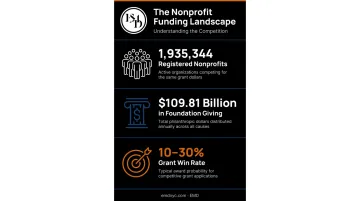
Candid reports 1,935,344 registered nonprofits in the United States as of 2023. Every one of them is competing for grant dollars, donor attention, and corporate partnerships.
The numbers make the challenge clear:
- Over 1.5 million organizations hold 501(c)(3) status with the IRS
- Foundation giving totaled $109.81 billion in 2024—substantial, but divided across millions of organizations
- Grant win rates typically fall between 10% and 30%, depending on the program
Barriers Specific to Smaller Organizations
That competition hits smaller organizations hardest. Smaller nonprofits — and specialized ones like K-12 schools or houses of worship applying for grants for the first time — face layered challenges that larger, well-staffed organizations can absorb more easily. Candid's 2026 research found that 57.1% of nonprofits that didn't apply for foundation grants cited lack of internal capacity, while 37.4% simply didn't know how to apply.
Common barriers include:
- No dedicated development staff or grants manager, leaving applications to already-stretched program teams
- Incomplete financial documentation (missing audits, outdated 990s) that disqualifies otherwise strong proposals
- Proposals that don't align with funder priorities because research was skipped or rushed
- Unfamiliarity with federal compliance requirements like SAM.gov registration
The Major Sources of Nonprofit Funding
Government and Federal Grants
Federal and state grants offer some of the largest awards available to nonprofits. Eligibility typically requires 501(c)(3) status and registration on platforms like SAM.gov and Grants.gov. Competition is significant, but award amounts can fund major programs or capital improvements that individual donors rarely cover.
One program worth knowing: The DHS Nonprofit Security Grant Program (NSGP) provides dedicated security funding for nonprofits at elevated risk of terrorist or extremist attack. FEMA allocated $274.5 million for FY2025, split evenly between urban area and state tracks.
Eligible organizations include:
- Houses of worship (synagogues, churches, mosques, temples)
- Museums and cultural institutions
- Community centers and social services agencies
- Private K-12 schools with 501(c)(3) status
- Advocacy organizations and ethnic-community institutions
NSGP funds physical security improvements: access control, surveillance systems, perimeter hardening, ballistic protection, intrusion detection, and emergency communications. Applications flow through each state's homeland security agency, which sets local deadlines before submitting to FEMA.
EMD's NSGP application process covers every stage: onboarding call, intake session, physical vulnerability assessment, threat narrative development, and full application package preparation. EMD has helped clients secure consecutive NSGP awards across states including Hawaii, Illinois, California, New York, Florida, and Virginia.
One client received two back-to-back awards that funded surveillance systems, upgraded access control software, panic buttons, reinforced doors, and active shooter training.
For K-12 schools, the COPS School Violence Prevention Program (SVPP) offers up to $500,000 per applicant for evidence-based school safety measures. EMD handles SVPP applications and state-level school safety grants using the same structured approach.
Private Foundation Grants
Foundations gave $109.81 billion in 2024, according to Giving USA 2025. That pool spans family foundations, community foundations, and corporate foundations, each with distinct priorities and processes.
A few practical realities:
- Foundations typically require relationship-building before they fund; cold applications rarely succeed
- Smaller family foundations are often overlooked but more accessible than large national ones
- Community foundations, with more than 900 operating across every U.S. state, often fund local programs that larger foundations ignore
Research foundation giving histories before applying. Foundation Directory (Candid) and ProPublica's Nonprofit Explorer both provide access to IRS Form 990 data, which shows exactly what each foundation has funded and at what amounts. Use this to identify funders who have already given to organizations like yours—they're far more likely to say yes.
Individual Donations, Corporate Sponsorships, and Emerging Sources
Individual giving dwarfs every other source. Giving USA 2025 reports individuals gave $392.45 billion in 2024—roughly two-thirds of all U.S. charitable giving.
Strategies to build a recurring donor base:
- Online donation pages with a default recurring-gift option
- Peer-to-peer fundraising campaigns (the top 30 U.S. programs raised $1.17 billion in 2024)
- Text-to-give campaigns for events and emergency appeals
- Email newsletters with concrete impact data
Supplementary revenue streams to consider:
- Corporate sponsorships tied to CSR initiatives
- Membership programs with tiered benefits
- Crowdfunding for specific projects
- Earned income from mission-related services or products
A diversified mix—where no single source exceeds 40-50% of total revenue—gives nonprofits the flexibility to absorb funding gaps without pausing programs.
How to Build a Sustainable Funding Strategy
Start with a Revenue Audit
Before pursuing new funding, analyze what you already have. Look back 3–5 years and answer:
- Which funding sources are growing? Which are shrinking?
- What percentage of revenue comes from your top one or two funders?
- Which channels are consuming the most staff time relative to return?
This audit often reveals uncomfortable concentration—and points clearly toward where to focus.
Concentrate, Don't Diversify (At Least at First)
This runs counter to conventional wisdom, but the data is clear. A 2024 SSIR/Bridgespan study of 297 nonprofits with over $50 million in annual revenue found that more than 90% raised the bulk of their funding from a single revenue category, with that category averaging 90% of total revenue. For smaller and midsize nonprofits, 74% raised at least half of revenue from one category.
The implication: organizations that go deep on one or two funding channels build stronger funder relationships and more capable internal teams than those spreading effort across six categories. Aim for one primary channel (70–90% of revenue) and one secondary channel (10–20%).
Match Your Strategy to Funder Motivations
Each funder category has specific motivations. A government agency funds programs that advance policy priorities. A foundation funds issues aligned with its mission. A corporation funds nonprofits that reinforce its brand and engage its employees.
Before applying or asking, understand why this particular funder would care about your organization. Then frame your mission, data, and outcomes in terms that connect directly to what they're trying to accomplish—not just what you need.
Build Internal Capacity to Execute
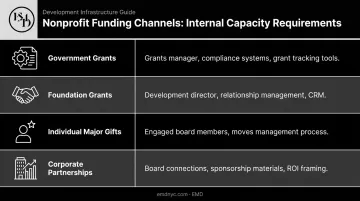
Strategy without execution capacity fails. The internal infrastructure you need depends on your primary funding channel:
| Funding Channel | Key Internal Need |
|---|---|
| Government grants | Grants manager, compliance systems, grant tracking tools |
| Foundation grants | Development director, relationship management, CRM |
| Individual major gifts | Engaged board members, moves management process |
| Corporate partnerships | Board connections, sponsorship materials, ROI framing |
Plan for an 18-24 Month Runway
Funding strategies take time. Most organizations won't see consistent results in the first year. Set early indicators to track progress—number of funder conversations initiated, pilot applications submitted, new donor relationships established—rather than measuring only by dollars raised in the first 12 months.
For nonprofits pursuing complex federal grants like NSGP, working with a consultant who understands both the security requirements and federal compliance framework can improve outcomes. These grant cycles typically span 12–18 months from application through close-out, so factor that timeline into your planning from the start.
How to Write a Winning Grant Proposal
Know the Anatomy of a Strong Proposal
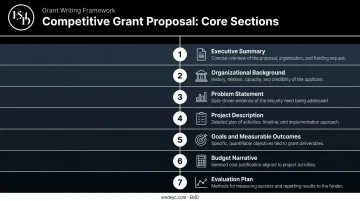
Every competitive grant proposal includes these core sections:
- Executive summary — 1-2 paragraphs capturing the request, amount, and expected impact
- Organizational background — Credentials, mission, and track record
- Problem statement — Data-driven description of the need, with human context
- Project description — What you'll do, how, and for whom
- Goals and measurable outcomes — Specific, trackable metrics tied to the funder's priorities
- Budget narrative — Itemized costs with clear justification
- Evaluation plan — How you'll measure and report results
Every section must connect to the funder's stated priorities—not just your organization's needs.
Tailor Every Application
Generic proposals fail. Read the Request for Proposals (RFP) carefully, follow formatting instructions exactly, and mirror the funder's language throughout. If a foundation's guidelines emphasize "community resilience," that phrase should appear naturally in your narrative—because it reflects genuine alignment, not just keyword matching.
For NSGP and SVPP applications specifically, proposal strength depends heavily on the quality of the underlying vulnerability assessment. A rigorous assessment that documents physical infrastructure gaps, operational risks, and threat scenarios gives you the raw material for three sections federal reviewers scrutinize most: the threat narrative, investment justification, and budget rationale. Organizations that invest in a credible assessment before applying consistently produce stronger, more fundable proposals.
Budget and Compliance Basics
Funders scrutinize budgets. Yours should be:
- Grounded in real vendor quotes or documented cost estimates — not rounded approximations
- Explained line by line in the budget narrative, with purpose tied to project goals
- Identical across all sections — discrepancies between the budget table and narrative are an immediate red flag
For federal grants, clean financial records and transparent reporting practices are prerequisites. Federal award noncompliance under 2 CFR 200.339 can result in suspended payments, disallowed costs, or terminated awards—consequences that extend well beyond losing a single grant.
Maintain a Grant Calendar
Track every active and prospective grant by:
- Application deadline
- Reporting due dates
- Renewal cycle
Many foundation renewals are won or lost not by the quality of new proposals, but by whether you delivered on what you promised in the previous grant period. Submitting complete, on-time reports — with measurable outcomes documented — signals the discipline that funders want in a long-term partner.
Cultivating Donors and Corporate Partnerships
Major donors and corporate partners take months or years to develop. The relationship comes first; the ask comes later.
The Moves Management Approach
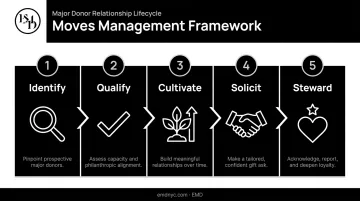
This framework structures donor relationships across five stages:
- Identify — Research prospects based on capacity and alignment
- Qualify — Confirm genuine interest through initial outreach
- Cultivate — Build the relationship through events, site visits, and impact updates
- Solicit — Make the ask at the right moment, after trust is established
- Steward — Maintain the relationship after the gift with recognition and ongoing updates
Skipping cultivation and jumping to solicitation is the most common major-gift mistake.
Digital Tools for Donor Expansion
Consistent digital presence converts passive followers into active donors. What works:
- Instagram and Facebook — Short-form video showing programs in action
- Email newsletters — Monthly or quarterly with specific impact data (not just thank-yous)
- Peer-to-peer campaigns — Turn current donors into fundraisers within their own networks
Board Engagement in Fundraising
A board that doesn't fundraise is passing up one of the most powerful funding channels available. No cold outreach matches the reach of a well-connected board member making a direct introduction to a major gift prospect or corporate partner.
Effective boards treat fundraising as a core responsibility, not an optional add-on. That starts with setting expectations during recruitment. Concrete activities to build into board culture:
- Open doors to major gift prospects through personal introductions
- Host or co-host cultivation events with their own networks
- Participate in corporate partnership conversations as organizational ambassadors
- Follow up with donors they know personally after gifts are received
Staying Legally Compliant as a Fundraising Nonprofit
Federal and State Registration Requirements
501(c)(3) status provides federal tax-exempt recognition — but it doesn't cover state charitable solicitation requirements. The IRS explicitly notes that state statutes usually require organizations to register before soliciting residents for contributions.
Most states have their own registration thresholds, and failing to comply before launching multi-state fundraising campaigns can expose your organization to fines and forced refunds.
Before any broad fundraising push, consult a nonprofit attorney familiar with the states where you'll actively solicit donations.
Consequences of Non-Compliance
Non-compliance isn't just a paperwork problem:
- Loss of donor trust if violations become public
- State-imposed fines and penalties
- Possible suspension of fundraising privileges
- For federal grantees: suspended payments, disallowed costs, or award termination under 2 CFR 200.339
Earned Income and UBIT
Compliance obligations don't end with registration. If your nonprofit earns revenue from products or services, the tax treatment depends on one key distinction:
- Mission-related revenue — tax-exempt
- Unrelated Business Income (UBIT) — taxable, even for nonprofits
As more organizations explore earned income streams — fee-based programs, merchandise, facility rentals — this line gets easier to cross than expected. Before launching any new revenue activity, have a nonprofit tax specialist review whether it triggers UBIT exposure and what documentation you'll need to defend the classification.
Frequently Asked Questions
What is the best way to get funding for a nonprofit?
The most effective approach combines 1-2 focused funding sources—such as government grants and individual donations—with a deliberate strategy and strong execution capacity. Organizations that commit fully to fewer channels consistently outperform those that spread thin across every available opportunity.
Why do nonprofits want $19 a month?
Monthly recurring donations provide predictable, sustainable cash flow that helps fund ongoing operations. Unlike one-time gifts, monthly commitments stabilize revenue between campaigns and allow nonprofits to plan staffing and programming with confidence.
Can a nonprofit apply for government security grants?
Yes. 501(c)(3) nonprofits—including houses of worship, museums, private schools, and community organizations—may qualify for the DHS Nonprofit Security Grant Program (NSGP). Eligibility and award amounts are administered at the state level through each state's homeland security agency.
How long does it take to secure nonprofit funding?
Timelines vary: crowdfunding can generate funds in days, while foundation grants typically take 6–9 months from proposal to check. Federal grants often take longer. Building a sustainable funding strategy generally takes 18–24 months to produce consistent results.
What documents do nonprofits need to apply for grants?
Most grant applications require: 501(c)(3) determination letter, board member list, audited financial statements, organizational budget, IRS Form 990, and project-specific materials such as a logic model or program budget. Federal grants also require SAM.gov registration.
Do small nonprofits qualify for federal grants?
Yes—many federal programs are open to small 501(c)(3) organizations, though eligibility criteria vary by program. Smaller nonprofits should target grants that match their size and mission, and working with a specialized grant consultant can strengthen applications and ease compliance requirements.