Introduction
Winning a grant is a milestone. Closing it out properly is what determines whether you win the next one.
Many organizations — schools, nonprofits, houses of worship, and public institutions — invest months into a successful grant application, then struggle at the finish line. Missed documentation, numbers that don't reconcile, and blown deadlines can turn a successful project into a compliance problem.
According to a GAO audit, more than $794 million in federal grant funds sat in expired accounts more than three months past grant end dates with no activity — a direct reflection of how poorly closeout is managed across the sector.
This guide covers everything you need to close out a federal grant correctly:
- What a grant closeout letter is and why it matters
- The three types you'll encounter
- Every component your letter must include
- A step-by-step writing process
- Ready-to-use templates
- The mistakes most likely to cost you future funding
Key Takeaways
- Closeout letters formally document the end of a grant and protect your organization's compliance record
- All final reports are due within 120 calendar days of the period of performance end date under 2 CFR 200.344
- Every figure in the letter must reconcile exactly with your SF-425
- Grant closeout does not end record retention obligations; federal records must be kept for 3 years from final report submission
- Closeout prep should begin at least 90 days before the period of performance end date
What Is a Grant Closeout Letter (and Why It Matters)?
A grant closeout letter is a formal written document that marks the official end of a grant's period of performance. It can flow in two directions: issued by the funder to confirm the award is administratively and fiscally closed, or submitted by the recipient alongside final reports to summarize outcomes and financial status.
The regulatory baseline is 2 CFR 200.344, which defines closeout as the process by which the federal agency or pass-through entity determines that all required work and administrative actions are complete. The regulation doesn't mandate a document called a "grant closeout letter" by name — but agencies like FEMA formally issue a closeout notice after reviewing and approving final reports, and recipients are generally expected to produce a corresponding summary.
Why This Document Matters Beyond Compliance
Closing a grant doesn't end your obligations. Several responsibilities carry forward even after the award is officially closed:
- Record retention runs 3 years from final report submission. Under 2 CFR 200.334, recipients must retain all federal award records for 3 years from the date of the final financial report submission, not from the date the closeout letter is received. Litigation, audits, or claims can extend that window further.
- Post-closeout adjustments are possible. Funders can still identify disallowed costs and pursue recovery within the retention period.
- Future funding depends on your track record. A clean closeout demonstrates stewardship of public funds and compliance with Uniform Guidance — both of which influence a funder's confidence in awarding future grants to your organization.
For schools, nonprofits, and houses of worship that may lack dedicated grant staff, a well-drafted closeout letter is not a formality. It's a compliance record that protects the organization.
Types of Grant Closeout Letters
Not all grant closeout letters serve the same purpose — and knowing which one your organization needs to produce (versus receive) saves time and prevents compliance missteps. Most organizations encounter one of three types:
| Type | Who Writes It | Purpose |
|---|---|---|
| Funder-to-Recipient Closeout Notice | Granting agency | Confirms the award is administratively and fiscally closed; lists funds disbursed and de-obligated |
| Recipient Closeout Summary Letter | Grantee organization | Submitted with final reports; summarizes accomplishments, expenditures, and compliance |
| Extension Request Letter | Grantee organization | Requests additional time when final reports cannot be completed within 120 days |
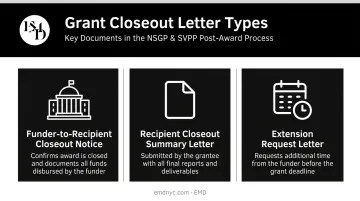
For most grantees, the Recipient Closeout Summary Letter is the primary deliverable — the document your organization produces and submits alongside your SF-425 and final progress report.
The Extension Request Letter becomes necessary when circumstances prevent on-time submission. If you need one, submit it before the deadline expires; after-the-fact requests are rarely accepted.
Agency-Specific Variations
Some federal programs have requirements beyond the standard Uniform Guidance process:
- FEMA NSGP recipients must submit a final Federal Financial Report (FFR), a final Performance Progress Report (PPR), and a closeout BSIR through the FEMA GO portal
- DOJ/COPS SVPP uses the JustGrants system, which sends closeout notifications and manages the resolved-closed status workflow
- HHS/NIH programs may require a Final Invention Statement (Form HHS-568) if the award supported research
Always verify requirements in your Notice of Award before drafting your closeout letter.
Key Components of a Grant Closeout Letter
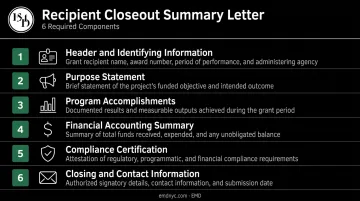
A complete grant closeout letter covers six core components. Miss one — especially the financial reconciliation — and you risk audit flags, delayed fund releases, or a deficiency finding that follows your organization into future award cycles. Here's what every recipient closeout summary letter must include:
1. Header and Identifying Information
The letter opens with:
- Organization's full legal name and address
- Funder's name, office, and contact information
- Grant award number
- Project title
- Period of performance (start and end dates)
- Date of the letter
2. Purpose Statement
Open with a direct statement confirming that the organization has completed the grant-funded project and submitted all required final reports. One or two sentences is enough — this paragraph sets the administrative tone, not the narrative.
3. Summary of Program Accomplishments
This section ties your outcomes directly to the original grant scope. Reference measurable outputs — people served, security systems installed, trainings conducted — drawn from your final progress report. Every figure must be traceable to supporting documentation. Estimated or approximated numbers are not acceptable here.
4. Financial Accounting Summary
Funders scrutinize this section closely, and for good reason — it's the primary paper trail for how public dollars were spent. Include:
- Total funds awarded
- Total funds expended
- Unobligated balance (if any)
- A note on how any remaining balance is being handled — returned to the agency, or retained with written funder approval
These figures must reconcile exactly with your SF-425 Federal Financial Report. Any mismatch between the letter and the SF-425 is a common audit trigger.
5. Compliance Certification Statement
Include a certification confirming that all grant activities were conducted in accordance with:
- The terms and conditions of the award
- Applicable federal regulations
- Uniform Guidance (2 CFR Part 200)
6. Closing and Contact Information
Close with the printed name, title, and wet or electronic signature of the authorized organizational representative, plus a direct phone number and email for follow-up questions from the funder's Grants Management Specialist (GMS) or Grants Management Officer (GMO).
How to Write a Grant Closeout Letter: Step-by-Step
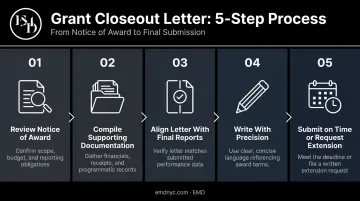
Step 1 — Review the Notice of Award First
Before writing a single word, re-read the NoA in full. Confirm:
- The specific reports required for closeout
- The exact deadline (typically 120 calendar days after the period of performance end date)
- Any agency-specific formatting requirements for the letter itself
Step 2 — Compile Supporting Documentation
Documentation gaps are the most common reason closeout submissions get rejected or flagged. Gather everything before drafting:
- SF-425 (Final Federal Financial Report)
- Final Progress Report
- Equipment inventory for items with a unit acquisition cost of $10,000 or more acquired with grant funds
- Any agency-specific documents required by your NoA (BSIR for NSGP, HHS-568 for NIH research awards)
Step 3 — Align the Letter With Final Reports
Cross-check every figure and claim in the letter against the final reports. Discrepancies between what the closeout letter states and what the SF-425 documents are a direct audit trigger. Verify:
- Dollar amounts match exactly across the letter and SF-425
- Program outcomes in the letter trace back to the final progress report
- Any equipment listed matches the inventory submitted
If the numbers don't align, do not submit until they do.
Step 4 — Write With Precision, Not Length
The closeout letter is an official record. Keep it concise and factual:
- Every dollar amount should be exact
- Every program outcome should be traceable to a specific supporting document
- Avoid vague language like "approximately" or "similar to" — these invite follow-up questions
Step 5 — Submit on Time (or Request an Extension Proactively)
The 120-day deadline under 2 CFR 200.344 is not flexible without an approved extension. If more time is needed:
- Submit the extension request letter before the deadline
- Include a specific reason for the delay
- Provide a realistic, achievable new submission date
- Address the letter to the Grants Management Specialist or GMO named in your award
K-12 schools, houses of worship, and nonprofits managing NSGP or SVPP awards frequently run into timing and documentation challenges at this stage. EMD's post-award administration service supports these organizations through the full closeout process, from SF-425 preparation to final submission coordination.
Grant Closeout Letter Template
Two ready-to-use templates are provided below: one for the standard recipient closeout summary and one for requesting a deadline extension. Customize the bracketed fields for your specific award.
Recipient Closeout Summary Letter Template
[Organization Name] [Organization Address] [City, State, ZIP Code]
[Date]
[Funder Name / Agency Name] [Program Office] [Funder Address]
RE: Final Closeout — [Grant Program Name], Award No. [XXXXXX]
Dear [Grants Management Specialist / Grants Management Officer Name],
On behalf of [Organization Name], I am writing to confirm the successful completion of the grant-funded project under Award No. [XXXXXX], titled [Project Title], with a period of performance from [Start Date] to [End Date]. All required final reports, including the Final Federal Financial Report (SF-425) and Final Progress Report, have been submitted in accordance with the terms and conditions of the award and 2 CFR Part 200.
Program Accomplishments
During the period of performance, [Organization Name] completed the following activities in alignment with the approved scope of work: [describe key activities — e.g., installation of access control systems at X locations, security training conducted for X staff members, perimeter hardening completed at X facilities]. These outcomes are documented in full in the accompanying Final Progress Report.
Financial Summary
| Line Item | Amount |
|---|---|
| Total Funds Awarded | $[XXXXXX] |
| Total Funds Expended | $[XXXXXX] |
| Unobligated Balance | $[XXXXXX] |
This financial summary reconciles with the Final Federal Financial Report (SF-425) submitted on [Date]. [If applicable: The unobligated balance of $[XXXXXX] has been [returned to the agency / retained per written authorization dated [Date]].]
Compliance Certification
[Organization Name] certifies that all activities conducted under this award were in full compliance with the terms and conditions of the award, applicable federal regulations, and Uniform Guidance (2 CFR Part 200). Grant records will be retained for a minimum of three years from the date of final financial report submission, in accordance with 2 CFR 200.334.
Sincerely,
[Authorized Representative's Signature]
[Printed Name] [Title] [Organization Name] [Phone Number] [Email Address]
Extension Request Letter Template
Use this template when final reports cannot be submitted by the 120-day closeout deadline. Unlike the summary letter above, this letter is submitted in advance — always before the original deadline expires — to formally request additional time from the granting agency.
[Organization Name] [Organization Address]
[Date]
[Grants Management Specialist / Grants Management Officer Name] [Agency / Program Office] [Address]
RE: Closeout Extension Request — [Grant Program Name], Award No. [XXXXXX]
Dear [GMS / GMO Name],
[Organization Name] respectfully requests an extension of the closeout deadline for Award No. [XXXXXX], currently due on [Original Deadline Date], pursuant to 2 CFR 200.344.
The following final reports have not yet been completed: [list specific reports — e.g., Final Federal Financial Report (SF-425), Final Progress Report].
The reason for the delay is as follows: [specific explanation — e.g., reconciliation of subrecipient expenditures is pending; final procurement documentation requires additional vendor invoices].
We request an extension to [Proposed New Submission Date], by which point all required closeout documents will be submitted in final form.
Please contact me directly with any questions or to confirm approval of this request.
Sincerely,
[Authorized Representative's Signature] [Printed Name] [Title] [Phone Number] [Email Address]
Common Mistakes to Avoid During Grant Closeout
Mismatched Financial Figures
The most common audit trigger is a discrepancy between the closeout letter and the SF-425. The HHS Payment Management System will reject an FFR submission outright if cash receipts, disbursements, and the federal share of expenditures don't reconcile. Reconcile your accounting records completely before writing the letter — not after.
Starting Too Late
The 120-day window sounds generous. It isn't. Collecting final reports from subrecipients, reconciling all expenditures, completing equipment inventories, and coordinating signature authority takes far longer than most organizations expect. Start closeout preparation at least 90 days before the period of performance end date. Build your timeline backward from the submission deadline, not forward from when you plan to start.
Assuming Closeout Ends All Obligations
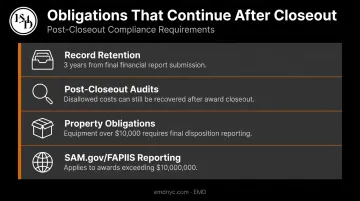
This is a critical misconception. Once a grant is closed:
- Record retention runs 3 years from final financial report submission under 2 CFR 200.334 — longer if litigation or audit activity is pending
- Post-closeout audits can still result in disallowed costs and fund recovery
- Property obligations continue for equipment with a unit cost of $10,000 or more until final disposition is reported
- FAPIIS/SAM.gov reporting applies to organizations with active federal awards exceeding $10,000,000 — large recipients should monitor SAM exposure through and after closeout
The closeout letter should acknowledge these continuing obligations explicitly. Document each obligation with its specific deadline and responsible party so your team has a clear post-closeout compliance calendar from day one.
Frequently Asked Questions
What is a grant closeout?
Grant closeout is the formal process of wrapping up a federal award after the project period ends. It covers final report submission, expenditure reconciliation, property accounting, and official confirmation from the funding agency that the award is closed.
Can you terminate a grant?
Yes. Under 2 CFR 200.340, a grant can be terminated before the period of performance ends — either voluntarily by the recipient or by the funder for non-compliance or changed circumstances. Early termination triggers an accelerated closeout with immediate reporting obligations.
What should be included in a grant closeout letter?
A recipient closeout letter must include:
- Grant identifying information
- Summary of program accomplishments
- Financial accounting statement matching the SF-425
- Compliance certification confirming adherence to award terms and 2 CFR Part 200
- Signature of the authorized organizational representative
When is a grant closeout letter due?
All final closeout documents are generally due within 120 calendar days of the project period end date under 2 CFR 200.344. Individual agencies — and your specific Notice of Award — may impose stricter deadlines, so always verify the exact date for your program.
What happens if you miss the grant closeout deadline?
Missing the deadline without an approved extension can result in non-compliance findings, required repayment of funds, negative reporting to federal integrity systems, and jeopardized eligibility for future awards from that agency. If you cannot meet the deadline, request an extension before it passes.
Do you need to return unused grant funds at closeout?
Any unobligated federal funds remaining at the end of the performance period must generally be returned to the funding agency. Retention is only permitted with specific written authorization from the agency, and the SF-425 and closeout letter must clearly account for any remaining balance.