Introduction: The Tension at the Heart of Every Campus Security Plan
Colleges and universities face a challenge that few other institutions share: they are legally obligated to protect their communities while operating environments specifically designed to feel open, accessible, and free.
That tension has grown sharper as security technology has outpaced the policies governing it. AI-powered cameras, biometric access systems, and real-time behavioral analytics can now track individual movement across an entire campus. Yet research from a 2024 study of U.S. college students found:
- 30% viewed facial recognition in school areas as completely unacceptable
- 72.1% had never been consulted about its use in public spaces
When deployment outpaces consent, even technically sound security programs erode the trust they depend on.
This guide covers a practical framework for campus security systems that are both effective and privacy-respecting. It spans physical design principles, access control, governance, funding, and stakeholder buy-in.
Key Takeaways
- Campus security design is proactive architecture — it determines what systems are needed before a single device is deployed.
- Effective design integrates five layers: environmental design (CPTED), access control, video surveillance, mass notification, and human personnel.
- Privacy-by-design means embedding data minimization, audit controls, and camera placement policies from day one, not retrofitting them after the fact.
- The Clery Act, FERPA, and state biometric privacy laws all shape what can be collected, retained, and shared.
- Federal and state grants (COPS SVPP, state school-safety programs) can fund security upgrades when paired with documented vulnerability assessments.
What Is Campus Security Design?
Campus security design is the structured process of planning integrated safety systems — physical, technological, and human — before procurement begins.
Most institutions manage security reactively: they respond to incidents, patch gaps, and upgrade equipment as budgets allow. Security design starts earlier. It begins with a comprehensive vulnerability assessment, maps threats against existing infrastructure, and produces a prioritized roadmap for how all systems should work together.
Why Campuses Are Uniquely Difficult to Design For
Campuses aren't corporate headquarters or government facilities. They're intentionally open environments with:
- High daily foot traffic from students, faculty, vendors, and visitors
- Rotating populations that change every semester
- Dozens of building types with different access needs (residence halls, labs, libraries, faith spaces, counseling centers)
- A cultural expectation that the campus feels like a community, not a checkpoint
The Clery Act adds another layer of complexity. Institutions must account for on-campus property, non-campus buildings, and adjacent public property — and the Department of Education does not define a measurable distance for "reasonably contiguous geographic area." In practice, that ambiguity means security design must extend beyond the campus map most administrators carry in their heads.
Corporate security frameworks, designed for controlled-access environments, don't translate cleanly to academia. Effective campus security design accounts for open access, evolving threat profiles, and the community expectations that make a campus function — not just a perimeter to harden.
The Core Components of Campus Security Design
Effective campus security design layers physical, electronic, and human systems into a unified whole. Each layer depends on the others — gaps in one can't be fully compensated by strength in another.
Physical Security and Environmental Design (CPTED)
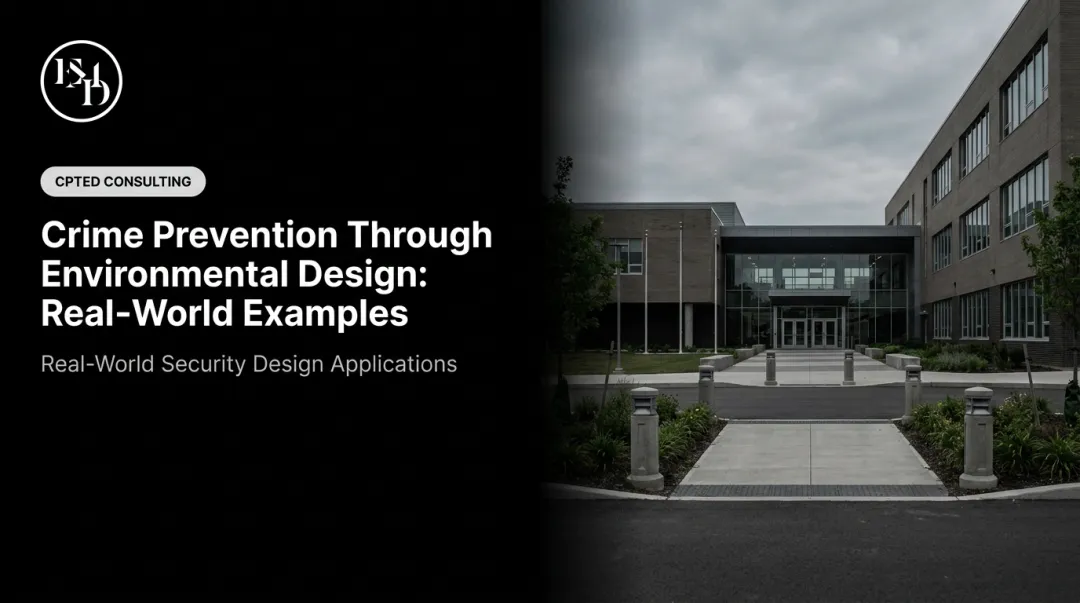
Crime Prevention Through Environmental Design (CPTED) uses spatial layout, lighting, sight lines, landscaping, and access point placement to reduce risk without requiring visible surveillance technology.
ASIS defines CPTED as combining architecture, urban planning, and facility management to discourage criminal behavior and reduce fear of crime. Applied to campuses, the five core principles are:
- Natural surveillance — clear sight lines that eliminate hidden alcoves near residence hall entries
- Natural access control — defined pathways that guide movement and signal boundaries
- Territorial reinforcement — signage, landscaping, and design that communicates ownership
- Maintenance — well-kept environments that signal active stewardship
- Activity support — programming and design that keeps spaces occupied
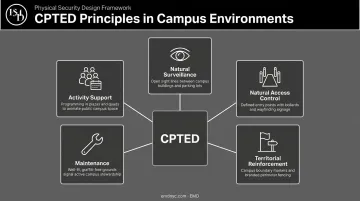
Campus security conversations frequently underweight CPTED relative to technology. It's often the most cost-effective intervention available — and the least privacy-invasive. Starting here, before layering in data-intensive systems, is the right sequencing decision.
Access Control Systems
Modern access control has moved well beyond keycards. Mobile credentials using NFC technology now allow role-based permissions managed from a centralized platform — with remote deactivation when a credential is lost or a student withdraws.
A NACCU survey found 15% of institutions had deployed mobile student IDs as of 2021, and adoption has continued to grow as smartphone penetration among 18-29 year-olds has reached 97%.
The privacy advantage of credential-based systems is significant: the system logs entry events without storing biometric templates. That distinction matters legally in states like Illinois, Texas, and Washington, where biometric identifiers trigger notice, consent, and retention obligations that credential systems avoid entirely.
Access control should be tiered and role-based. Not every person needs access to every space — but authorized movement should feel frictionless, not obstructive.
Video Surveillance and Analytics
The shift from passive CCTV to AI-powered video platforms has changed what campus surveillance can do. Modern systems offer capabilities that passive cameras never could:
- Real-time behavioral analysis and anomaly detection
- Footage search by physical description
- Occupancy monitoring across buildings and zones
- Individual tracking at scale across the full campus
These capabilities deliver genuine security value — and genuine risks. Systems that identify, classify, and track individuals continuously go far beyond what most campus communities have consented to.
The UCLA case is instructive: the university dropped a facial recognition proposal after student backlash, following reports that a test had misidentified 58 faculty members and athletes — most of them people of color. By early 2020, approximately 50 schools had committed not to use facial recognition. A proposal alone was enough to damage institutional trust.
Cameras and analytics require documented purpose, community consultation, bias review, and governance structures — before pilots, not after.
Mass Notification and Emergency Communication
Communication infrastructure is a core design component, not an add-on. The Clery Act distinguishes between emergency notifications (required upon confirmation of an immediate threat) and timely warnings (required for Clery crimes presenting a continuing threat) — and institutions need systems capable of both, across multiple channels.
Adoption is mature but uneven. A 2024 Campus Safety survey found 80% of higher-ed institutions had integrated mass notification technologies to some degree. A 2025 survey found 94% use SMS text alerts and 70% use fixed panic buttons.
The design gap isn't capability — it's integration. Notification systems that operate as standalone platforms, disconnected from access control and video infrastructure, slow response times and break down coordination exactly when coordination matters most.
Human Security Personnel
Security officers on campus are community-facing figures as much as enforcement personnel. Effective design defines their role clearly: access management, behavioral observation, early-warning reporting, and referral to appropriate services.
This is especially relevant for mental health crisis response and Title IX-adjacent situations, where an enforcement-first approach can cause harm. Training requirements and referral protocols must be built into the security design from the outset — not left to individual officer judgment.
Privacy-by-Design: Building Security Systems That Respect Student Rights
The privacy challenge on campus is structural. Students have legal protections under FERPA, a cultural expectation of academic freedom, and a reasonable assumption that they are not under continuous observation.
Institutions carry a legal duty of care and, increasingly, access to tools capable of tracking individual behavior in real time. Those two realities create a tension that good security design must actively manage.
The technologies that create the highest privacy risk are:
- Facial recognition and biometric access systems
- Behavioral analytics software
- Always-on video feeds in or near residential areas
- Aggregated location data from mobile credentials or campus Wi-Fi
Surveillance Creep Is a Real Risk
Systems installed for narrow purposes tend to expand. A parking garage camera network gets extended to walkways. Footage accessed for one incident gets reviewed for unrelated purposes. Analytics configured to flag specific behaviors get applied more broadly over time, often without updated policy or community notification.
This pattern, sometimes called surveillance creep, erodes trust gradually and is difficult to reverse once established.
Privacy-by-Design in Practice
Privacy considerations must be embedded into every design decision from the start — not retrofitted after a system is already live. In practice, this means:
- Collect only what's necessary. Access control logs entry events; it doesn't need to store biometric templates. Limit data at the point of collection, not after the fact.
- Restrict system access by role. Camera feeds, footage retrieval, and access control logs should be available only to staff with a defined operational need — not every administrator by default.
- Log every access event. Record who pulled what data, when, and for what purpose. Audit trails create accountability and give institutions a defensible record when access is questioned.
- Document placement decisions explicitly. Residential areas, counseling centers, medical facilities, and faith spaces require written policy justification — and in most cases, cameras should not be placed there at all.
- Set and publish retention limits. Define how long footage is stored and under what conditions it can be accessed. In some jurisdictions this is a legal requirement; in all cases, a published policy is a baseline community expectation.
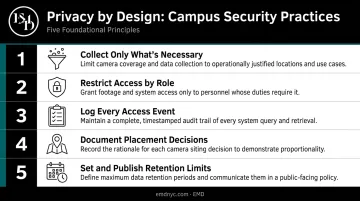
Universities like Princeton, the University of Arizona, and Rice have published formal camera policies that offer practical templates for governance and usage frameworks. EMD's campus security design work integrates this kind of policy architecture alongside technical specifications — because hardware without governance answers only half the question.
Governance, Policy, and Compliance
Three regulatory frameworks shape campus security design in the U.S.:
- The Clery Act requires annual security reports (due October 1), three years of crime statistics, daily crime logs, and emergency notifications and timely warnings under defined triggers. Clery geography — on-campus, non-campus, and adjacent public property — should map directly to camera placement, access control zones, and alert coverage.
- FERPA protects education records but excludes law enforcement unit records created and maintained for law-enforcement purposes. It also allows disclosure of personally identifiable information without consent during genuine health or safety emergencies.
- State biometric privacy laws in Illinois (BIPA), Texas, and Washington impose notice, consent, disclosure, and retention obligations for biometric identifiers. All 50 states introduced AI legislation in 2025 — the regulatory environment is tightening, not stabilizing.
Clery as an Intelligence Tool
Treat Clery compliance as a byproduct of a well-run security program, not its primary goal. The underlying data — incident types, locations, patterns over three years — is a powerful design input. It tells you where vulnerabilities concentrate and where lighting, access control, or CPTED interventions would have the most impact.
Governance Must Precede Deployment
A cross-functional committee should define data access, retention, use, and oversight policies before any technology goes live. At minimum, that group should include:
- Legal and compliance
- IT and facilities
- Student affairs
- Academic leadership
This committee should maintain and update the policy framework continuously, not treat it as a one-time launch deliverable. Retrofitting governance after a system is live is far harder — and it's exactly how surveillance creep starts.
Funding, Phasing, and Cross-Departmental Collaboration
Comprehensive campus security redesign is expensive, and most institutions face tight budgets. Several federal and state mechanisms can help:
- FEMA BRIC (Building Resilient Infrastructure and Communities) — a pre-disaster mitigation grant program for resilience projects
- FEMA HMGP (Hazard Mitigation Grant Program) — post-disaster mitigation funding; FEMA announced more than $492 million in HMGP grants in April 2026
- Department of Education Project SERV — funds education-related recovery services for institutions disrupted by violent or traumatic events
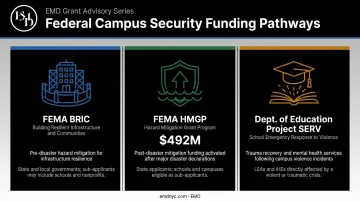
These programs are hazard mitigation and recovery frameworks, not general surveillance funding. The strongest applications are anchored in documented vulnerability assessments that justify specific, phased resilience improvements — which is precisely where EMD's grant navigation work begins. EMD has supported NSGP and SVPP applications across more than a dozen states, helping institutions build the documentation foundation that makes federal and state funding requests competitive.
The Case for Phased Implementation
A full campus security redesign doesn't need to happen at once. A prioritized, phased approach — starting with highest-risk areas identified through a formal vulnerability assessment — lets institutions:
- Demonstrate progress to boards and community stakeholders
- Build institutional knowledge before scaling
- Allow governance policies to keep pace with technology adoption
- Sequence investments to match budget cycles
EMD's vulnerability assessments deliver a prioritized sequencing plan specific to each campus — identifying which areas to address first, in what order, and at what cost — so institutions can move from assessment to implementation without guesswork.
Who Needs to Be in the Room
Campus security design fails when departments operate in silos. Effective design requires active input from:
- Security and public safety
- IT and facilities
- Student affairs and housing
- Legal counsel
- Communications
- Academic leadership
When these groups aren't involved from the start, the result is disconnected systems, inconsistent policies, and slower incident response — problems that surface during an actual event, not during planning.
Frequently Asked Questions
What is campus security design?
Campus security design is the structured, proactive process of planning integrated safety systems — physical, technological, and human — for a campus environment. It happens before deployment to ensure all elements work together and align with both safety goals and community values.
What are the main components of campus security design?
The five core layers are: environmental/physical design (CPTED), access control systems, video surveillance and analytics, mass notification and communication, and trained human security personnel. A well-executed design integrates all five layers, since gaps between systems are where vulnerabilities form.
How does campus security design protect student privacy?
The privacy-by-design approach embeds data minimization, role-based access controls, audit logging, camera placement policies, and transparent community communication into the design from the start. Privacy safeguards are built in, not bolted on afterward.
What regulations govern campus security design in higher education?
The Clery Act (crime reporting and transparency), FERPA (student data privacy), and state biometric privacy laws collectively shape what data can be collected, retained, and shared. These frameworks must be understood before any security system is procured or deployed.
How can institutions fund campus security upgrades?
The Nonprofit Security Grant Program (NSGP), the COPS School Violence Prevention Program (SVPP), and state school-safety grant programs are the primary funding pathways for campus security upgrades. A documented vulnerability assessment strengthens any application by justifying the specific systems and phased scope requested.
What is the difference between campus security design and campus security management?
Design is the upfront planning phase: determining what systems, policies, and physical elements are needed and how they integrate. Management is the ongoing operation, maintenance, and response function that follows. Both are necessary; one does not substitute for the other.