Introduction
School administrators face a familiar bind: after a high-profile incident, boards push for immediate action — better cameras, stronger access control, threat assessment teams — but funding rarely keeps pace with the demand. The question of how to pay for it often goes unanswered.
Here's what most districts don't realize: federal agencies, state programs, and private foundations make hundreds of millions of dollars available annually for K-12 school safety. According to NCES data, 97% of public schools already control building access and require visitor sign-in, yet real security gaps remain — particularly around emergency notification, behavioral threat assessment, and integrated technology. The funding to close those gaps exists.
The FY2025 DOJ K-12-specific programs alone total $156 million — $73M through COPS SVPP and $83M through BJA STOP. Add FEMA's NSGP and Title IV-A formula funding, and the opportunity is substantial. Most districts simply aren't familiar enough with the landscape to act on it.
This guide covers the major federal and state grant programs, what they fund, and how to build an application that competes.
Key Takeaways
- Federal K-12 safety grants total $156M+ annually through COPS SVPP and BJA STOP alone
- Private and faith-based schools can access up to $200,000 per site through FEMA's NSGP
- COPS SVPP covers physical security hardware; BJA STOP covers prevention and training — use both
- Start with a formal site vulnerability assessment — applications built on one consistently outperform those that aren't
- "Grant stacking" (layering multiple funding sources) is legal and the fastest path to a full security upgrade
What Are K-12 School Safety Grants?
School safety grants are monetary awards from government agencies or private organizations given to schools to fund security improvements, training, and prevention programs. Unlike loans, they don't need to be repaid — provided the school maintains compliance with grant terms and spends funds on allowable expenses.
Two primary categories exist:
| Grant Type | How It Works | Example Programs |
|---|---|---|
| Formula-based | Non-competitive; allocated by statutory formula using enrollment or poverty data | Title IV-A (SSAE) |
| Competitive | Application-based; awarded on merit through a review process | COPS SVPP, BJA STOP, FEMA NSGP |
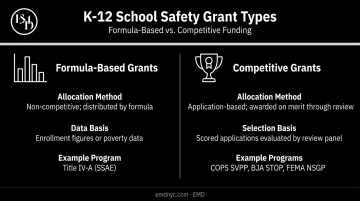
Both types require formal applications and documentation — the distinction is whether you're competing against other applicants or simply meeting eligibility thresholds.
Either way, grant funds are earmarked. Every dollar must align to allowable expense categories spelled out in each program's Notice of Funding Opportunity (NOFO). Start your search with SchoolSafety.gov's Grants Finder Tool, which catalogs active federal opportunities by program type and eligible applicant.
Federal School Safety Grant Programs
The federal government is the largest and most reliable source of school safety funding. Multiple agencies administer distinct programs targeting physical security, violence prevention, and emergency preparedness — often covering different aspects of the same safety challenge.
COPS School Violence Prevention Program (SVPP)
Administered by the U.S. Department of Justice's COPS Office, the SVPP is the primary federal grant for K-12 physical security upgrades.
FY2025 key figures:
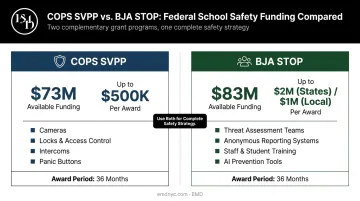
- Total available: up to $73 million
- Maximum per award: $500,000
- Award period: 36 months
- Local match required: 25% (financial hardship waivers available)
Eligible uses include:
- Access control systems, locks, and door hardware
- Metal detectors and lighting improvements
- Emergency notification and panic button technology
- Communication upgrades (intercoms, PA systems, two-way radios)
- Law enforcement training and emergency coordination
Who qualifies: States, units of local government, Indian tribes, school districts, school boards, and law enforcement agencies. Public charter schools may qualify as eligible public agencies under the NOFO.
A comprehensive school safety assessment is required during the grant period — not just before applying. The FY2025 NOFO was released April 24, 2025, with a Grants.gov deadline of June 18, 2025, and a projected project start of October 1, 2025.
BJA STOP School Violence Program
The Bureau of Justice Assistance STOP program focuses on prevention rather than hardware. With $83 million available in FY2025, it funds the human and programmatic side of school safety.
Eligible uses include:
- Behavioral threat assessment and intervention teams
- Anonymous reporting systems (hotlines and apps)
- Training for students and school personnel in violence recognition
- School climate improvement strategies
- AI/predictive analytics tools for threat identification (with civil-liberties safeguards)
What STOP does NOT fund: Target hardening — cameras, locks, fencing, security systems, and armed officer hiring are all explicitly excluded from the FY2025 NOFO.
Award structure:
- Category 1 (States): up to $2 million
- Category 2 (Local agencies, districts, nonprofits): up to $1 million
- Period of performance: 36 months
The FY2025 Grants.gov deadline is October 27, 2025. Schools pursuing both SVPP and STOP can build a more complete safety strategy: physical hardening funded through SVPP, prevention programming funded through STOP.
FEMA Nonprofit Security Grant Program (NSGP)
Private and faith-based K-12 schools classified as 501(c)(3) nonprofits have a dedicated funding pathway through FEMA's NSGP.
FY2025 key figures:
- Total available: $274.5 million (split evenly between NSGP-UA and NSGP-S)
- Maximum per applicant: $200,000 per site, for up to three sites per funding stream
Eligible uses include:
- Reinforced doors, gates, and perimeter fencing
- Alarm systems, locks, and access control equipment
- Camera-based security systems
- Blast-resistant film and lockdown systems
- Active shooter training and emergency response exercises for staff
One procedural point that catches many applicants off guard: NSGP funds flow through State Administrative Agencies (SAAs), so schools apply as subapplicants through their state's designated agency — not directly to FEMA. State deadlines vary and often close weeks before the federal deadline, so confirming your SAA's timeline early is essential.
EMD has helped educational institutions navigate this process successfully — including a charter school in Makawao, Hawaii that secured two consecutive NSGP awards.
Title IV-A and the Stronger Connections Grant Program
Title IV-A (Student Support and Academic Enrichment) is formula-based funding distributed to Local Educational Agencies, making it available to most public school districts without competing against other applicants.
Key requirements:
- Districts receiving more than $30,000 must conduct a formal needs assessment
- At least 20% of funds must address Safe and Healthy Students activities
- Allowable expenses span technology, training, and mental health services
The Stronger Connections Grant Program — created by the Bipartisan Safer Communities Act — adds a competitive layer on top of Title IV-A. It provides a one-time $1 billion subgrant pool for high-need LEAs, available for obligation through September 30, 2026.
Allowable expenses include emergency operations planning, school-based mental health services, threat assessment teams, and certain safety equipment. SEAs determine high-need eligibility based on factors like poverty rates and school violence indicators.
State-Level School Safety Grant Programs
Every state offers its own school safety funding, administered through state education agencies, emergency management offices, or attorney general offices. These programs often complement federal funding with faster application cycles and region-specific priorities.
The SchoolSafety.gov State Search Tool is your starting point for identifying active state programs. Your State Educational Agency (SEA) website will list current opportunities and SAA contacts.
Arizona's Department of Education School Safety Program (SSP) runs on three-year grant cycles, covering SROs, school counselors, social workers, and juvenile probation officers. The program currently reaches:
- Over 1,077 schools across 14 counties
- 369 counselors, 143 social workers, and 247 SROs funded statewide
- LEAs with unfilled positions by December 31, 2026, may propose alternative uses for safety technology, training, or infrastructure improvements
- A separate Nonprofit Security Grant Program provides up to $100,000 per applicant
Other states follow distinct models. Texas ran a $400 million formula-based School Safety Standards Grant from 2022–2025, alongside a dedicated Silent Panic Alert Technology grant. Florida's School Hardening Grant allocates funds to districts for physical security based on needs identified through the Florida Safe Schools Assessment Tool.
These examples illustrate how much grant structures vary — amounts, eligibility, and allowable uses differ by state and school type. Public, private, and charter schools each face different requirements. Register with your SAA to receive timely notifications when each fiscal year's opportunities open.
What Do K-12 School Safety Grants Fund?
Eligible expenses vary by program, but most federal and state grants broadly cover four categories. The strongest applications weave all four together rather than treating them as separate budget lines.
Physical Security Infrastructure
- Access control systems: door locks, intercoms, card readers, entry control equipment
- Surveillance cameras (NSGP and SVPP explicitly cover camera systems)
- Alarm systems, panic buttons, and lockdown systems
- Perimeter lighting improvements and fencing
- Reinforced doors, blast-resistant film, and secure entryway modifications
Grant language typically requires expenses to align with "evidence-based" security measures.
Training and Personnel
- SRO salaries and law enforcement training (SVPP)
- Behavioral threat assessment team development (STOP, Stronger Connections)
- Crisis management and conflict resolution training for staff
- Active shooter response training
- Suicide prevention programs
Technology and Software
- Emergency notification systems
- Visitor management platforms
- Anonymous reporting tools and hotlines
- Two-way communication devices
- AI-assisted threat identification tools (STOP explicitly supports this with civil-liberties safeguards)
One important distinction: STOP does not fund physical security hardware. For cameras, access control equipment, and related infrastructure, SVPP and NSGP are the right programs.
Mental Health and Prevention Programming
Under Stronger Connections and STOP, schools can fund:
- Social-emotional learning curriculum
- School-based mental health professional hiring
- Behavioral intervention systems
- School climate improvement programs
Grant reviewers respond well to proposals that pair physical security with prevention programming. A hardened entry paired with a behavioral threat assessment team and a school counselor hire tells a complete safety story — and that completeness strengthens the application across all four categories.
How to Build a Winning Grant Application
The difference between funded and rejected applications usually comes down to preparation, not writing quality.
Start With a Formal Vulnerability Assessment
Before writing a single word, conduct a site-based risk and vulnerability assessment. This means identifying specific gaps — blind spots in camera coverage, delays in emergency notification, weaknesses in visitor screening — not generic statements like "we need better security."
The assessment becomes the evidentiary backbone of your entire proposal. REMS guidance describes site assessments as examining safety, security, accessibility, and emergency preparedness across the full campus environment, including parking lots, approach pathways, and first responder coordination.
EMD's AI-augmented assessment methodology identifies gaps across physical infrastructure, technology platforms, and operational processes. That specificity is what separates a compelling grant narrative from a generic one.
Assemble Your Team Early
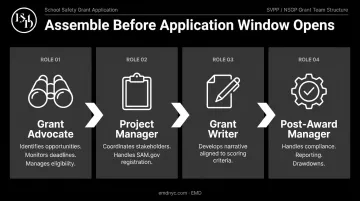
A disorganized or late submission is one of the most common rejection causes. Build your team before the application window opens:
- Grant Advocate — Identifies opportunities, monitors deadlines, manages eligibility
- Project Manager — Coordinates stakeholders, handles SAM.gov registration
- Grant Writer — Develops the narrative aligned to program scoring criteria
- Post-Award Manager — Handles compliance, reporting, and drawdowns
SAM.gov registration can take up to 10 business days — start at least 30 days before your Grants.gov deadline. COPS explicitly recommends this lead time in their FY2025 NOFO guidance, and OJP/BJA advises submitting at least 72 hours early to resolve any technical issues.
Align Your Narrative to Funder Priorities
Different programs score on different criteria:
- SVPP: Physical security upgrades and law enforcement coordination — build the story around specific gaps and hardware solutions
- STOP: Prevention, school climate, and threat assessment — lead with behavioral data and training needs
- NSGP: Facility hardening for at-risk nonprofits — demonstrate why your school faces elevated risk
Every strong narrative follows the same logic chain: identified risk → planned response → technology or training needed → measurable outcomes.
For STOP applications specifically, BJA scores on five dimensions: problem description, project design, capabilities, budget, and data/performance measures. Align your narrative explicitly to each.
Documentation Checklist
Most federal grant applications require:
- Completed site risk and vulnerability assessment
- Detailed budget justifications with cost breakdowns
- Implementation timeline with measurable milestones
- Emergency management plan
- Threat assessment procedures
- Letters of support from law enforcement or community partners
- SAM.gov registration confirmation
Federal applications submit through Grants.gov and typically require prior JustGrants registration for DOJ programs. Submit early — technical issues at submission are common.
EMD provides end-to-end support across this process: from the vulnerability assessment that anchors the application through post-award administration — EHP submissions, procurement, drawdowns, and close-out. Schools stay focused on core decisions while EMD manages the process work on both ends.
Strategies to Maximize Your School Safety Funding
Stack Grants Legally
"Grant stacking" means layering multiple funding sources across a single safety initiative. For example:
- COPS SVPP → physical hardware (cameras, locks, access control)
- BJA STOP → threat assessment teams and anonymous reporting tools
- State competitive grant → technology infrastructure or SRO salaries
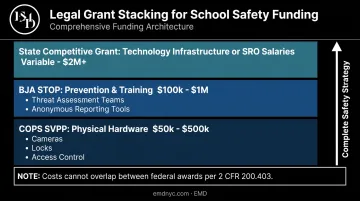
Each application must clearly specify how funds will be used. Under 2 CFR 200.403, costs cannot be included in multiple federal awards for the same expense. The COPS SVPP NOFO also explicitly prohibits using funds for items already covered by another DOJ award. Document delineation clearly in each application narrative.
Map Your Grant Calendar
Federal competitive grants run on varying cycles — plan 6–9 months ahead:
- COPS SVPP: NOFO typically releases in spring (FY2025: April 24), project start in October
- BJA STOP: FY2025 deadline was late October/early November
- FEMA NSGP: State-controlled deadlines through SAAs; check your SAA annually
- Title IV-A: Varies by state LEA process
Begin your needs assessment and law enforcement partnership development before windows open, not after.
Plan for Sustainability
Every competitive application needs a sustainability plan — reviewers will ask what happens when the award period ends. Address this directly in your narrative:
- Identify which funded positions or programs will transition to budget line items
- Reference future grant cycles for recurring costs
- Use purchasing cooperative agreements (such as TIPS, E&I, or OMNIA Partners) for post-grant procurement — these allow compliant security technology purchases without a full RFP process
Frequently Asked Questions
What federal grants do schools get?
K-12 schools can access four primary federal programs:
- COPS SVPP — physical security technology, up to $500,000
- BJA STOP — prevention and training, up to $2 million for state-level applicants
- FEMA NSGP — facility hardening for 501(c)(3) nonprofits, up to $200,000 per site
- Title IV-A / Stronger Connections — formula and competitive funding for safety needs including mental health and technology
What is the school safety grant program in Arizona?
The Arizona Department of Education School Safety Program is a three-year competitive grant funding SROs, counselors, school social workers, and school safety officers across public schools and charters. LEAs with unfilled positions can propose alternative safety technology and infrastructure investments instead. Arizona schools can also layer in the state NSGP (up to $100,000), COPS SVPP, and Stronger Connections.
Can schools apply for multiple school safety grants at the same time?
Yes — schools can and should pursue multiple grants simultaneously from different sources. Each application must clearly delineate how funds will be used to prevent duplication of funding for the same expenses. This approach — known as grant stacking — is how schools fund comprehensive safety overhauls no single grant could cover alone.
What documentation is required for school safety grant applications?
Most applications require:
- Completed site risk and vulnerability assessment
- Detailed budget justifications and implementation timeline
- Emergency management plan and threat assessment procedures
- Letters of support from law enforcement or community partners
Federal applications also require active SAM.gov registration.
What types of security technology do school safety grants typically fund?
Commonly funded technology includes:
- Surveillance cameras and access control systems (door locks, card readers, intercoms)
- Panic buttons, emergency notification systems, and anonymous reporting tools
- Visitor management platforms and two-way communication devices
BJA STOP also supports AI-assisted threat identification tools with appropriate civil-liberties safeguards.
How long does the school safety grant application and approval process take?
Federal application timelines vary by program. COPS SVPP ran roughly five months from NOFO release (April) to project start (October) in FY2025. BJA STOP had a similar window. Schools should begin needs assessments and team assembly 6–9 months before target application deadlines to avoid rushed submissions.