Grant funding represents a significant, underutilized source of financial support. It can cover everything from urgent building repairs and community services to critical security upgrades. This guide breaks down the major grant programs available to places of worship, explains eligibility essentials, and provides practical tips for crafting a successful application.
Key Takeaways
- Places of worship can access grants from federal agencies, private foundations, and community organizations, but eligibility and rules vary widely.
- The FEMA Nonprofit Security Grant Program is one of the largest federal grants available to houses of worship for physical security improvements.
- Private foundations like the Lilly Endowment and Oldham Little Church Foundation focus on congregational development and facility maintenance.
- Successful applications require a clear mission alignment, data on community impact, and strict adherence to funder guidelines.
- Working with an experienced grant consultant can significantly improve your chances of securing complex federal and state funding.
What Are Grants for Places of Worship?
Unlike a loan, a grant is non-repayable funding awarded by a government agency, private foundation, or corporation. These funds support specific projects, programs, or services that align with the funder's mission. For houses of worship, grants fall into two primary categories:
- Faith-Specific Grants: From religious foundations, these funds support congregational development, denominational programs, or pastoral support to strengthen the faith community.
- Community-Benefit Grants: Awarded by government agencies and secular foundations, this funding is for services benefiting the broader public, such as food pantries, childcare, or addiction recovery programs.
Your tax-exempt status is a critical factor. While the IRS automatically considers qualifying houses of worship to be 501(c)(3) tax-exempt, many grantmakers require an official determination letter as proof. Obtaining this letter opens the door to a much wider range of foundation and government grants.
Major Grants for Places of Worship
The grants below were selected based on their funding scope, direct relevance to houses of worship, and documented impact. They represent a mix of federal, private, and community-focused opportunities available to organizations across the US.
FEMA Nonprofit Security Grant Program (NSGP)
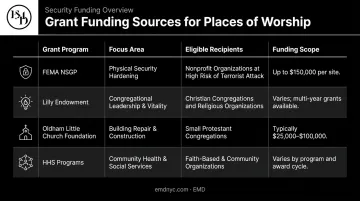
The Nonprofit Security Grant Program (NSGP), administered by the Department of Homeland Security, is a federal program that provides funding to nonprofits—including houses of worship—to harden their physical security against threats of terrorism and targeted violence. For FY 2025, $274.5 million is available through the program.
This is one of the few federal grants explicitly designed to fund security infrastructure for faith-based communities. It can cover access control systems, surveillance cameras, security assessments, and staff training, with awards that can transform a facility’s safety posture.
| Aspect | Details |
|---|---|
| Focus Area | Physical security enhancements: access control, surveillance, perimeter security, and training. |
| Eligible Recipients | 501(c)(3) nonprofit organizations, including churches, mosques, synagogues, and temples. |
| Application Process | Submit applications via State Administrative Agencies (SAAs) after completing a required security assessment. A professional consultant can help ensure a competitive submission. |
| Maximum Request | Up to $200,000 per unique physical site. |
Lilly Endowment
The Lilly Endowment is one of the largest private philanthropic foundations in the US, with a dedicated Religion Division that funds projects related to faith leadership, pastoral health, and congregational vitality. Its programs are competitive but offer high-value awards for projects that demonstrate a transformative impact on congregational health or ministry innovation.
| Aspect | Details |
|---|---|
| Focus Area | Clergy development, congregational renewal, seminary partnerships, and church innovation. |
| Eligible Recipients | Primarily Christian churches and faith-based nonprofits. Check lillyendowment.org for current eligibility. |
| Grant Range | Varies significantly by program. For example, the National Clergy Renewal Program offers grants up to $50,000. |
Oldham Little Church Foundation
This foundation focuses exclusively on the physical infrastructure of small evangelical Christian churches. It provides grants for building repairs, accessibility improvements, and emergency maintenance for congregations with minimal capital budgets. Its narrow focus makes it an excellent fit for smaller churches that might be overlooked by larger foundations.
| Aspect | Details |
|---|---|
| Focus Area | Building repairs, structural maintenance, and accessibility upgrades. |
| Eligible Recipients | Small evangelical Christian churches. Verify specific denomination requirements at oldhamlcf.org. |
| Grant Range | The average grant in 2025 was between $10,000 and $15,000. |
HHS Faith-Based Funding Programs
The U.S. Department of Health and Human Services (HHS) awards grants to faith-based organizations for community-benefit programs like child care, addiction recovery, food assistance, and mental health services. These funds are for secular service programs, not worship activities. HHS maintains a Center for Faith-Based and Neighborhood Partnerships to help connect religious organizations to relevant funding.
| Aspect | Details |
|---|---|
| Focus Area | Child care, substance abuse recovery, nutrition programs, and family services. |
| Eligible Recipients | Faith-based nonprofits and houses of worship that operate qualifying community service programs. |
| Key Requirement | Programs must serve the general public and be secular; religious activities must be separate in time or location from the funded program. |
Local and Regional Community Foundations
Thousands of community foundations across the US—such as The Cleveland Foundation and The Chicago Community Trust—offer grants to nonprofits, including faith-based organizations serving demonstrable community needs. These foundations are often more accessible to smaller congregations than national programs and may have dedicated "Faith-Based" or "Community Impact" grant categories. You can search for foundations serving your area on platforms like Candid.org.
How to Apply: Practical Tips for a Winning Application
Securing a grant requires more than just filling out a form. Funders are looking for partners who are organized, impactful, and aligned with their goals.
Prioritize Mission Alignment
Every grant application must start by demonstrating how your project directly advances the funder's stated priorities. Read their mission statement, review their list of past grantees, and tailor your proposal to their specific interests. Generic proposals that could apply to any organization are consistently rejected.
Quantify Your Community Impact
Funders want to see evidence, not just a vision. Your application should be supported by data that tells a compelling story. Include metrics like:
- Congregation size and demographics.
- Number of community members served by your programs.
- Measurable outcomes from past work (e.g., "we served 5,000 meals last year").
- Specific, quantified goals for the grant (e.g., "this grant will help us increase meal capacity by 25%").
Know What Not to Say
Steer clear of common mistakes that can lead to immediate disqualification:
- Keep language neutral, especially for secular funders; focus on community impact over theology.
- Itemize your budget specifically, avoiding vague categories that raise red flags.
- Present your capacity honestly and be realistic about what you can achieve.
- Respect all exclusions—for example, don't request NSGP funds for worship equipment.
Master the Logistics
Treat the application as a test of your organization's competence, because that's how funders see it.
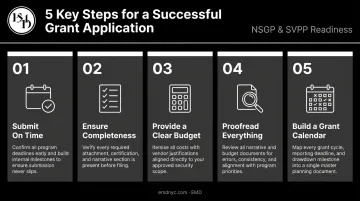
- Submit on time. Late applications are almost never considered.
- Ensure completeness. Double-check that all required documents and signatures are included.
- Provide a clear budget. The numbers should be easy to understand and add up correctly.
- Proofread everything. Typos and grammatical errors suggest a lack of attention to detail.
- Build a grant calendar. Use it to track deadlines, reporting requirements, and key contacts.
Beyond the application itself, try to connect with a program officer at the foundation before you submit. Building that relationship can significantly improve your chances of success. For complex applications like the NSGP, partnering with a grant writing expert can help you navigate these nuances and ensure every detail is perfectly aligned with the funder's expectations.
How to Choose the Right Grant for Your Place of Worship
Finding the right grant is about matching your needs with the funder's purpose. Before you invest time in an application, evaluate every opportunity against four key criteria:
- Confirm Geographic Eligibility: First, ensure the funder serves your specific city, state, or region. This is the easiest initial filter.
- Verify Mission Alignment: Does your project match the funder's historical priorities? Review their past awards for clues about what they value.
- Assess Reporting Requirements: Can your team handle the funder's reporting schedule and documentation needs? Federal grants often have stricter compliance rules than private foundations.
- Check Use Restrictions: Are the grant's allowed uses compatible with your project? A grant prohibiting construction funds, for example, won't work for a building renovation.
Federal grants like the FEMA NSGP typically involve more complex application and reporting requirements but offer larger awards. For these high-stakes opportunities, working with a specialized consultant is critical. They can navigate the bureaucracy, ensure compliance, and manage complex post-award administration like the mandatory Environmental and Historic Preservation (EHP) review.
To find opportunities, consider using databases like GrantWatch.com, Candid, or Instrumentl. These are often subscription-based but can save hundreds of hours of research time.
Conclusion
From federal security programs to private foundation support, places of worship have access to a meaningful range of grant funding. Success depends on finding the right match, submitting a strong application, and managing compliance carefully.
As you plan, don't overlook security-focused grants like the FEMA NSGP. These programs directly fund the physical safety of your congregation and the surrounding community. Navigating this type of funding requires a unique combination of security expertise and grant-writing skill.
Organizations like EMD specialize in helping houses of worship manage the entire process—from the initial vulnerability assessment and application to post-award administration.
If you're ready to explore your eligibility for federal and state security grants, contact EMD. Our proven grant management process can help you secure and deploy funding to protect what matters most.
Frequently Asked Questions
How do I get money for my church?
Primary funding avenues include private foundation grants, federal programs like FEMA NSGP, state grants, and local community foundations. Churches with official 501(c)(3) status generally have access to the most opportunities, which can be found on databases like GrantWatch and Candid.
What not to say when applying for a grant?
Avoid overly theological language that could alienate secular funders, vague budget requests, and unsubstantiated claims about your organization's capacity. Most importantly, never request funding for activities the grantmaker explicitly excludes in their guidelines.
Who is eligible to receive a grant?
Eligibility varies by program. Most foundation and government grants require 501(c)(3) status and often require projects to benefit the broader community. Specific programs, like the FEMA NSGP, are open to nonprofit houses of worship for defined security purposes.
Can a place of worship apply for a government grant?
Yes. The government funds faith-based organizations for community-benefit programs (not worship itself). FEMA, HHS, and the Department of Education all offer relevant grant programs to qualifying religious nonprofits that serve the public.
What is the FEMA Nonprofit Security Grant Program?
It is a federal program administered by DHS that provides funding to at-risk nonprofits, including houses of worship, to improve physical security against terrorism and targeted violence. A formal security assessment is a required part of the application.
Do places of worship need 501(c)(3) status to apply for grants?
Although the IRS automatically recognizes churches as tax-exempt, obtaining an official 501(c)(3) letter is highly recommended. Most private foundations and government programs require this formal status to apply, which significantly expands your funding opportunities.