This guide covers everything districts need to know before the next funding window opens: eligibility rules, award structure, what the program funds (and what it won't), the two-step application process, and how to build a submission that reviewers actually fund.
Key Takeaways
- SVPP funds K-12 physical security upgrades including access control, cameras, emergency notification systems, locks, and law enforcement coordination
- FY25 awards reached up to $500,000 per award over 36 months, covering 75% of project costs with a required 25% local cash match
- A microgrant track (up to $100,000, no match required) reserves roughly $1 million for smaller, rural, and tribal districts
- Eligible applicants are states, local governments, and Indian tribes — individual schools and private schools cannot apply directly
- Strong applications document risk first, then connect every proposed cost to a statutory purpose area and measurable outcome
What Is the COPS SVPP Grant?
The COPS Office School Violence Prevention Program was created under the STOP School Violence Act of 2018, passed as part of Public Law 115-141. The House passed it on March 14, 2018 — exactly one month after the attack at Marjory Stoneman Douglas High School in Parkland, Florida. That timing made it the first legislative response by either chamber to that tragedy.
SVPP is administered by the COPS Office (Community Oriented Policing Services), a component of the U.S. Department of Justice. Its scope is narrow by design: K-12 school grounds only. Higher education, general criminal justice programs, and community-wide violence prevention initiatives are not eligible under SVPP. The funding structure reflects that focus directly.
Funding Structure and Award Details
Based on the FY25 program cycle:
- Total available funding: approximately $73 million
- Maximum award: $500,000 in federal funds per award
- Award period: 36 months
- Federal/local split: 75% federal / 25% local cash match (in-kind contributions are not acceptable)
- Anticipated awards: approximately 200
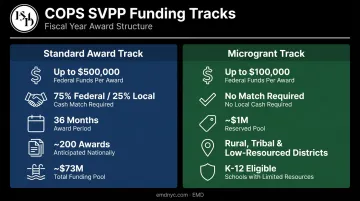
The microgrant track sets aside approximately $1 million specifically for rural, tribal, and low-resourced school districts. Microgrant requests cannot exceed $100,000, and the COPS Office waives the 25% cash match requirement for selected microgrant recipients — a meaningful distinction for districts that simply cannot meet a match obligation.
FY26 note: No FY26 SVPP NOFO had been published as of this writing. Monitor the official COPS SVPP page and Grants.gov for updates.
Who Can Apply for SVPP?
Eligible Applicants
SVPP is open to:
- States
- Units of local government (including school districts, school boards, and law enforcement agencies)
- Indian tribes
- Public agencies of any of the above
Most public school districts qualify directly as units of local government or apply through a city or county partner. Public charter school districts that function as independent local education agencies also qualify.
Ineligible as Primary Applicants
- Individual schools that do not operate as full school districts
- Independent schools
- Private schools (including private charter schools)
Multiple entities can participate in a single award, but only one eligible entity can serve as the lead applicant. Applicants list additional partners as proposed subrecipients — not co-applicants.
Eligibility determines who can apply — but purpose areas govern what the funding can actually support.
The Five Statutory Purpose Areas
SVPP funds only activities that fall within one of five statutory purpose areas:
- Coordination with local law enforcement
- Training for law enforcement officers to prevent school violence
- Placement of metal detectors, locks, lighting, and other deterrent measures
- Acquisition of technology for expedited notification of law enforcement during an emergency
- Any other measure the COPS Office Director determines may provide a significant improvement in security
What SVPP Funds — and What It Won't Cover
Allowable Security Measures
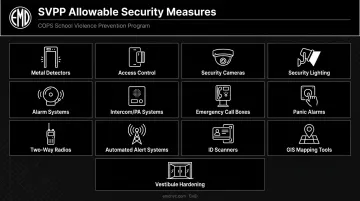
The FY25 Application Resource Guide confirms these categories as eligible:
- Metal detectors and X-ray equipment
- Access control equipment and door-locking mechanisms
- Security cameras and surveillance systems
- Security lighting
- School alarm and intrusion detection systems
- Intercom and public address systems
- Emergency call boxes
- Panic and immediate alarm notification systems
- Two-way radios
- Automated emergency text and email alert systems
- ID scanning devices
- GIS mapping tools
- Vestibule and entry hardening measures
SVPP also funds non-sworn civilian personnel directly supporting the approved project — project coordinators, technology managers, emergency management coordinators, and trainers are allowable examples.
Advanced Technology and AI-Based Tools
AI-enhanced camera analytics and automated emergency notification systems can fit within SVPP's allowable purpose areas when tied to a larger eligible project — such as a camera system upgrade linked to expedited law enforcement notification — and directly connected to documented risk. Note that any technology relying on biometric identification is explicitly prohibited, regardless of how it is framed in the application.
Unallowable Costs
The FY25 guidance is clear on these exclusions:
- Biometric technology, including facial recognition systems
- Automatic license plate recognition (ALPR) software
- Salaries and benefits for sworn officers or civilian security guards
- In-kind match contributions
Threat assessment and intervention team development falls outside SVPP's scope. If that's your district's primary need, the BJA STOP School Violence Program — a separate DOJ track — is better suited for threat assessment and intervention work.
When a specific line item is borderline, document its connection to an allowable purpose area before submitting — the COPS Office will scrutinize items that don't map clearly to the approved categories.
The Two-Step SVPP Application Process
SVPP applications run through two separate federal platforms with two separate deadlines. Missing either one ends your application.
Step 1: Grants.gov (SF-424 Submission)
Submit the SF-424 and required federal forms through Grants.gov by the Grants.gov deadline. In FY25, that deadline was June 18, 2025 at 4:59 PM ET.
This step is a prerequisite. Even if your full application is perfectly prepared, failing to complete the Grants.gov step disqualifies you from submitting through JustGrants.
Step 2: JustGrants (Full Application)
The complete application — project narrative, budget detail worksheet, certifications, letters of support, and all supporting documents — is submitted through JustGrants by a later deadline. In FY25, that deadline was June 26, 2025 at 4:59 PM ET.
Pre-Season Registration Checklist
Complete these in the off-season, well before the application window opens:
- SAM.gov registration — active and current (renewals can take several weeks)
- Unique Entity Identifier (UEI) — obtained through SAM.gov
- Grants.gov account access — verified and working
- JustGrants organizational access — all users who will submit or manage the application must have verified access
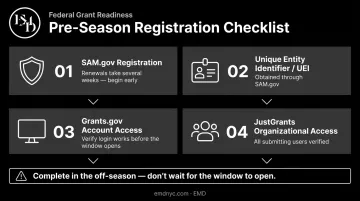
Based on FY25 patterns, the application window typically opens in spring and closes in early summer. Federal timelines shift with appropriations — and SAM.gov renewals alone can take weeks — so waiting until the window opens is not a viable strategy.
How to Build a Winning SVPP Application
Assess First, Plan Second
Every line in the budget should trace back to a documented gap. Reviewers do not fund equipment wish lists — they fund documented needs.
Ground your application in:
- A recent physical security vulnerability assessment
- Site and risk review findings
- Incident trend data and law enforcement response-time records
- Equipment inventory gaps tied to specific purpose areas
Free assessment resources are available through the National Institute of Justice and similar federal sources. That said, a structured, grant-ready assessment built around SVPP's statutory framework is different from a general walkthrough — the documentation needs to hold up under reviewer scrutiny.
Lead with Expedited Notification
SVPP's core statutory purpose is faster law enforcement response. Applications that lead with this — showing how proposed tools measurably reduce the time between an incident and law enforcement notification — align most directly with what Congress funded this program to do.
For every proposed technology or physical measure, make the connection explicit in the narrative: what does this enable, and how does it shorten response time or improve coordination?
Stakeholder Engagement Is Required, Not Optional
SVPP requires documented consultation with a broad stakeholder group before submission:
- Licensed mental health professionals and social workers
- Students, parents, and teachers
- Principals and other school personnel
- Law enforcement officers
- School violence researchers or academics (where practical)
A stronger coalition also signals to reviewers that proposed technology will be implemented responsibly and maintained over time.
Frame Safety Outcomes, Not Product Catalogs
Reviewers fund outcomes. An application that connects security measures to a comprehensive school safety strategy — emergency operations planning, regular drills, staff training, positive school climate — reads very differently from a list of gear.
Avoid framing your proposal as "we want to buy X cameras and Y door locks." Frame it as: here is what currently limits our ability to protect students, here is what we propose to change, and here is how we will measure whether it worked.
Working with a Security Consultant
Each of the steps above requires documentation that holds up under federal reviewer scrutiny — and that starts before the application is written. EMD provides end-to-end SVPP application services for K-12 districts, covering:
- Physical vulnerability assessments that produce grant-ready risk documentation
- Full project narrative drafting and budget detail construction
- Submission support via Grants.gov and JustGrants
- Post-award grant management: EHP submission, procurement oversight, drawdown support, and close-out
EMD's methodology combines AI-driven scenario analysis with 15+ years of physical security expertise, helping districts document risk in formats that map directly to SVPP's statutory purpose areas.
A financial hardship waiver is available for SVPP applicants, and EMD offers a complimentary onboarding call to get started. Contact the team at info@emdnyc.com or (833) 363.6921.
Frequently Asked Questions
Can a private school or individual K-12 school apply directly for SVPP?
No. Private schools, independent schools, and individual schools that don't operate as full school districts are ineligible as primary applicants. Eligible lead applicants must be states, units of local government, Indian tribes, or their public agencies. Private schools may participate as subrecipients under an eligible lead applicant.
What is the local cash match requirement, and can it be waived?
The standard requirement is a 25% local cash match paid during the award period — in-kind contributions are not acceptable. Waivers are available based on demonstrated severe financial need. Districts selected for the microgrant track (awards up to $100,000) have the match requirement waived automatically.
Does SVPP fund school resource officer positions or security guard salaries?
No. Salaries and benefits for sworn officers and civilian security guards are explicitly unallowable. SVPP may fund allowable training activities, law enforcement coordination, and non-sworn civilian project personnel — such as a project coordinator or technology manager — who directly support the SVPP project.
What technologies are explicitly unallowable under SVPP?
The FY25 Application Resource Guide identifies biometric technology (including facial recognition) and automatic license plate recognition software as unallowable. Review the current NOFO's unallowable-cost section carefully, and contact the COPS Office directly for any technology not clearly addressed there.
What is the difference between the COPS SVPP and the BJA STOP School Violence Program?
Both programs stem from the STOP School Violence Act of 2018 but are administered by different DOJ offices. COPS SVPP focuses on physical security, technology, and law enforcement coordination. The BJA STOP School Violence Program covers a broader set of prevention activities including threat assessment teams, anonymous reporting systems, and training.
How long do SVPP projects last, and what should recipients plan for?
FY25 awards covered a 36-month period of performance. Recipients must complete all procurement, installation, testing, training, reporting, and close-out within that window — and many districts underestimate how long compliant federal procurement actually takes. Start vendor identification early.